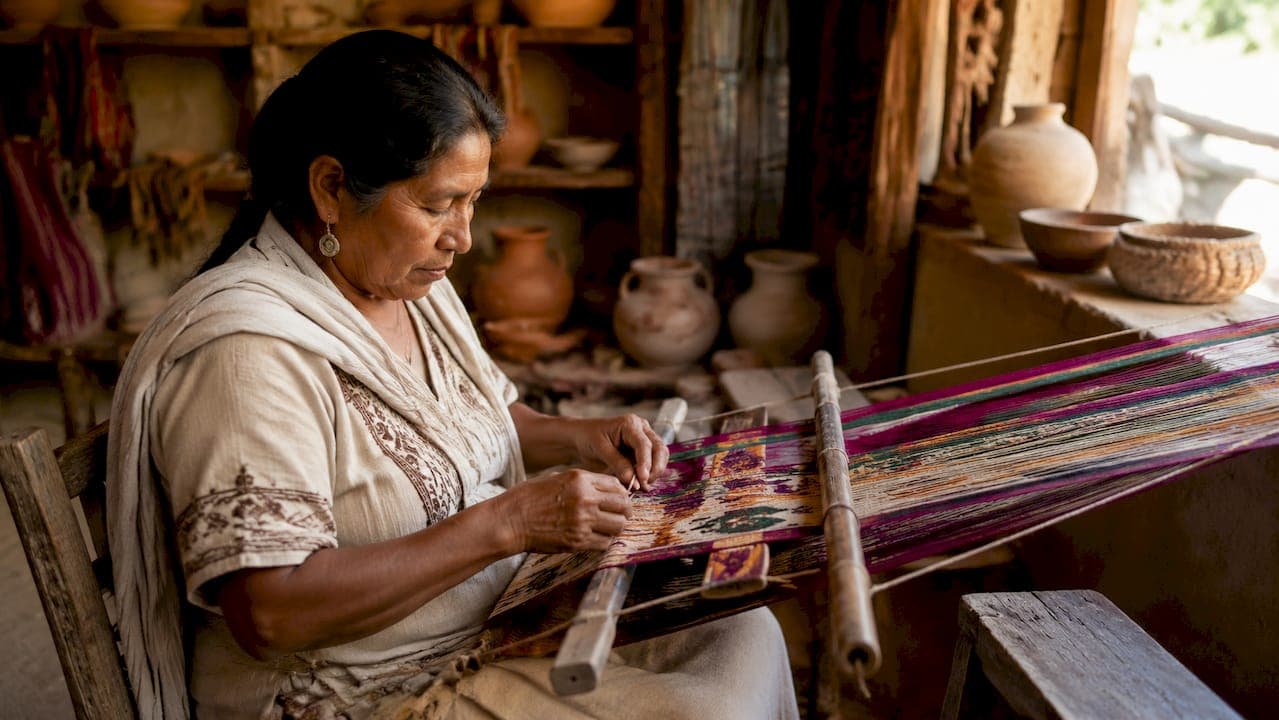
Mexican artisan craft tradition, known formally as artesanía, is defined as the body of handmade objects rooted in indigenous and colonial-era techniques that express Mexico's cultural identity through both functional and decorative arts. The term artesanía was popularized in the 20th century specifically to differentiate community-rooted handmade work from mass-produced goods. Each piece carries the memory of the community that made it, the materials its land provides, and the ancestral knowledge passed from one generation to the next. For anyone drawn to cultural heritage or considering how traditional Mexican crafts can transform a living space, understanding this tradition is the starting point for everything.
What is Mexican artisan craft tradition and why does it matter?
Artesanía is not a single craft. It is a living system of knowledge, technique, and cultural expression that spans textiles, ceramics, woodcarving, beadwork, lacquerware, and more. The artesanía concept functions as a cultural marker, separating community-rooted handmade art from anything produced by machine or factory. This distinction carries real weight. When you hold a piece of authentic artesanía, you are holding the result of skills refined over centuries, not a product optimized for speed.
The cultural significance of Mexican craft lies in its dual nature. Pieces are simultaneously utilitarian and symbolic. A hand-woven Zapotec rug from Oaxaca covers a floor and tells a cosmological story. A Talavera tile from Puebla waterproofs a kitchen wall and displays a 400-year-old fusion of Spanish Moorish and indigenous Mixtec design. This layering of purpose and meaning is what separates artesanía from ordinary decoration.
Mexico's artisan traditions also carry national identity in a way few other cultural forms do. The Mexican government officially recognizes artesanía as part of the country's intangible cultural heritage. Communities in states like Oaxaca, Chiapas, Guerrero, and Michoacán have maintained unbroken craft lineages through conquest, industrialization, and globalization. That continuity is itself a form of cultural resistance and pride.
What are the major types and regional styles of Mexican artisan crafts?
Mexico's geography and indigenous diversity produce a craft map unlike any other country. Each region's materials, climate, and cultural history shape a distinct visual language.
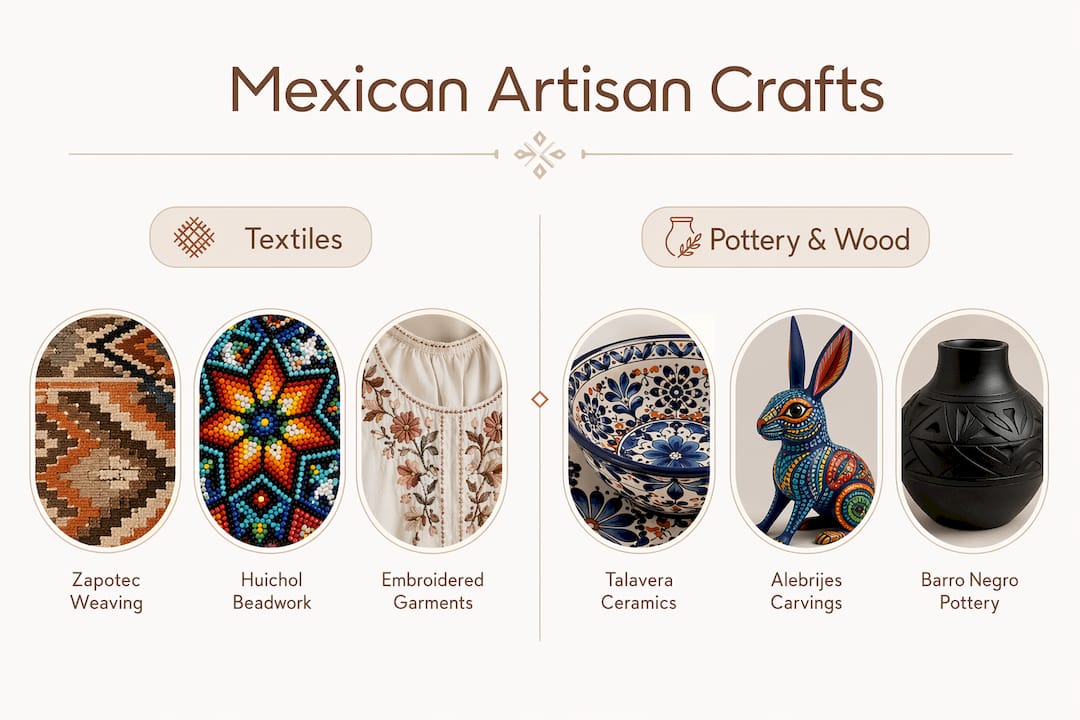
Textiles represent one of the most widespread and varied categories. Zapotec weavers in Teotitlán del Valle, Oaxaca, use backstrap looms and natural dyes derived from cochineal insects, indigo plants, and marigold flowers. Chiapas produces huipiles, traditional blouses embroidered by Tzotzil and Tzeltal Maya women with patterns that identify the wearer's community and social status. These are not decorative choices. They are identity documents woven in thread.
Ceramics divide into several distinct traditions:
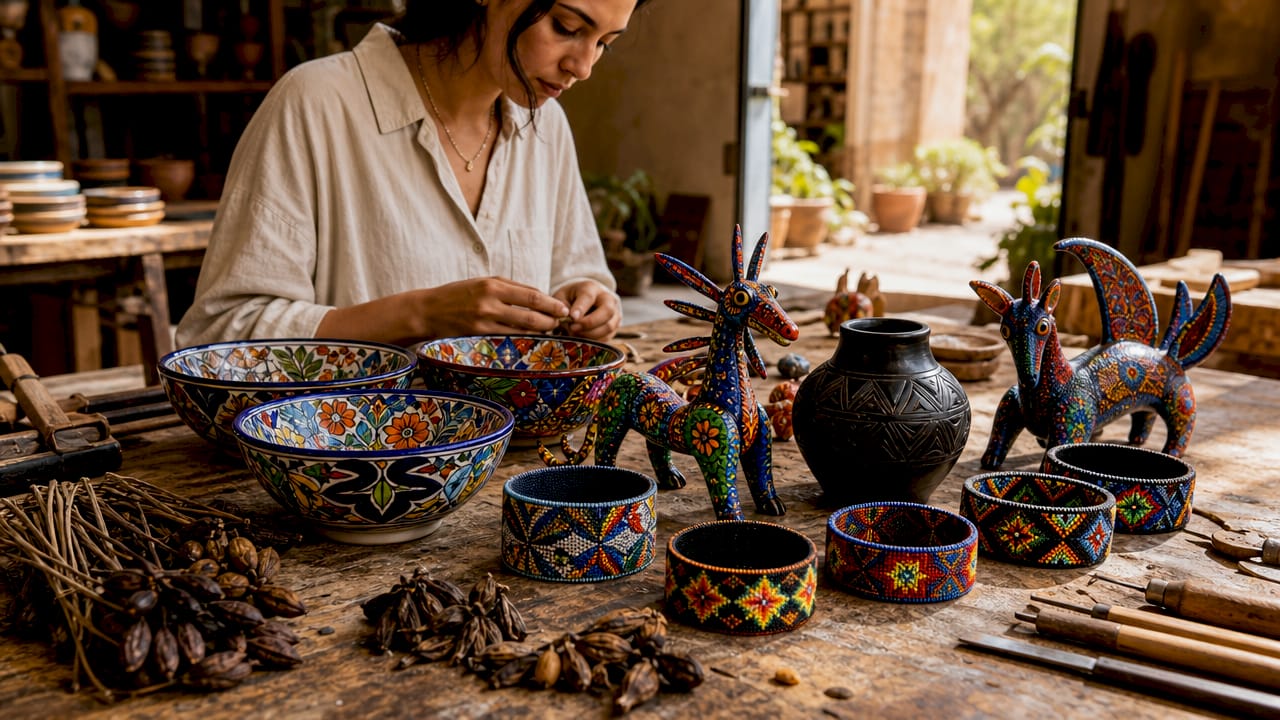
- Barro negro from San Bartolo Coyotepec, Oaxaca, is polished black pottery shaped entirely by hand without a wheel, achieving a metallic sheen through burnishing with a quartz stone.
- Talavera ceramics from Puebla and Tlaxcala follow a strict production protocol recognized by UNESCO as Intangible Cultural Heritage, using specific local clays and lead-free glazes in a palette of six traditional colors.
- Árboles de la vida (trees of life) have a production tradition of about 100 years centered in Metepec, State of Mexico. These ceramic trees narrate biographical and biblical scenes using a naive style that combines humor, symbolism, and vivid painted motifs.
Woodcarving is dominated by the alebrijes tradition from the Oaxacan villages of San Martín Tilcajete and La Unión Tejalapam. Artisans carve fantastical animal figures from copal wood and paint them with intricate geometric patterns, each family developing a recognizable visual signature.
Huichol beadwork and yarn paintings from the Sierra Madre Occidental carry symbolic motifs linked to cosmogony and Wixáritari mythology. Deer, peyote flowers, and serpents appear in compositions that function as prayers and cosmological maps, not decorations. This is indigenous worldview made visible.
The diversity across these categories reflects how geography and culture shape craft. Coastal communities work with shells and fibers unavailable inland. Highland communities use wool from sheep introduced during the colonial period, now fully absorbed into indigenous weaving traditions. Understanding regional origin is the first step in appreciating what you are looking at.
How to distinguish authentic Mexican artisan crafts from mass-produced souvenirs
Authentic artisan crafts and commercial imitations often look similar at first glance. The differences become clear when you know what to examine.
| Feature | Authentic artisan craft | Mass-produced imitation |
|---|---|---|
| Texture and surface | Subtle irregularities, hand-tool marks, natural variation | Uniform surface, machine-perfect edges |
| Dyes and color | Natural dyes with slight tonal variation across the piece | Synthetic dyes with flat, consistent color |
| Provenance | Maker's name, community, or certificate of origin | Generic "Made in Mexico" label or no label |
| Price | Reflects labor and materials honestly | Priced for volume, not craft |
| Weight and material | Natural materials with authentic density | Lightweight composites or synthetic substitutes |
Hand-woven textiles show subtle imperfections and visible knotting on the reverse side. Machine-made replicas have uniform backing and perfectly trimmed edges. That small irregularity is not a flaw. It is the signature of a human hand.
Price is one of the clearest signals. Authentic artisan blouses from Juchitán typically retail between $180 and $350 USD, reflecting realistic labor and material costs. A $25 version of the same blouse is not a bargain. It is a different product entirely, one that likely underpays workers and uses synthetic materials. Fair pricing is not a premium. It is an honest reflection of what skilled craft actually costs.
For alebrijes specifically, authentic versions are carved from copal wood and hand-painted with fine brushes, then signed by the maker. Factory-made versions lack cultural grounding and traceable origin.
Pro Tip: When buying online, request a video call or GPS-tagged photos from the seller. Authentic artisan pieces have inherent variations between repeated items. If every piece in a seller's catalog looks identical, that uniformity is itself a red flag.
Asking specific questions about community origin is more effective than general inquiries. "Which village made this?" and "Can you show me the workshop?" produce more useful answers than "Is this handmade?"
How have Mexican artisan crafts shaped contemporary home decor?
Mexican artisan crafts operate as living heritage, which means artisans are permitted to evolve designs while maintaining the ancestral logic and community agreement behind them. This is not compromise. It is how traditions survive across centuries.
Contemporary reinterpretations of traditional Mexican crafts appear across interior design categories:
- Zapotec-pattern textiles translated into luxury throw pillows and upholstered ottomans bring geometric precision and natural color depth into modern living rooms.
- Talavera-inspired ceramics appear as statement vases and artisan pottery in kitchens and entryways, functioning as focal points in both minimalist and eclectic spaces.
- Huichol-inspired beadwork motifs appear on decorative trays, mirror frames, and accent furniture, translating spiritual geometry into everyday objects.
- Embroidered textiles from Chiapas and Oaxaca have moved from traditional garments into wall hangings and cushion covers, where their color density and narrative detail read as fine art.
The influence of artesanía on home decor is strongest in bohemian, eclectic, and culturally inspired interior styles, though contemporary designers increasingly integrate individual pieces into otherwise neutral spaces for contrast and warmth. A single barro negro vessel on a white shelf carries more visual authority than a shelf full of mass-produced objects.
Purchasing authentic crafts also carries a sustainability dimension. Artisan production uses natural materials, traditional tools, and small-scale processes that generate minimal industrial waste. Digital archives like "Crafted in Mexico" now catalog over 32 artisan stories across 8 communities, supporting cultural tourism and preservation efforts that keep these practices economically viable. Buying authentic is a direct investment in that ecosystem. The impact of embroidered textiles on the feel and aesthetic of a living space goes beyond decoration. It introduces human presence and cultural depth into a room in a way that manufactured goods cannot replicate.
What practices support fair compensation and preservation of artisan communities?
Supporting Mexican artisan communities requires more than good intentions. Specific practices and institutional frameworks make the difference between genuine preservation and cultural extraction.
-
Seek certified provenance. The Oaxacan Registro de Artesanos certifies makers who meet criteria including community practice, traditional tool use, and cultural transmission to younger generations. Purchasing from certified artisans or verified cooperatives connects your money directly to the people doing the work.
-
Pay fair prices without negotiating down. Aggressive bargaining on artisan goods transfers value away from the maker. The price of a hand-embroidered piece reflects weeks of skilled labor. Treating it like a market commodity undercuts the economic foundation that allows artisans to keep practicing.
-
Buy directly from artisan cooperatives or verified fair-trade retailers. Cooperatives like Mujeres Artesanas de las Regiones de Oaxaca (MARO) and Sna Jolobil in San Cristóbal de las Casas, Chiapas, channel revenue back to weaving communities and fund apprenticeship programs for younger generations.
-
Ask about cultural transmission. Communities that actively teach younger members their craft traditions are the ones most likely to sustain them. Asking sellers about apprenticeship programs or family workshops signals that buyers value this dimension of the work.
-
Avoid platforms that aggregate artisan-style goods without verifiable origin. Mass marketplaces frequently list factory-made items alongside genuine artisan work with no meaningful distinction. Verified origin is the only reliable filter.
Pro Tip: When visiting Mexico, look for the "Hecho en México" certification alongside community-specific labels. A piece labeled as Zapotec from Teotitlán del Valle carries more provenance information than a generic regional label, and that specificity protects both you and the artisan.
The economic impact of fair compensation extends beyond individual artisans. Craft income supports entire households, funds children's education, and keeps communities from migrating to urban centers where traditional knowledge is lost. Preservation is not a museum project. It is an economic reality.
Key takeaways
Mexican artisan craft tradition is a living cultural system that requires informed, respectful engagement from buyers to survive and thrive in the modern marketplace.
| Point | Details |
|---|---|
| Artesanía defined | Artesanía is community-rooted handmade art distinct from industrial production, carrying cultural identity and ancestral technique. |
| Regional diversity | Major craft types include Zapotec textiles, barro negro pottery, Talavera ceramics, alebrijes, and Huichol beadwork, each tied to specific regions. |
| Authenticity markers | Look for natural dyes, hand-tool irregularities, maker signatures, and prices that reflect genuine labor costs. |
| Living heritage | Artisans evolve designs within community-agreed frameworks, making contemporary reinterpretations culturally valid, not compromised. |
| Ethical purchasing | Buying from certified cooperatives, paying fair prices, and verifying provenance directly supports artisan community preservation. |
Why I believe authenticity is the only standard worth holding
I have spent years studying how traditional crafts move through the global marketplace, and the pattern I keep seeing is the same. Buyers fall in love with the aesthetic of Mexican artisan work, then compromise on authenticity to save money or because verification feels complicated. That compromise is where the tradition starts to erode.
What strikes me most about artesanía is that it is not fragile in the way people assume. These traditions survived Spanish colonization, the industrial revolution, and decades of cheap import competition. They survive because communities choose to transmit them, generation after generation, as acts of cultural identity. What they cannot survive is a market that treats their work as interchangeable with factory replicas.
The contemporary home decor world has genuinely embraced the visual language of Mexican craft, and that is a real opportunity. A Zapotec-pattern pillow in a New York apartment is not cultural appropriation if it was purchased from the weaving community that created the pattern and priced to reflect their labor. It becomes a problem only when the aesthetic is extracted and the community is cut out.
My honest observation is that the buyers who engage most meaningfully with artesanía are the ones who slow down. They ask where something was made. They read about the community. They accept that a piece costing $200 is not overpriced. That mindset shift, from consumer to custodian, is what the tradition actually needs from the global audience it has earned.
— Ernesto
Bring Mexican artisan heritage into your home with Createdecorus
At Createdecorus, every piece in our collection is a dialogue between artisan heritage and contemporary design. We work directly with Mexican artisans whose embroidery techniques, natural dyes, and hand-finishing methods trace back generations. Each handcrafted luxury pillow carries that lineage into your living space, not as a souvenir, but as a considered object with cultural depth and tactile richness.

We believe that luxury is about thoughtful materials and human skill, not excess. When you bring a Createdecorus piece into your home, you are supporting the artisans who made it and the communities that sustain their craft. That is what Hecho en México means to us: not a label, but a commitment.
FAQ
What does artesanía mean in Mexican culture?
Artesanía refers to handmade objects rooted in ancestral techniques that carry cultural identity and community meaning. The term distinguishes community-produced craft from mass-manufactured goods and was formalized in the 20th century to protect that distinction.
What are the most recognized types of Mexican handcrafts?
The most recognized types include Zapotec woven textiles, Talavera ceramics from Puebla, barro negro pottery from Oaxaca, copal wood alebrijes, and Huichol beadwork and yarn paintings. Each type is tied to a specific region and indigenous cultural tradition.
How can I tell if a Mexican craft is authentic?
Authentic pieces show hand-tool marks, natural dye variation, minor surface irregularities, and carry the maker's name or community certification. Prices between $180 and $350 USD for embroidered blouses, for example, reflect genuine labor costs that mass-produced versions cannot match.
Why is supporting Mexican artisan traditions important?
Supporting artisan traditions preserves indigenous knowledge, sustains community economies, and keeps cultural transmission alive across generations. Fair compensation allows artisans to teach younger community members, which is the only mechanism that keeps these traditions from disappearing.
How do Mexican artisan crafts fit into contemporary home decor?
Traditional Mexican crafts integrate naturally into bohemian, eclectic, and culturally inspired interiors through textiles, ceramics, and embroidered accents. Contemporary artisans adapt ancestral motifs and color palettes to modern formats like luxury pillows and decorative vases while maintaining the cultural logic of the original tradition.