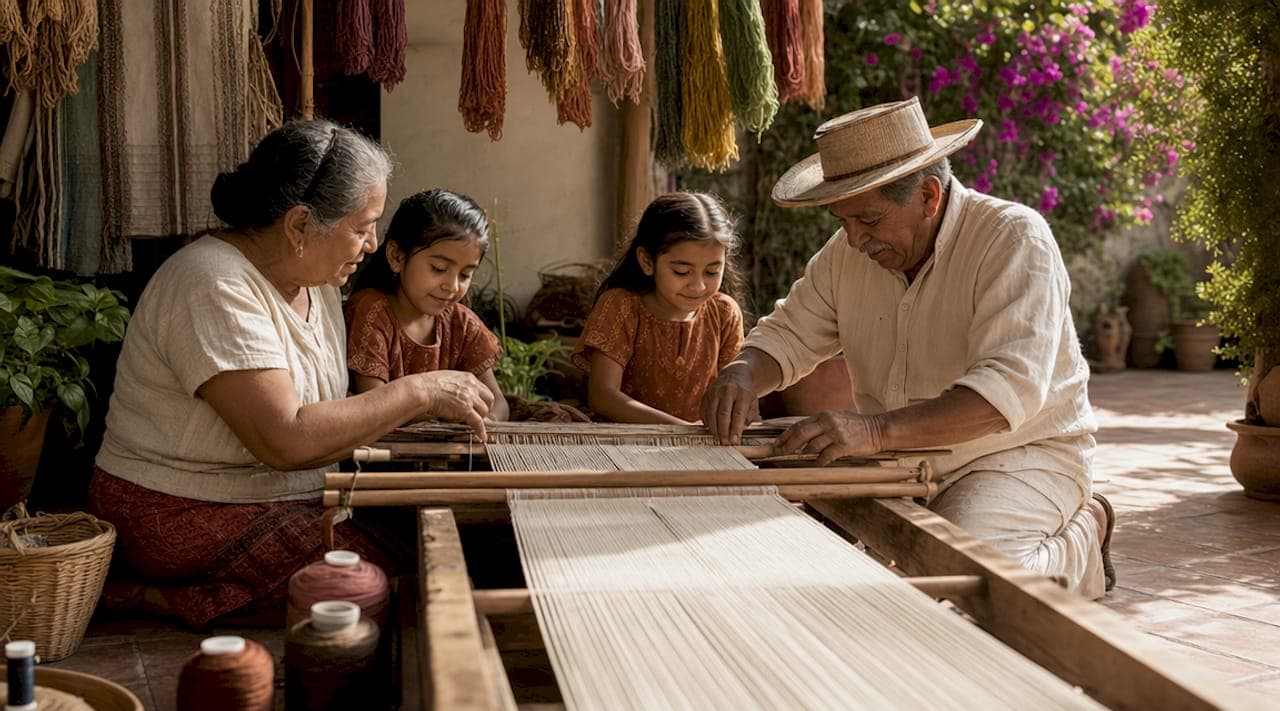
Mexican craftsmanship passed down generations is defined as the intentional transmission of artisanal knowledge, cultural identity, and community values through family and collective apprenticeship systems rooted in indigenous and mestizo traditions. This practice is not simply about replicating technique. It is about preserving a living record of who a community is, where it came from, and what it believes. From the silk weavers of Oaxaca to the Otomí doll makers of Hidalgo, these traditions survive because they are woven into the fabric of daily life, not stored in museums. Understanding why these skills endure across generations reveals something profound about the relationship between craft, culture, and human resilience.
How is Mexican craftsmanship passed down through generations?
The transmission of generational skills in craft across Mexico happens primarily through informal family apprenticeship, a system where the home itself functions as a living workshop. Children in artisan households do not attend formal classes to learn their craft. They absorb it through proximity, observation, and participation from birth. In San Pedro Cajonos, Oaxaca, silkworms are kept in domestic spaces, so children grow up tending them as naturally as they learn to cook or speak. This immersive model means technique and cultural meaning are transmitted simultaneously, not as separate lessons.
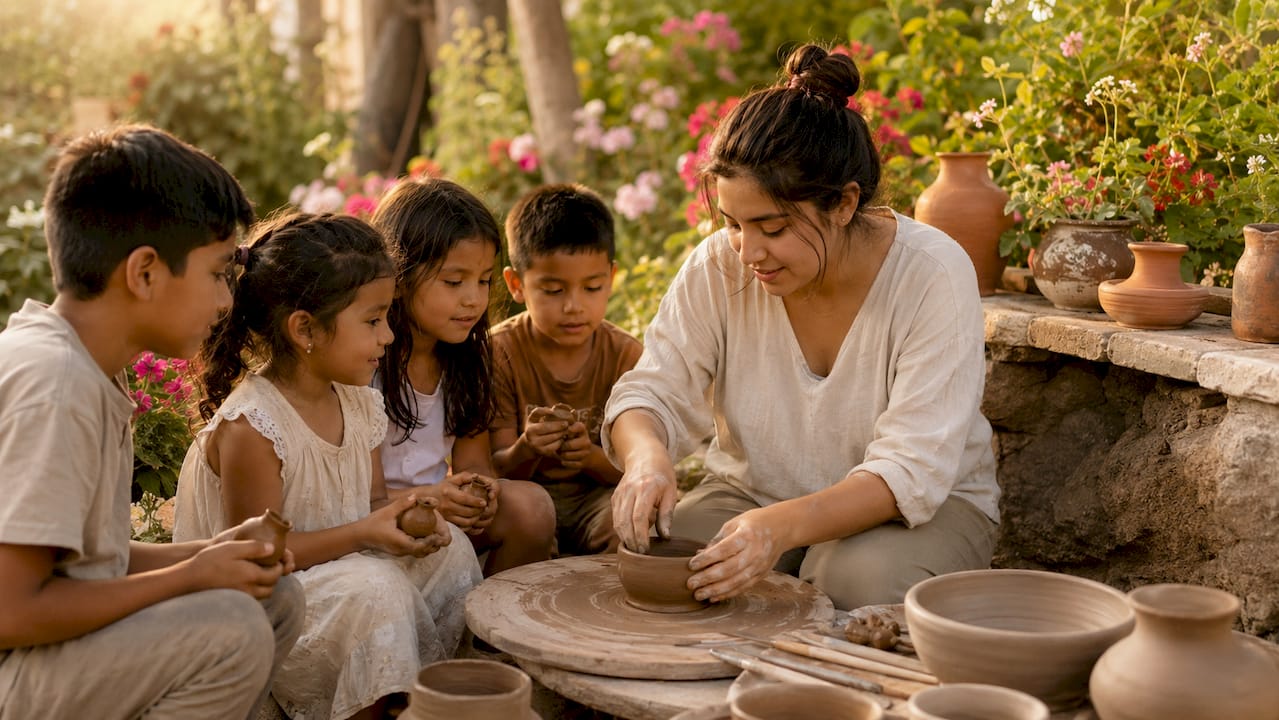
The structure of this learning follows a recognizable arc: observation first, then guided participation, then independent practice. A child watches a grandmother spin fiber for years before touching the loom. When she finally does, her hands already carry the memory of the motion. This is how artisanal techniques in Mexico preserve not just the physical skill but the emotional and symbolic weight behind each object.
Community cooperatives extend this family model outward. The Yagaa collective, established in 1993 in Oaxaca, revitalized silk weaving traditions that date to 1523, when Spanish colonizers introduced sericulture to the region. Yagaa demonstrates that when family transmission alone is insufficient, organized community structures can step in to preserve and revitalize what might otherwise disappear. The cooperative model pools resources, shares knowledge across households, and creates economic structures that make continued practice viable.
- Apprenticeship begins at home, with children learning by watching and doing alongside family members
- Community collectives like Yagaa formalize knowledge sharing when family structures cannot sustain it alone
- Textile dye traditions in Teotitlán del Valle require years of mentored practice to master mordant chemistry and color sequencing
- Silk production in Oaxaca integrates biological knowledge of silkworms with weaving technique, both passed through household immersion
Pro Tip: If you want to understand a craft tradition deeply, trace where it is taught. If the answer is "at home, from a parent," you are looking at a living tradition. If the answer is "in a school program," the tradition is already in recovery mode.
What cultural and economic factors make generational craftsmanship matter?
Mexican artisan traditions carry indigenous knowledge, historical memory, and social identity in ways that no written record fully replicates. A woven textile from Teotitlán del Valle is not just a product. It is a record of the community's cosmology, its relationship to land and color, and its negotiation between pre-Hispanic and colonial influences. Handmade Mexican crafts reflect a mestizo aesthetic that blends indigenous and European techniques, making each piece a physical artifact of Mexico's cultural synthesis. That synthesis cannot be downloaded or outsourced.
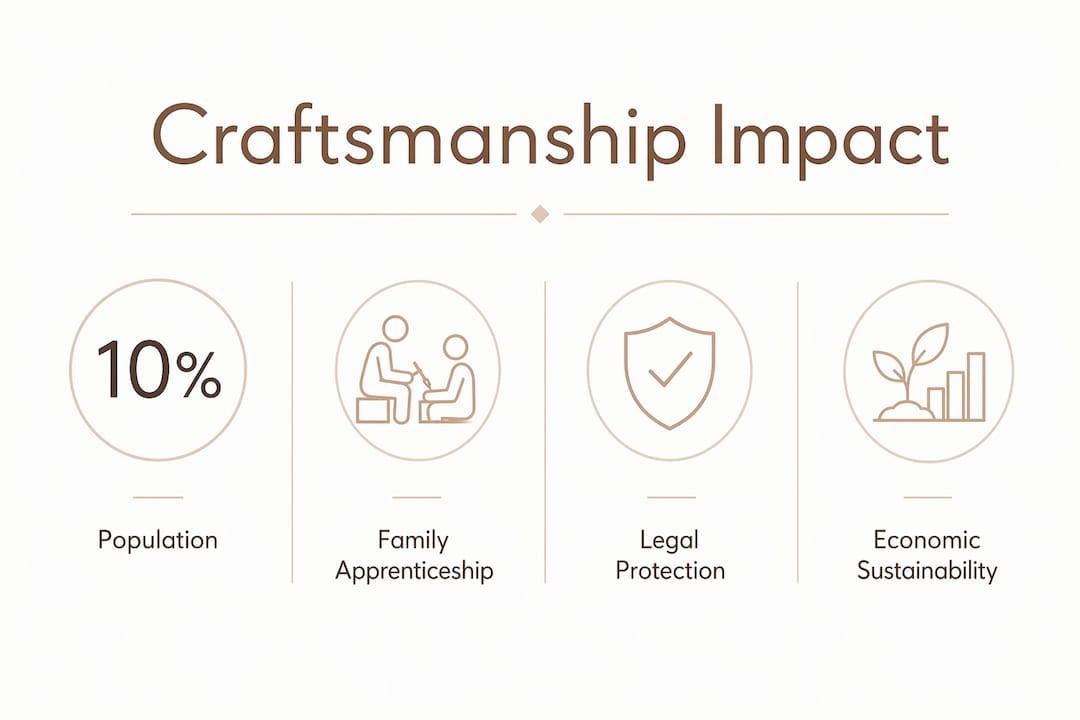
The importance of cultural heritage in this context is also economic. Approximately 10% of the Mexican population engages in artisanal work, yet the majority earn below minimum wage. This means the people carrying centuries of knowledge are often the most economically vulnerable members of their communities. When income is insufficient, younger generations migrate to cities for better-paying work, and the knowledge chain breaks.
Legal protections are beginning to address this gap. Geographical Indication (GI) status, a legal designation similar to the one protecting Champagne or Parmigiano-Reggiano, formalizes the cultural origin of specific crafts and prevents commercial misuse. In January 2026, GI protection was granted to Lele and Dönxu dolls, recognizing their Otomí cultural heritage and giving artisan communities legal standing to protect their work in global markets. This kind of recognition matters because it connects cultural sustainability to economic viability.
| Factor | Impact on generational transmission |
|---|---|
| Family apprenticeship | Primary vehicle for skill and cultural meaning transfer |
| Aging artisan demographics | Most artisans are over 50, creating urgent succession gaps |
| Low income levels | Economic hardship drives younger generations away from craft |
| Geographical Indication protection | Legal recognition supports fair compensation and cultural ownership |
| Community cooperatives | Fill gaps when family transmission alone cannot sustain a tradition |
Craftsmanship also fulfills ceremonial and social roles that reinforce its transmission. Textiles appear in weddings, funerals, and festivals. Objects made by hand carry relational meaning that mass-produced goods cannot replicate. This social function gives artisans a reason to teach and communities a reason to learn, beyond any market calculation.
What distinguishes Mexican artisan techniques in their transmission?
The artisanal techniques in Mexico that survive across generations share one defining characteristic: they are inseparable from their local materials and environment. Natural dyes derived from cochineal insects and indigo plants are not simply colorants. They are carriers of indigenous cultural meaning that require specialized teaching to preserve both their technical complexity and their symbolic significance. Juana Gutiérrez, a master dyer from Teotitlán del Valle, has spent decades transmitting mordant chemistry knowledge that determines how color bonds to fiber. Without that specific knowledge, the colors fade. Without the cultural context, the colors lose their meaning entirely.
Adaptation to scarcity has also shaped the forms these crafts take. The Dönxu dolls of the Otomí people were originally crafted from fabric scraps during periods of economic hardship, turning waste material into objects of beauty and cultural expression. This origin story is itself part of what gets transmitted. When a grandmother teaches her granddaughter to make a Dönxu doll, she is also teaching her that creativity is a response to constraint, not a luxury of abundance.
| Technique | Material source | What gets transmitted |
|---|---|---|
| Cochineal dyeing | Insects harvested from nopal cactus | Mordant chemistry, color sequencing, cultural symbolism |
| Silk weaving (Oaxaca) | Silkworms raised in domestic spaces | Biological care, spinning, loom technique, community identity |
| Dönxu doll making | Repurposed fabric scraps | Pattern construction, Otomí iconography, adaptive resourcefulness |
| Backstrap loom weaving | Locally sourced plant fibers | Body mechanics, pattern memory, generational design vocabulary |
Pro Tip: When evaluating the authenticity of a Mexican craft, ask about the dye source. Synthetic dyes are faster and cheaper, but natural cochineal or indigo dyeing signals a living connection to indigenous knowledge systems that took generations to develop.
The layered meanings embedded in these techniques are what make them resistant to simple documentation. A video tutorial can show the hand movements of backstrap loom weaving. It cannot transmit the understanding of why a particular pattern belongs to a particular community, or what it means to wear it at a specific ceremony. That knowledge lives in relationship, not in instruction manuals.
How are modern challenges shaping the future of this tradition?
The handmade crafts legacy in Mexico faces its most serious structural threat not from cultural indifference but from economic arithmetic. Without viable economic models, artisan skills face extinction as aging demographics dominate the field and younger generations cannot afford to stay. The average master artisan in Mexico is over 50 years old. The knowledge they carry has no automatic successor unless the economic conditions change.
Several forces are working in the tradition's favor:
- Ethical consumer demand is growing, with buyers in North America and Europe actively seeking authentic, handmade goods with traceable cultural origins
- Platforms and intermediary organizations are creating structured partnerships between artisan communities and global markets, with fair compensation built into the model
- Craftsmanship as a strategic cultural asset is gaining recognition among purpose-driven companies that see artisan collaboration as both ethical and commercially differentiated
- UNESCO describes living heritage skills as renewable community resources, a framing that shifts the conversation from preservation as nostalgia to preservation as active investment in community resilience
The revival of silk weaving in San Pedro Cajonos through the Yagaa collective is the clearest proof that organized support can reverse decline. Before Yagaa formed in 1993, the silk tradition was nearly extinct in the village. Today it is a functioning economic and cultural institution. That outcome required both cultural commitment and a workable business structure. Neither alone was sufficient.
The sustainability and ethical consumption movements have also created new market conditions that favor authentic Mexican craftsmanship. Consumers who once bought mass-produced decor are now willing to pay more for objects with documented cultural provenance. This shift does not solve every problem, but it creates the economic opening that artisan communities need to make teaching the next generation a financially rational choice.
Key takeaways
Mexican craftsmanship survives across generations because it is transmitted through family apprenticeship, community cooperatives, and economic structures that make cultural knowledge worth passing on.
| Point | Details |
|---|---|
| Family as the primary classroom | Children in artisan households learn through immersion, not formal instruction, absorbing technique and meaning simultaneously. |
| Economic viability determines survival | Most artisans earn below minimum wage; without sustainable income, younger generations leave and knowledge chains break. |
| Legal protections matter | Geographical Indication status, as granted to Dönxu dolls in 2026, gives artisan communities legal and economic standing in global markets. |
| Materials carry cultural meaning | Natural dyes from cochineal and indigo transmit indigenous knowledge systems that synthetic alternatives cannot replicate. |
| Community cooperatives fill the gaps | Organizations like Yagaa prove that collective structures can revive traditions that family transmission alone cannot sustain. |
What I've learned watching these traditions up close
I have spent years working alongside artisan communities in Mexico, and the thing that surprises most people is how unsentimental the artisans themselves are about tradition. They are not preserving their crafts out of nostalgia. They are preserving them because the craft is how they understand themselves and their place in the world. A weaver in Teotitlán del Valle does not think of herself as a guardian of heritage. She thinks of herself as someone who makes beautiful, meaningful things the way her mother did, and her mother before that.
What I have come to believe is that the biggest threat to these traditions is not globalization or cultural change. It is the assumption that cultural preservation and economic sustainability are separate problems. They are the same problem. When an artisan cannot earn a living wage from her craft, she does not stop valuing it. She stops being able to afford it. The knowledge does not disappear from her mind. It disappears from practice, and practice is the only thing that keeps it alive.
The intermediary organizations doing the most effective work are the ones that understand this clearly. They are not running cultural preservation programs. They are building business models where artisan knowledge is the product, properly valued and fairly compensated. That is the model that works. Everything else is well-intentioned but ultimately insufficient.
I also think there is something worth saying about what it means for those of us outside these communities to engage with this work. Buying an authentic piece of Mexican craftsmanship is not a charitable act. It is a recognition that the knowledge embedded in that object has real value, and that the person who made it deserves to be compensated accordingly. That distinction matters to the artisans, and it should matter to us.
— Ernesto
Bring authentic Mexican artisanship into your home
At Createdecorus, we believe that every handcrafted piece tells a story that deserves to be heard in the spaces where you live. Our collection of handcrafted luxury home accents is made in Mexico by artisans whose techniques reflect the same generational knowledge described throughout this article. Rich textures, bold colors, and intentional design are not aesthetic choices made in a studio. They are the result of traditions refined across centuries and taught hand to hand.

When you bring a Createdecorus piece into your home, you are participating in the economic sustainability that keeps these traditions alive. Each purchase supports the artisan communities whose knowledge is genuinely irreplaceable. This is what Hecho en México means at its fullest: not just a label of origin, but a gesture of cultural pride and shared responsibility.
FAQ
Why is Mexican craftsmanship passed down through families?
Mexican craftsmanship is transmitted through families because the home functions as a living workshop, where children learn through daily immersion rather than formal instruction. This model transmits both technical skill and cultural meaning simultaneously, which no classroom setting can replicate.
What role do community cooperatives play in preserving craft traditions?
Cooperatives like Yagaa in Oaxaca formalize knowledge sharing across households and create economic structures that make continued practice viable. They step in when family transmission alone cannot sustain a tradition, as Yagaa demonstrated by reviving silk weaving that had nearly disappeared by 1993.
Why are natural dyes important to Mexican artisan traditions?
Natural dyes from cochineal and indigo carry indigenous knowledge systems that include complex mordant chemistry and deep cultural symbolism. Replacing them with synthetic dyes preserves the visual output but severs the connection to the knowledge tradition that gives the craft its meaning.
What is Geographical Indication protection and why does it matter for artisans?
Geographical Indication (GI) protection is a legal designation that ties a product to its cultural and geographic origin, preventing commercial misuse. In January 2026, GI status was granted to Dönxu and Lele dolls, giving Otomí artisans legal standing to protect their work in global markets.
How does economic hardship threaten the future of Mexican craftsmanship?
With most artisans over age 50 and the majority earning below minimum wage, the economic conditions that would motivate younger generations to learn these trades are largely absent. Without sustainable income from their craft, artisans cannot justify the years of apprenticeship required to master and transmit these traditions.