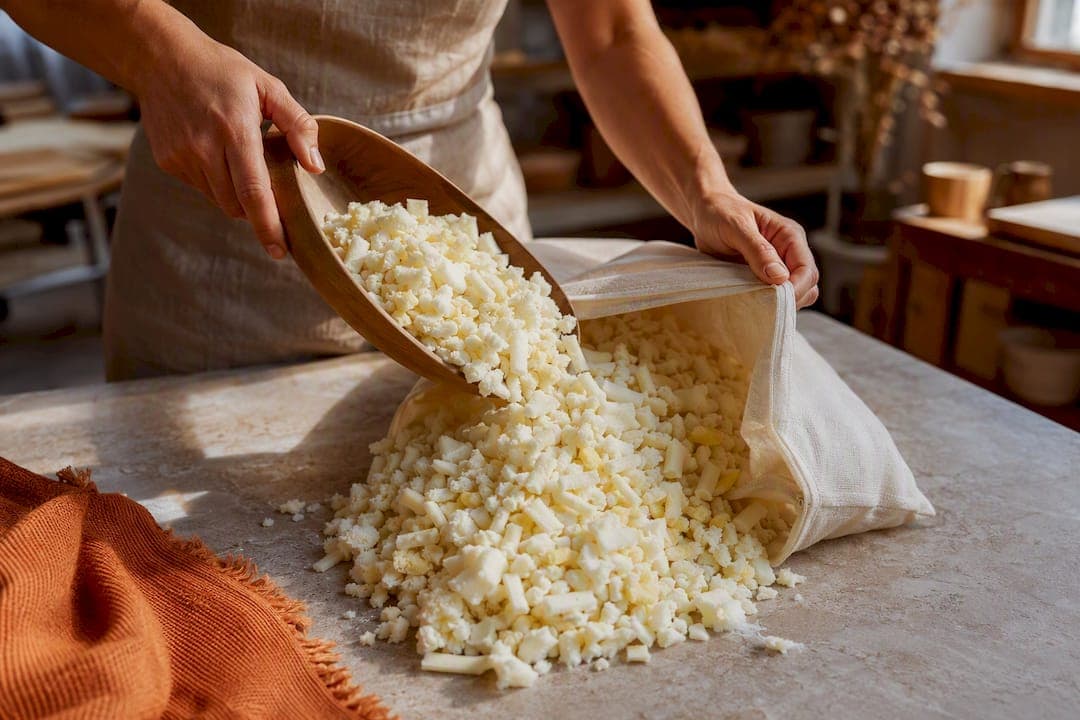
Shredded viscoelastic foam is a genuinely good fill choice for refillable pillows, cushions, and pufs, thanks to its contouring feel and adjustable loft. The tradeoff is real: it breathes less than fiberfill and can never go in a washing machine. If you already know your use case, skip to how much to buy; if not, read on for the specs that separate a good bag from a disappointing one.
TL;DR:
- Shredded viscoelastic foam is suitable for pillows and cushions with low to medium density, but it is not ideal for structured furniture or those needing firm support.
- Verify foam weight, expanded volume, density, and certifications before purchasing, and be cautious of heat retention and odor without proper treatment.
- A typical 50×50 cm cushion requires about 1 kilogram of shredded foam, while larger pieces like pufs may need 3 to 5 kilograms for desired firmness.
- Foam should be spot-cleaned and aired out after unpacking, as machine washing can damage the shredding and cause mold issues.
- Blending shredded foam with other materials alters its feel, but it is not recommended for support pillows requiring stable, predictable firmness.
Table of Contents
- What Is Shredded Viscoelastic Foam, and What Do the Specs Mean?
- How Do You Choose the Right Grade and Seller?
- How Much Shredded Foam Do You Need for Common Cushion Sizes?
- How Do You Clean and Store Shredded Foam Safely?
- Where Does Shredded Foam Work Best, and What Should You Blend It With?
- How Create Decorus Approaches Fill Choices for Decorative and Wholesale Pillows
- When We Choose Shredded Foam, and When We Don't
- Ready to Bring Handcrafted Comfort Into Your Space?
- Sources
What Is Shredded Viscoelastic Foam, and What Do the Specs Mean?
Shredded viscoelastic foam, often called shredded memory foam, starts as solid memory foam that gets torn into irregular pieces. That process changes everything about how it behaves. Solid memory foam holds one dense shape and slowly springs back after pressure. The shredded version moves like loose stuffing, molding around a body or an elbow, then redistributing when the weight lifts. Suppliers market it specifically for pillows, cushions, beanbags, and pet beds because it keeps the contouring feel of memory foam while letting the filler shift inside a cover the way shredded memory foam is designed to.
Reading a listing correctly means knowing a handful of terms:
- Density and ILD: Sellers often list figures like 4 lb density with an ILD (Indentation Load Deflection) of 13, which signals a soft grade suited to pillows rather than seating, according to FoamOrder's shredded foam specs.
- Gel-infused: Foam with gel beads or swirls mixed in, marketed to reduce heat buildup.
- Certifications: Look for references to STANDARD 100 by OEKO-TEX, which tests textile and foam products for harmful substances. It is not a comfort rating; it is a safety one.
- Pack size: Retailers commonly sell shredded foam in 2.3 kg, 5 lb, or 5 to 10 kg bags, according to listings on MercadoLibre.
Prices swing widely between sellers. A 2.3 kg bag sold through a large retailer can run in the low thousands of Mexican pesos, based on a listing from Bodega Aurrera, so comparing per-kilogram cost matters more than comparing sticker prices.
How Do You Choose the Right Grade and Seller?
Match the density to the job. A pillow wants a soft, low-ILD grade that yields easily under a head or neck. Seat cushions and ottoman fills want medium to firm foam that resists flattening under sustained weight. Buying the softest bag available for a dining bench cushion is a common, avoidable mistake.
Airflow and odor deserve real attention before checkout. Plain shredded foam traps heat more than fiberfill, which is why gel-infused and charcoal-treated versions exist. Treat cooling and odor-control marketing claims with some skepticism, and lean toward sellers who back their listings with certification references rather than adjectives alone.
Before adding anything to your cart, verify:
- Listed weight AND expanded volume, so you can compare cost per liter, not just cost per kilogram
- Density/ILD figures, not just words like "soft" or "firm"
- Certification mentions (OEKO-TEX or similar) on the product page
- Seller return policy, since foam that arrives too firm or too soft is hard to exchange once opened
Pro Tip: If a listing gives you weight but not expanded volume, message the seller before buying. A 5 lb bag that expands to roughly 2 cubic feet is a very different value than one that barely fills a lumbar pillow.
How Much Shredded Foam Do You Need for Common Cushion Sizes?
Quantity is where most first-time buyers overspend or underspend. A widely cited supplier benchmark puts roughly 1 kilogram of shredded viscoelastic foam as right for a 50×50×10 cm cushion, and that ratio scales reasonably well across common shapes.
- 45×45 cm pillow: About 0.7 to 0.9 kg for a soft fill, closer to 1 kg for a fuller, firmer look.
- 50×50 cm cushion: Roughly 1 kg as a baseline, per supplier guidance.
- Lumbar pillow (30×50 cm roughly): About 0.6 to 0.8 kg, since the volume is smaller than a square cushion of similar width.
- Puf or floor cushion (60×60 cm or larger): Plan for 3 to 5 kg or more, depending on desired firmness and height.
Packaging often lists expanded volume alongside weight. A 5 lb bag expanding to around 2 cubic feet, as some retail packaging shows, gives you a real reference point rather than a guess. Order a little extra if you want a firm, well-packed look. It is far easier to top up a cushion later than to compress an overstuffed one.
How Do You Clean and Store Shredded Foam Safely?
Shredded viscoelastic foam is not machine washable, and that single fact causes more buyer disappointment than any other. Water breaks down the foam's cell structure and the shreds do not dry evenly, which leads to mildew trapped deep inside the fill.
Safe care looks different from washing a cushion cover:
- Spot-clean the outer cover only, and choose a removable cover whenever possible.
- Vacuum the foam lightly through a mesh bag to pull out dust without disturbing the shred size.
- Air new foam outdoors or near an open window for a day or two after unpacking to reduce the initial off-gassing smell.
- Sprinkle baking soda on foam left to air, let it sit, then shake or vacuum it off to neutralize odor.
- Store spare foam in a breathable bag in a dry space. A sealed plastic bag in a damp closet is how loft and freshness disappear together.
Replace the fill once you notice persistent odor, noticeably flattened loft, or any sign of moisture damage.
Where Does Shredded Foam Work Best, and What Should You Blend It With?
Shredded viscoelastic foam earns its place in decorative pillows, refillable pillow inserts, beanbags and pufs, pet beds, and small ergonomic cushions where contouring matters more than bounce. It is a poor match for anything that needs one consistent, unchanging shape.
Blending it with other fills changes the feel in predictable ways:
- Add polyester fiber (roughly 20 to 40%) for more loft and a lighter, airier feel, especially in larger floor cushions.
- Add latex shreds for more bounce-back and improved airflow compared with pure memory foam.
- Keep it pure for maximum contouring in a lumbar or seat cushion where body-hugging support is the entire point.
One caution matters here: avoid blended or pure shredded foam in cervical or medical support pillows that require consistent, predictable firmness. Blends shift over time and use, which works against the steady support those pillows are designed to provide.
How Create Decorus Approaches Fill Choices for Decorative and Wholesale Pillows
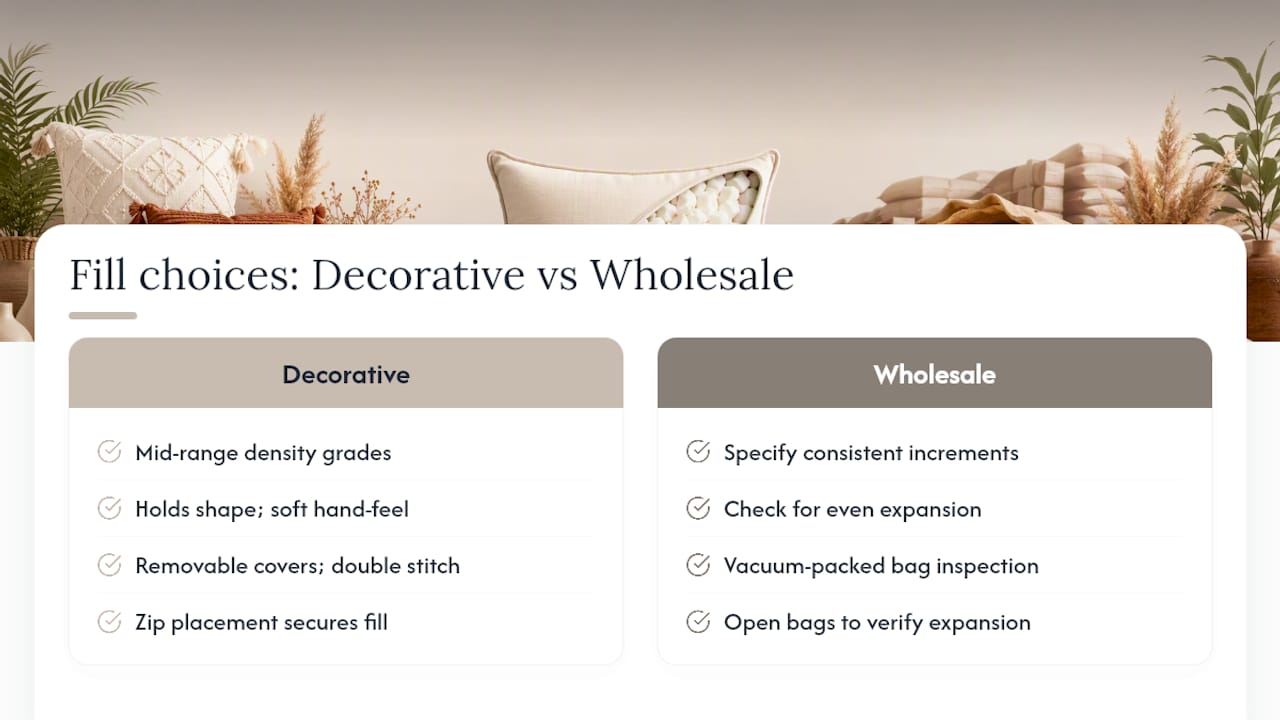
We build our handcrafted pillows around the idea that the fill inside should feel as considered as the textile outside. For decorative pieces, we favor mid-range density grades that hold shape through daily use without losing the soft hand-feel a living room piece needs, paired with removable covers, double stitching, and zip placement that keeps the fill secure during washing and handling. Our guide to choosing the right cushion filling covers this in more depth.
For wholesale partners, we recommend ordering fill in consistent increments and inspecting incoming vacuum-packed bags for even expansion once opened, since a bag that expands unevenly often signals inconsistent shred size from that production run.
When We Choose Shredded Foam, and When We Don't
In our workshop, shredded viscoelastic earns its place in pillows and pufs meant to be sat on, hugged, and reshaped daily. For structured ottomans or pieces meant to hold a crisp silhouette for years, we lean toward denser, more stable fills instead. That is a tradeoff we accept happily: softness and adaptability for casual pieces, firmness and permanence for statement furniture. Neither choice is wrong. It depends on what a piece is asked to do in your home.
— Ernesto
Ready to Bring Handcrafted Comfort Into Your Space?
Createdecorus builds every pillow around the same question this guide just answered for raw foam: which fill actually earns its place inside a specific cushion. Our decorative pillows pair artisan textiles from Mexico with fill choices selected for how the piece will actually be used, not just how it photographs.

Before you buy anywhere, check three things: the fill material and density, whether the cover is removable, and how the seams are finished. Our full pillow collection shows those details on every product page, and if you are furnishing multiple rooms or buying for a design practice, our wholesale trade program offers bulk pricing built for boutiques and interior designers. Browse the collection and find the piece that fits your space today.
Sources
- STANDARD 100 by OEKO-TEX®
- Espumaencasa
- Shredded Memory Foam | Foam By Mail
- Shredded Memory Foam — FoamOrder