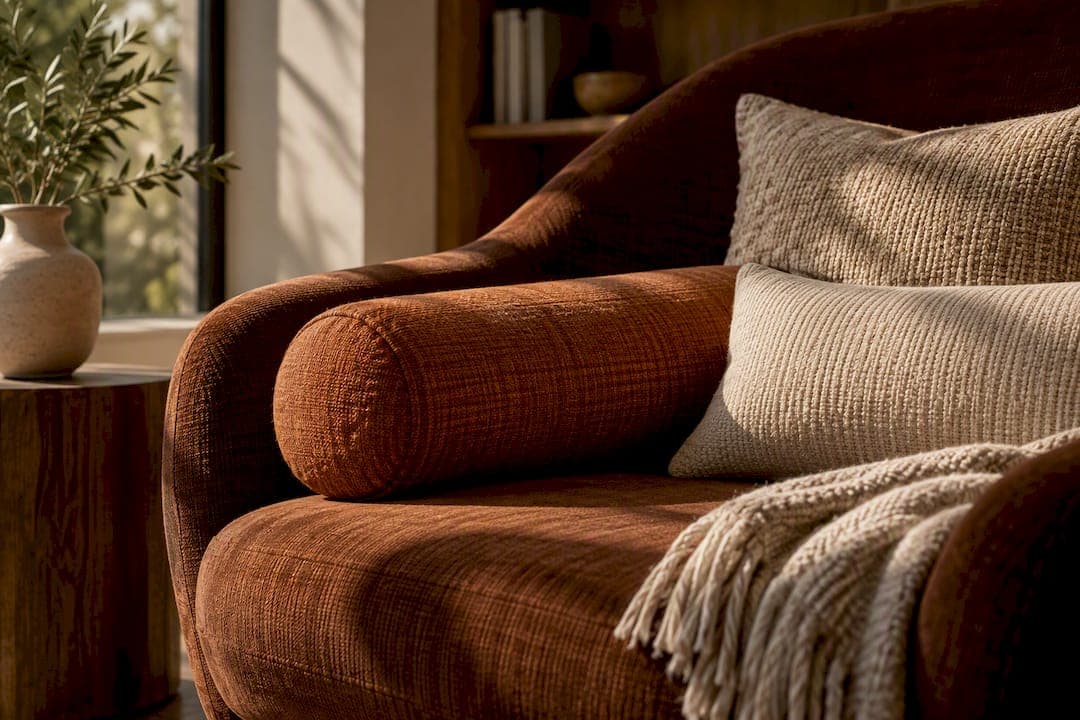
Choose a lumbar pillow when your main goal is sustained sitting support at a desk, in the car, or on the couch. Choose a bolster when you need targeted sleep support, pregnancy or recovery positioning, multipurpose use, or a strong decorative anchor for a bed or sofa. Many households end up owning both, since the two complement rather than compete with each other once you see how differently they're built.
TL;DR:
- A lumbar pillow is better suited for long-term sitting support in desks, cars, or chairs, especially if used for multiple hours at a time.
- Bolsters are ideal for sleep, pregnancy, recovery positioning, or decorative purposes due to their moldable shape and targeted support.
- Memory foam fills in lumbar pillows provide durable support, while shredded foam or latex offers adjustable and long-lasting options for bolsters.
- Proper placement of a lumbar pillow is slightly above the small of the back, and a bolster should be positioned between or under the knees for optimal spinal alignment.
- For frequent travel or quick repositioning, a lumbar pillow's slim, portable design generally outperforms the bulkier bolster.
Table of Contents
- Bolster vs Lumbar Pillow: Design, Shape, and Size Differences
- How Bolsters and Lumbar Pillows Support Your Posture
- Materials, Fill Types, and Firmness Trade-Offs
- The Real Benefits of a Bolster Pillow
- The Real Benefits of a Lumbar Pillow
- How to Choose Between a Bolster and a Lumbar Pillow
- Placement and Styling Tips That Actually Work
- The Createdecorus Approach to Support and Style
- Which Pillow Should You Buy First?
- Find Handcrafted Bolsters and Lumbar Cushions at Createdecorus
- Sources
- FAQ
Bolster vs Lumbar Pillow: Design, Shape, and Size Differences
A bolster is a long cylindrical cushion, built to roll into tight spaces like the gap between your knees or the curve behind your neck. A lumbar pillow is typically rectangular or gently kidney-shaped, contoured to sit flush against the small of your back. That geometry isn't cosmetic. A cylinder distributes pressure along a line of contact, which is why it works so well tucked under a knee or wedged against a headboard. A curved rectangle spreads pressure across a flat plane, which is why it fills the lumbar arch without shifting when you lean back.
Typical size ranges reflect those jobs:
- Knee or under-knee bolsters: roughly 20 to 30 inches long, often around 9 inches in diameter, with firm fill recommended as a solid starting point.
- Cervical or neck bolsters: smaller in size, suitable for neck support.
- Lumbar pillows: commonly 12 to 16 inches wide and 3 to 5 inches thick, sized to nest into a chair back without crowding the seat.
Because a bolster is round, it can roll if your surface isn't stable. A lumbar pillow, by contrast, tends to stay put once it settles into the curve of your spine.
How Bolsters and Lumbar Pillows Support Your Posture
The two shapes change your body in different ways once you're actually using them.
- Lumbar pillows fill the gap at your lower back, keeping your spine closer to its natural curve during long stretches at a desk or on a road trip. This matters most for anyone sitting more than an hour at a stretch.
- Bolsters placed under the knees shift pelvic tilt, taking pressure off the lower back for back sleepers. Physiotherapy guidance consistently points to this placement for reducing morning stiffness.
- Bolsters placed between the knees stop the top leg from rotating inward, which is the detail most side sleepers miss when they wake up with hip or lower back pain.
Desk workers gravitate toward lumbar pillows. Side sleepers, pregnant sleepers, and anyone recovering from surgery tend to reach for bolsters instead, since the cylinder adapts to more joints than a flat cushion can.
Materials, Fill Types, and Firmness Trade-Offs
Fill choice decides how a pillow feels years down the road, not just on day one.
- Solid memory foam holds its shape densely and gives durable, consistent support, which is why it shows up in most commercial lumbar pillows, including a common 3-inch-thick, medium-firm design built for chairs and cars.
- Shredded foam lets you adjust loft by hand, useful for bolsters that need to fit an irregular gap between knees or under an ankle.
- Polyester fiber feels soft out of the box but compresses fastest, so it's a budget option rather than a long-term one.
- Natural latex resists compression and breathes well, trading a higher price for durability that outlasts most synthetic fills.
- Buckwheat offers firm, moldable support but adds weight and noise, better suited to stationary use than travel.
Pro Tip: Match firmness to the job, not your general preference. A soft fill under your knees feels great but collapses within weeks, while a firm lumbar pillow with a removable, washable cover holds its shape and stays fresh through daily use.
The Real Benefits of a Bolster Pillow
A well-placed bolster does more work than its simple shape suggests.
- Spinal alignment for side and back sleepers improves noticeably once the cylinder sits between the knees or under them, correcting the hip rotation that causes lower backache.
- Pregnancy and post-op comfort benefits from a bolster's ability to prop, wedge, or cradle at almost any angle, which a flat cushion can't match.
- Decorative anchoring is where a bolster earns its place outside the bedroom. Laid across the foot of a bed or along the back of a deep sofa, its horizontal line creates a visual anchor that squared cushions can't replicate on their own.
A single firm bolster, sized around 9 by 36 inches, covers most of these sleep and support scenarios without needing a second piece for basics.
The Real Benefits of a Lumbar Pillow
Where a bolster works hard in a lot of positions, a lumbar pillow does one job extremely well.
- Sustained posture correction is a lumbar pillow's whole reason for existing. It fills the arch of your lower back so your spine doesn't slump forward after the first twenty minutes in a chair.
- Compactness makes it the easier fit for small apartments, tight desk chairs, or a car seat where a bolster would simply be too large.
- Portability matters if you move between a home office, a car, and a couch in the same day. A slim lumbar pillow travels easily; a bolster generally doesn't.
Firmness is the detail most buyers get wrong. Too soft, and you get pushed forward out of the seat's natural recline, which defeats the purpose. A thinner, medium-firm profile around 3 inches thick tends to support without shoving you out of position.
How to Choose Between a Bolster and a Lumbar Pillow
The decision comes down to one question: what's your main goal, sitting support or sleep and decor?
- Ask where you'll use it. A desk, car seat, or dining chair points to a lumbar pillow. A bed, nursery glider, or sofa points to a bolster.
- Ask how long you'll use it per session. Multi-hour sitting favors lumbar support. Overnight use favors a bolster's adaptability.
- Check cover and care needs. If it'll travel with you or sit near kids and pets, prioritize a removable, machine-washable cover.
- Decide on firmness last. Firm holds shape longer for both types, but a bolster used for sleep can go slightly softer than one used to prop up a knee for hours.
| Use case | Recommended shape | Typical size |
|---|---|---|
| Office chair support | Lumbar pillow | 12–16 in wide, 3–5 in thick |
| Between-the-knees sleep support | Bolster | 20–28 in long, ~9 in diameter |
| Under-knee elevation | Bolster | 20–30 in long |
| Car seat lower back | Lumbar pillow | 3 in thick, medium-firm |
| Bed or sofa styling accent | Bolster | around 36 inches long |
Placement and Styling Tips That Actually Work
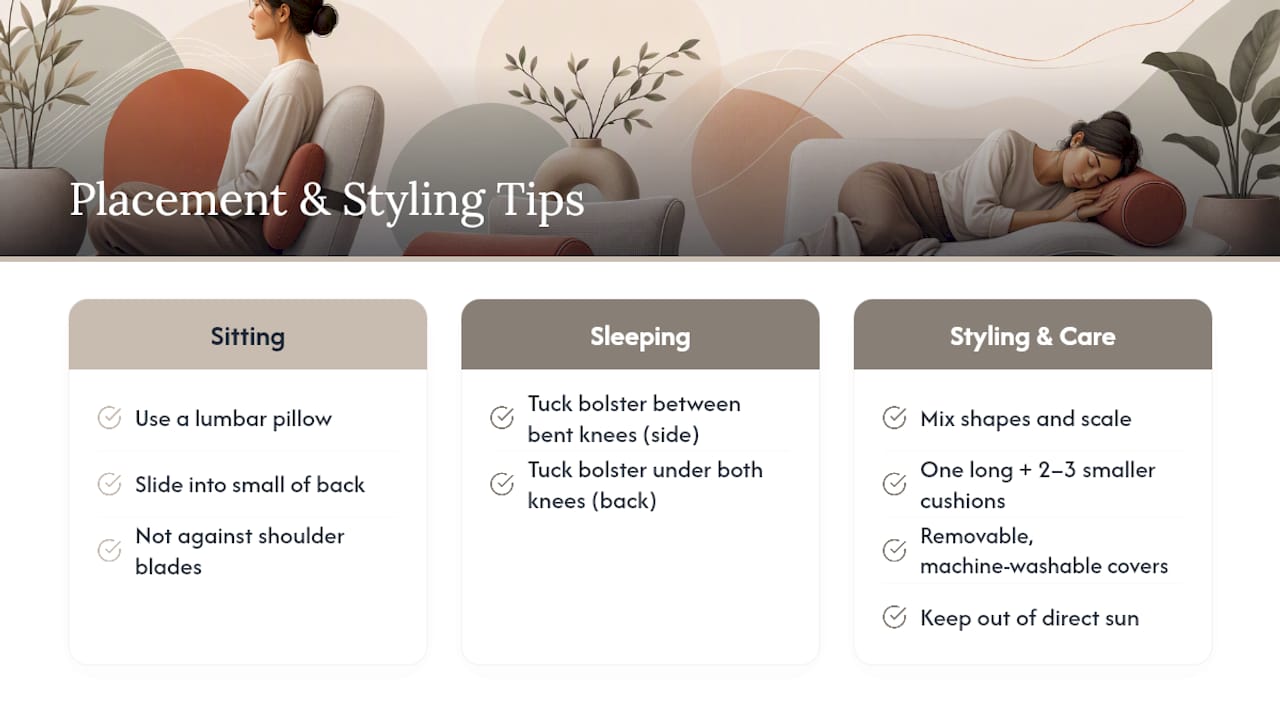
Placement decides whether either pillow earns its keep. For sitting, slide a lumbar pillow into the small of your back, not higher against your shoulder blades. For sleep, tuck a bolster between bent knees if you sleep on your side, or under both knees if you sleep on your back.
Styling works best when you mix shapes and scale rather than lining up identical squares. Pair one long bolster with two or three smaller square or lumbar-shaped cushions for contrast in texture and height, an approach covered in more depth in our guide to decorative pillow pairing.
Pro Tip: Keep bolster and lumbar covers removable and machine-washable, especially for pieces used during pregnancy or recovery, and keep both out of direct sun to protect dye and fabric over time.
The Createdecorus Approach to Support and Style
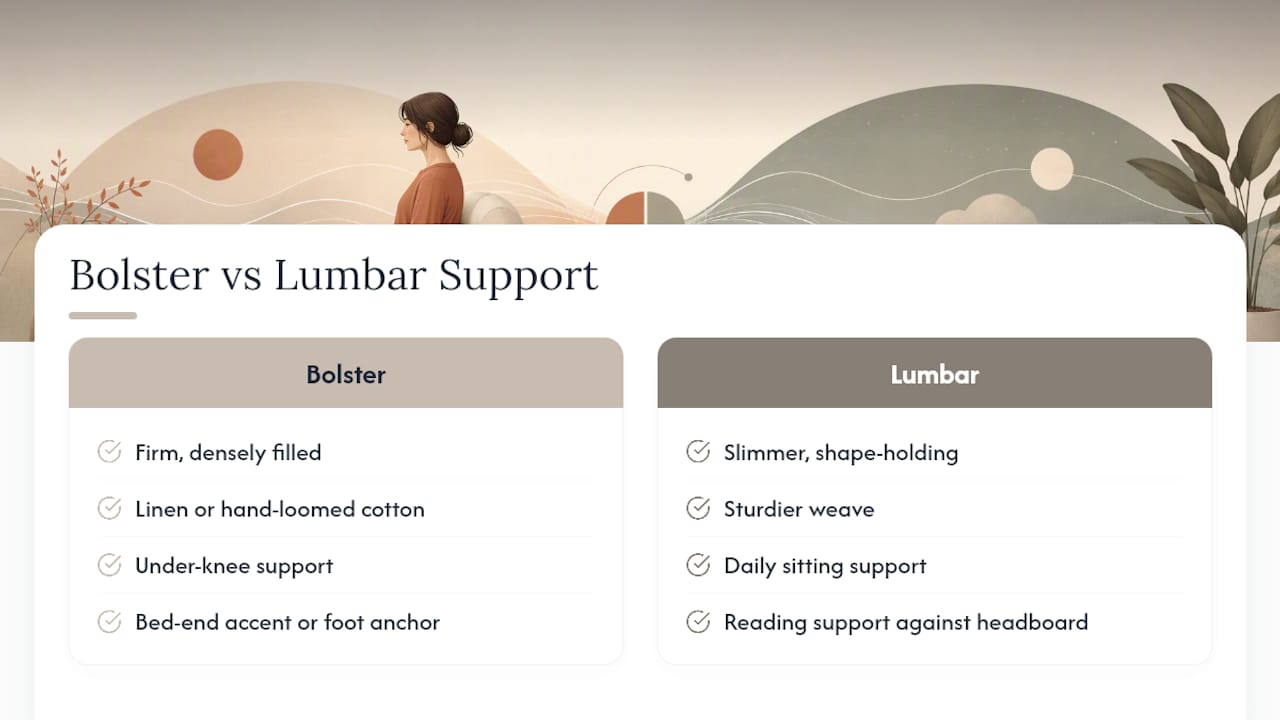
We build every bolster and lumbar shape around the same question: how will this actually get used? A firm, densely filled bolster gets chosen for under-knee support and doubles as a bed-end accent in linen or hand-loomed cotton. A slimmer lumbar cushion gets a sturdier weave built to hold shape through daily sitting, then pairs with two smaller accent pillows on a reading chair. In a living room, we've paired a long bolster with textured square cushions along a deep sofa; in a bedroom, a firm bolster anchors the foot of the bed while a lumbar-shaped pillow rides against a headboard for reading support.
Which Pillow Should You Buy First?
If you sit for work most of the day, buy the lumbar pillow first. It solves the more common daily problem. If your discomfort shows up at night or you're pregnant or recovering from a procedure, start with a medium-firm bolster instead. Most retailers allow exchanges, so testing firmness in your own space beats guessing from a size chart alone.
— Ernesto
Find Handcrafted Bolsters and Lumbar Cushions at Createdecorus
This brand offers an alternative to mass-market foam pillows for anyone who wants ergonomic support that doesn't look like a medical device. Their bolsters and lumbar shapes are handcrafted in Mexico with artisan textiles, premium fill, and feature texture and color that turn a support pillow into a design statement rather than an afterthought.

Our current Decor Pillows collection includes lumbar-contoured shapes for chairs and headboards alongside firmer bolster styles suited to knee support, nursery gliders, and bed styling. Interior designers and boutiques working across multiple rooms or client projects can apply for wholesale and trade pricing to source both shapes at scale. Browse the shop, pick the shape that matches your main goal from this guide, and place your first order today.
Sources
- What Is a Bolster Pillow? Sizes, Fills & 7 Best Uses (2026) | Banner Mattress Online
- Bolster Pillows: Uses for Side, Back | Mattress Miracle
- Relax Support - RS9 Black Lumbar Support Pillow - 100% Memory Foam (Walmart product page)
FAQ
Why Do People Use Bolster Pillows for Sleep?
Bolsters give side and back sleepers a firm, shapeable support that a flat pillow can't provide, whether tucked between the knees or placed underneath them. This placement is widely recommended by physiotherapy sources for easing hip rotation and reducing morning lower back stiffness.
Are Bolster Pillows Good for Back Pain?
Yes, particularly for pain linked to sleep posture. A bolster placed under the knees for back sleepers or between the knees for side sleepers helps correct pelvic tilt, which reduces the strain that builds up overnight.
What Is the Point of a Bolster Pillow?
A bolster's cylindrical shape lets it wedge into spots a flat cushion can't reach, like under a knee, behind the neck, or along a bed's edge. It's also a common decorative anchor for beds and sofas, thanks to the horizontal visual line it creates.
Is a Bolster Pillow the Same as a Body Pillow?
No. A body pillow is long and often curved to wrap around the whole torso and legs, while a bolster is a shorter, firmer cylinder meant for targeted spots like under the knees or against the lower back. Bolsters also double as decorative accents; most body pillows don't.
Which Is Better, a Lumbar or a Bolster Pillow?
Neither is universally better. A lumbar pillow wins for sitting posture at a desk or in a car, while a bolster wins for sleep positioning, pregnancy support, and decorative styling.
How Do I Choose the Right Firmness for a Lumbar Pillow?
Pick a medium-firm, thinner profile, often around 3 inches thick, since overly soft lumbar pillows can push you forward out of a chair's natural recline. Firmer fills hold their shape longer under daily sitting pressure.