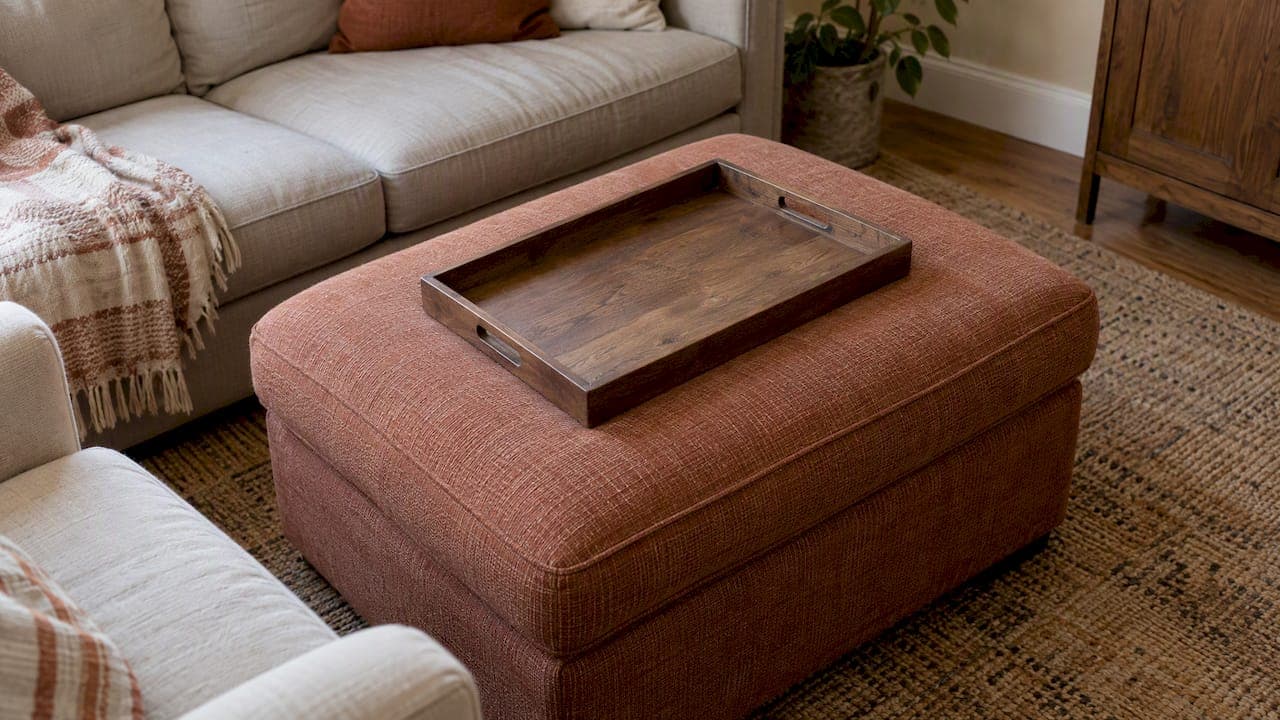
Pick a tray that covers about two-thirds of your ottoman's top surface for everyday use like serving drinks, stacking books, or holding a candle and a catchall dish. For a purely decorative tray, half the surface or smaller keeps the composition light and breathable. Measure the ottoman's top, apply that proportion, and you have your tray dimensions before you ever open a shopping tab.
TL;DR:
- Before ordering, test the calculated footprint with paper or masking tape; make the template slightly smaller because upholstered tops often dome at the center.
- Match the tray shape to the ottoman: use round or octagonal trays for round tops, and align rectangular trays lengthwise with the ottoman.
- For taller glasses, slightly taller walls help contain spills; add a nonslip pad beneath hard trays and coasters beneath glassware to protect upholstery and surfaces.
- On a large ottoman, two smaller trays can balance the surface better than one oversized tray; center heavier objects to prevent tipping.
Table of Contents
- Recommended proportional rules for sizing an ottoman tray
- How to measure your ottoman and pick tray dimensions
- Shape considerations for square, rectangular, and round ottomans
- Tray depth, material, and practical use considerations
- Styling and placement: what belongs on an ottoman tray
- Create Decorus sizing rules and expert guidance
- Pragmatic design versus showpiece styling
- How we can help you size and style your ottoman
- FAQ
Recommended proportional rules for sizing an ottoman tray
The two-thirds rule exists because a tray that nearly swallows the ottoman leaves no room for a propped foot or a folded throw, while one that is too small looks like an afterthought. When the tray will act as a real surface, something you set a mug or a stack of magazines on, give it roughly two-thirds of the ottoman's top. When the tray is there purely to look good, cutting that down to half or less lets the ottoman's own upholstery and texture show through, which matters more on a tufted or richly patterned piece.
Deciding between the two comes down to how you actually use the ottoman. A family room ottoman doubling as a coffee table earns the fuller two-thirds treatment. A bedroom accent ottoman styled with a single vase can go smaller and still feel intentional.
- A square ottoman about 36 inches on each side pairs well with a tray roughly two-thirds that size, such as around 24 inches square.
- A rectangular ottoman about 48 by 30 inches works with a tray scaled to roughly two-thirds the surface area, such as approximately 32 by 20 inches.
How to measure your ottoman and pick tray dimensions
Getting the numbers right takes a few minutes and spares you a return shipment.
- Measure the ottoman's top: length and width for square or rectangular pieces, diameter for round ones, using a standard tape measure.
- Multiply those figures by roughly 0.66 for a functional tray or 0.5 for a decorative one, in inches or centimeters, whichever you shop in.
- Cut a piece of paper or lay down masking tape in those dimensions directly on the ottoman to see how the proportion actually sits before you commit to a purchase.
That third step catches what math alone misses. A tray that looks correct on paper can feel oversized once it meets a plush, rounded ottoman top, and a quick mock-up shows you that in seconds.
Pro Tip: Cut your paper template slightly smaller than your calculated size on each side, since most upholstered tops dome slightly in the center and reduce usable tray space.

Shape considerations for square, rectangular, and round ottomans
A tray's shape should echo the ottoman beneath it, not fight it.
- Square ottomans suit a square tray or one with a gentle rectangular lean, sized to the proportions above.
- Rectangular ottomans look best when the tray's long side runs parallel to the ottoman's long side, and asymmetrical balance works well with two smaller trays instead of one large one.
- Round ottomans call for round or octagonal trays that pick up the curve, with a wider visible border than you'd leave on a square piece so the composition still reads as intentional rather than crowded.
Mixing shapes works when you're deliberate about it: two smaller trays of different shapes can balance a large round ottoman better than a single oversized piece ever would.
Tray depth, material, and practical use considerations
Wall height changes how a tray behaves day to day. A low profile roughly one to one and a half inches keeps the silhouette slim and suits everyday styling, while a slightly taller wall helps corral taller glasses or candles without risk of spillage onto the upholstery.
Material carries its own trade-offs:
- Wood brings warmth and sturdiness but adds weight, which matters on a softer ottoman top.
- Metal and acrylic stay light and easy to wipe down, though metal can show scratches over time.
- Leather and bamboo age well and bring texture, with leather needing occasional conditioning to stay supple.
A non-slip pad under a hard tray protects upholstery and keeps the whole setup from sliding when the ottoman gets bumped, and coasters underneath glassware do the same work on the tray's surface.
Pro Tip: Choose a lighter, easily removable tray if the ottoman still doubles as a footrest, and save the heavier, more substantial options for ottomans that function mainly as a coffee table.
Styling and placement: what belongs on an ottoman tray
A tray composition reads best with one taller focal item anchoring the arrangement.
- Start with a single taller piece, a vase, a stack of books, or a small lamp, as the visual anchor.
- Add two or three smaller supporting pieces around it, like a candle, a small dish, or a single decorative object, keeping the grouping uneven in height.
- Leave visible space near the tray's edges rather than pushing items flush to the rim, which keeps the whole vignette from looking crowded.
- For everyday life, keep a drink-safe zone with a coaster ready, and swap in a tray's items quickly before guests arrive without rearranging the entire ottoman.
Center heavier pieces rather than letting them lean toward one edge, both for visual balance and so nothing tips when the tray gets nudged.
Create Decorus sizing rules and expert guidance
There are two rules that make this decision easier for anyone furnishing around a handcrafted ottoman: the Two Thirds Rule, which guides tray-to-ottoman proportion as outlined above, and the 1 to 3 Inch Rule, which addresses how much bare ottoman edge should stay visible around the tray for both visual balance and upholstery protection.
- Apply the Two Thirds Rule first to settle on overall tray dimensions.
- Apply the 1 to 3 Inch Rule second to fine-tune the tray's exact footprint against your specific ottoman.
- Test the result with a paper template before ordering, especially on a tufted or rounded top where visual proportion shifts more than the numbers suggest.
For readers who want to see these rules applied to real handcrafted pieces, our ottoman styling examples walk through photographed compositions built around both rules.
Pragmatic design versus showpiece styling
Most of the ottomans we see styled well aren't the ones dressed for a photograph. They're the ones where someone measured first, mocked up the tray size with tape, and then let the everyday use guide the final call. An oversized decorative tray looks striking for a week and gets moved to a closet the first time someone needs to put their feet up.
— Ernesto
How we can help you size and style your ottoman
Once you know your tray proportions, the next step is finding an ottoman and accents built with that same intention. Each handcrafted piece comes out of artisan workshops where proportion, texture, and comfort are considered together, not as an afterthought to a finished product.

- Measure your ottoman's top using the steps above to land on a tray size that fits your space.
- Browse decor pillows to find pieces that complement your tray's palette and texture.
- Round out the vignette with a piece from rugs or wall art collections to anchor the whole seating area.
Your measurements are the starting point. From there, our shop makes it simple to build a composition that feels considered rather than assembled.
FAQ
What shape tray should you put on a round ottoman?
A round or octagonal tray works best on a round ottoman since it echoes the existing curve instead of fighting it. Leave a slightly wider visible border than you would on a square ottoman so the shape transition still looks intentional.
What is the standard size of a food tray?
There is no single standard size for a food serving tray, since dimensions vary widely by manufacturer and intended use, from small individual trays to large serving platters. For ottoman styling, the better approach is sizing the tray to your ottoman's proportions rather than matching a generic food tray standard.
What is a 17 inch tall ottoman?
An ottoman's height from floor to top surface is a common consideration for pieces meant to double as a coffee table or extra seating at a comfortable sitting height. That height doesn't change your tray's footprint calculation, which depends on the ottoman's top surface dimensions rather than how tall it stands.
How do you decorate a large ottoman?
Start with the two-thirds proportion rule for a functional tray, then build a composition with one taller focal item and two or three smaller supporting pieces, leaving breathing room near the edges. On a larger ottoman, two smaller trays can sometimes balance the surface better than one oversized piece.