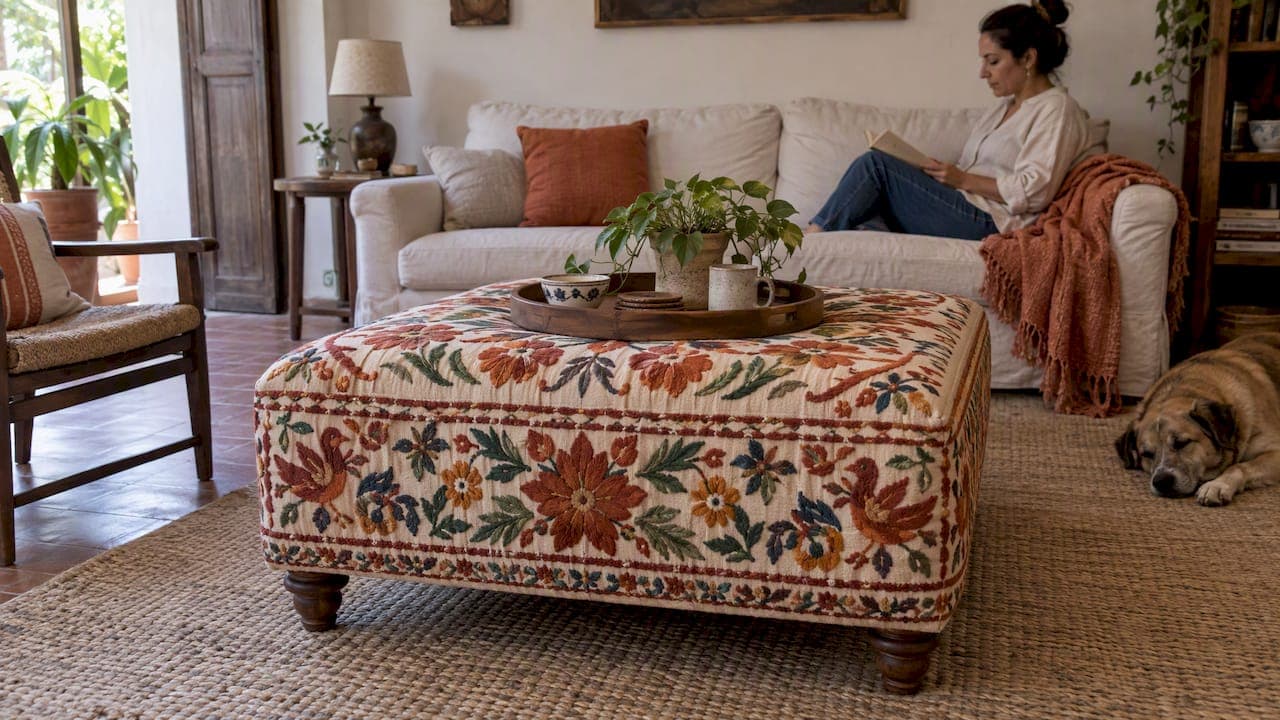
Style an ottoman with a tray sized to its shape, a layered arrangement that builds height and texture, fabric chosen for how the room actually gets used, and a silhouette matched to its job, whether that's a coffee table, extra seating, or compact desk storage solutions. Twelve practical ideas and quick how-to sections follow, so you can copy what fits your space today.
TL;DR:
- Match the tray to the ottoman’s shape, leave a visible fabric border, check handle clearance, and keep one corner free for drinks.
- Keep the ottoman about two thirds the sofa’s length, leave a gap of one to three inches, and preserve 30 inches for walking.
- Choose flatweave or performance fabric for busy family rooms; reserve velvet or leather for lightly used spaces, and consider washable slipcovers around pets.
- Use pads that prevent slipping under trays and silicone coasters for drinks; anchor tall storage ottomans used by children into wall studs.
Table of Contents
- 1. Twelve Ottoman Styling Ideas You Can Copy Today
- 2. How to Use an Ottoman as a Coffee Table
- 3. Choosing Fabrics and Caring for Your Ottoman
- 4. Sizing and Placement Rules That Keep the Room Balanced
- 5. Safety and Staging Tips for Homes With Kids and Pets
- 6. Why Handcrafted Artisan Ottomans Hold Up to Daily Styling
- 7. Integrating Bold Colors and Rich Textures Around an Artisan Ottoman
- 8. Bringing Cultural Authenticity Into Your Ottoman Styling
- 9. Pairing Ottomans With Other Handcrafted Accents
- 10. Using an Ottoman as the Heart of a Personal Sanctuary Space
- Balancing Personality and Practicality in Ottoman Styling
- Shop Handcrafted Pieces to Complete Your Ottoman Styling
- FAQ
- Sources
1. Twelve Ottoman Styling Ideas You Can Copy Today
Each idea below works as a standalone vignette. Pick one that matches your ottoman's shape and your household's daily habits, rather than trying to combine all twelve at once.
- Tray plus books plus vase. Center a tray on top, stack two or three books at one side, and finish with a single bud vase for height. House & Garden notes that this layering method, paired with thinking in odd-numbered groupings, is the foundation most stylists return to.
- Coffee-table book stack. Swap the tray for a single oversized coffee-table book, add a small decorative bowl, and tuck a sculptural object beside it for contrast in shape.
- Minimalist clear top. Leave the surface bare when the ottoman doubles as extra seating for guests or kids, since a styled surface only gets cleared off anyway during entertaining.
- Throw and cushion cluster. Fold a textured throw along one edge and rest one or two cushions against it for a lived-in, cozy look that invites someone to sit down.
- Bold patterned textile. Drape a woven or patterned fabric panel across part of the ottoman to introduce color without repainting a wall or reupholstering furniture.
- Plant and pottery trio. Group a small potted plant, a ceramic vessel, and a wooden object together for an organic, grounded feel.
- Stacked poufs. Place two or three small poufs of varying heights together for a sculptural cluster that also offers backup seating when company arrives.
- Storage ottoman styling. Keep the lid simple, maybe a single tray, and let woven baskets or fabric boxes do the organizing work out of sight.
- Seasonal swap vignette. Rotate in fresh florals, a different vase color, or a holiday-specific object every few months to refresh the look without buying new furniture.
- Bench-style alignment. Line a long bench-ottoman up with the sofa's front edge and run a slim tray or table runner down its length for a tailored look.
- Coastal or knit pouf. Pair a woven pouf with a few shells, a light linen throw, and a natural-fiber tray for a relaxed, breezy mood.
- Statement fabric with exposed legs. Choose an ottoman with visible wooden or metal legs and dress the top in a contrasting bold textile so the silhouette reads as furniture, not just a cube.
Pro Tip: Start with one vignette idea per ottoman and live with it for a week before adding more. Overstyled surfaces tend to come apart the first time someone sets down a coffee mug.
2. How to Use an Ottoman as a Coffee Table
An ottoman earns its place as a coffee table through the right tray and a layering method that keeps things stable, not just attractive.
Choose a tray that leaves a visible border of ottoman fabric around its edges, so the tray reads as a defined frame rather than swallowing the whole top. Shape matching matters here: round ottomans pair naturally with round trays, while rectangular ottomans look more intentional with a rectangular one. PECA, a Mexican furniture design studio, recommends calculating handle clearance too, so the tray can actually be lifted off without catching on anything nearby.
- Set the tray down first as your base, then build a small stack of books to one side.
- Add a decorative bowl or box on the opposite side for balance.
- Finish with a taller vase toward the back, keeping the front edge clear for sightlines across the room.
- Use coasters or a removable serving tray when drinks are involved, and keep one corner permanently clear for quick use.
A tray does more than hold objects. According to Better Homes & Gardens, a tray corrals items into a defined island that protects the upholstery underneath and turns a soft surface into something that functions reliably like a table.
3. Choosing Fabrics and Caring for Your Ottoman
The fabric you choose should match how your household actually lives, not just how a photo looks. House & Garden points out that patterned or woven textiles hide wear far better than plain velvet, which makes them a more forgiving choice for busy homes.
- Choose flatweave or performance textiles for family rooms where spills and foot traffic are a given.
- Reserve velvet or leather for formal sitting rooms that see lighter, more occasional use.
- Look for removable or washable slipcovers if you're renting, redecorating often, or living with pets.
- Clean according to the fabric's own care code, since cleaning methods that work on cotton can damage silk or leather.
For handcrafted upholstered pieces specifically, our guide to fabric care codes for handcrafted ottomans walks through the steps that protect artisan textiles without stripping their color or texture.
4. Sizing and Placement Rules That Keep the Room Balanced
Scale makes or breaks an ottoman's presence in a seating area, and a few simple rules take the guesswork out of it.
- Keep the ottoman's length at roughly two-thirds the length of the sofa it sits in front of, a ratio we break down further in our Two Thirds Rule guide.
- Leave a seat-to-ottoman gap of about one to three inches so legs rest comfortably without the two pieces colliding, following the fit guidance in our 1 to 3 Inch Rule post.
- Maintain at least 30 inches of walking clearance around the ottoman for comfortable circulation through the room.
- Consider castors or a lower bench-style profile in tight layouts where a bulky ottoman would block natural foot traffic.
5. Safety and Staging Tips for Homes With Kids and Pets
A styled ottoman still has to survive daily life, and a handful of small precautions make that possible.
- Slide non-slip pads under any tray so it doesn't shift when someone bumps the ottoman.
- Use silicone coasters for drinks to protect both the tray and the upholstery beneath it.
- Anchor tall storage ottomans used by children with anti-tip hardware, and secure that hardware into a wall stud rather than drywall, as PECA advises for any tall or heavy piece under load.
- Keep a washable slipcover on hand so a quick wash handles spills instead of a trip to a cleaner.
Pro Tip: Treat the tray as a grab-and-go unit. Lifting it off entirely clears the whole ottoman in one motion when kids need the surface for floor time.
6. Why Handcrafted Artisan Ottomans Hold Up to Daily Styling
We build every ottoman to carry both a styled tray and the daily weight of a real living room, using artisan textiles and premium fillings that hold their shape through repeated use. Our ergonomic guidance draws on the same fit principles covered above, including the gap and scale rules detailed in our coffee-table condition guide for readers weighing whether a given ottoman can safely double as a table.
- Look for dense, well-anchored filling that resists sagging under a loaded tray.
- Check seam construction along edges and legs, since this is where daily use shows first.
- Favor natural or performance-grade textiles that take color well and wear evenly over time.
7. Integrating Bold Colors and Rich Textures Around an Artisan Ottoman
A handcrafted ottoman with saturated color or hand-woven texture works best as an anchor, not a lone accent fighting for attention. Build the rest of the room's palette around two or three of its dominant tones rather than matching every shade exactly, since a slightly looser color relationship reads as intentional rather than overly coordinated.
Layer textures deliberately: a smooth leather ottoman gains warmth next to a chunky knit throw, while a richly embroidered piece can sit comfortably alongside simpler linen cushions without competing. Keep surrounding walls or large furniture pieces more neutral so the ottoman's color and craftsmanship stay the visual focus rather than getting lost in competing patterns. A single supporting accent, one patterned pillow or a textured rug edge, is usually enough to echo the ottoman's personality without duplicating it outright.
8. Bringing Cultural Authenticity Into Your Ottoman Styling
Every piece we craft carries hand-applied details, from embroidery to woven textile patterns, that trace back through generations of Mexican artisan technique rather than a factory template. Letting those details stay visible, instead of burying them under heavy styling, is part of what keeps the authenticity intact.

We'd rather see one ottoman with genuine hand-finished stitching take center stage than watch it disappear under an overdecorated tray. Pairing it with simpler, quieter surrounding pieces, plain-weave cushions or a solid-toned throw, lets the craftsmanship read clearly instead of blending into a crowded vignette. The goal is a room that feels considered rather than assembled, where the story behind the piece has room to actually show.
9. Pairing Ottomans With Other Handcrafted Accents
An ottoman rarely stands alone in a finished room, and the accents around it either reinforce its craftsmanship or distract from it. Decorative pillows in a complementary weave or embroidery style, like the pieces in our decor pillows collection, extend the same artisan sensibility onto the sofa without repeating the ottoman's exact pattern.
A handwoven rug beneath the seating group ties the ottoman's color story into the floor, grounding the whole arrangement the way our rugs are designed to do. Wall art with similar tonal warmth, rather than matching motifs, rounds out the room without making every piece look purchased as a set. The strongest pairings share a feeling, rich materials and visible handwork, more than they share an exact color or pattern.

10. Using an Ottoman as the Heart of a Personal Sanctuary Space
A well-placed ottoman can turn a reading corner or a quiet seating nook into the room's emotional center, especially when it's layered with a soft throw, a low lamp nearby, and a tray holding something as simple as a candle and a book. The goal isn't an untouchable display. It's a surface that invites someone to actually sit down, put their feet up, and stay a while.
Lighting matters here as much as the object you're styling: a warm lamp placed near the ottoman does more to create ambiance than any single decorative item on top of it. Keep the surrounding furniture slightly pared back so the ottoman, and the handcrafted details in its fabric, remain the first thing the eye lands on when entering the space.
Balancing Personality and Practicality in Ottoman Styling
I keep coming back to the same rule when I style an ottoman: a vignette should survive someone actually using the room. Rotate trays and objects seasonally, keep a washable slipcover ready, and let a piece's craftsmanship carry the room instead of piling on more objects than it needs. Experiment freely, but keep usability as the real test of a good arrangement.
— Ernesto
Shop Handcrafted Pieces to Complete Your Ottoman Styling
Once you've settled on a styling direction, the accents around your ottoman are what pull the whole vignette together. We handcraft decorative pillows, rugs, and wall art in Mexico using traditional techniques and premium materials, so the pieces you add carry the same artisan quality as the ottoman itself.

Browse our decor pillows for textures that pair naturally with a styled ottoman tray, or look through rugs and wall art to build out the rest of the seating area. Designers and shops interested in bulk orders can also explore our wholesale trade program. Visit our shop to find the piece that fits your space today.
FAQ
What is the easiest way to style an ottoman?
Center a tray sized to the ottoman's shape, add a stack of books for height, and finish with one decorative object like a small vase or bowl. House & Garden recommends grouping items in odd numbers for a more natural, balanced look.
Can an ottoman really work as a coffee table?
Yes, as long as a tray sits on top to create a stable, defined surface for drinks and objects. Better Homes & Gardens notes that the tray protects the upholstery underneath while giving the ottoman a reliable table-like function.
How big should my ottoman be compared to my sofa?
A common guideline keeps the ottoman's length at roughly two-thirds the length of the sofa it sits in front of, which our Two Thirds Rule guide explains in more detail. Leaving a small gap of about one to three inches between the seat and the ottoman also keeps the arrangement comfortable.
What fabric should I choose for a family ottoman?
Woven or performance textiles hold up best in homes with kids or pets, since patterned fabrics are more forgiving of everyday wear than plain velvet. Removable slipcovers are worth considering too, since they allow for easy washing without replacing the whole piece.
Does Create Decorus make ottomans that can double as coffee tables?
Yes, some handcrafted ottomans are built with the fit and construction needed to support a styled tray for everyday coffee-table use. Our coffee-table condition guide outlines the specific conditions that make an artisan ottoman a good fit for that role.
Sources
- How to style an ottoman | House & Garden
- 33 Ottoman Decor Ideas for a Stylish Living Room
- PECA — Mexican furniture design studio (tray/anchoring guidance)