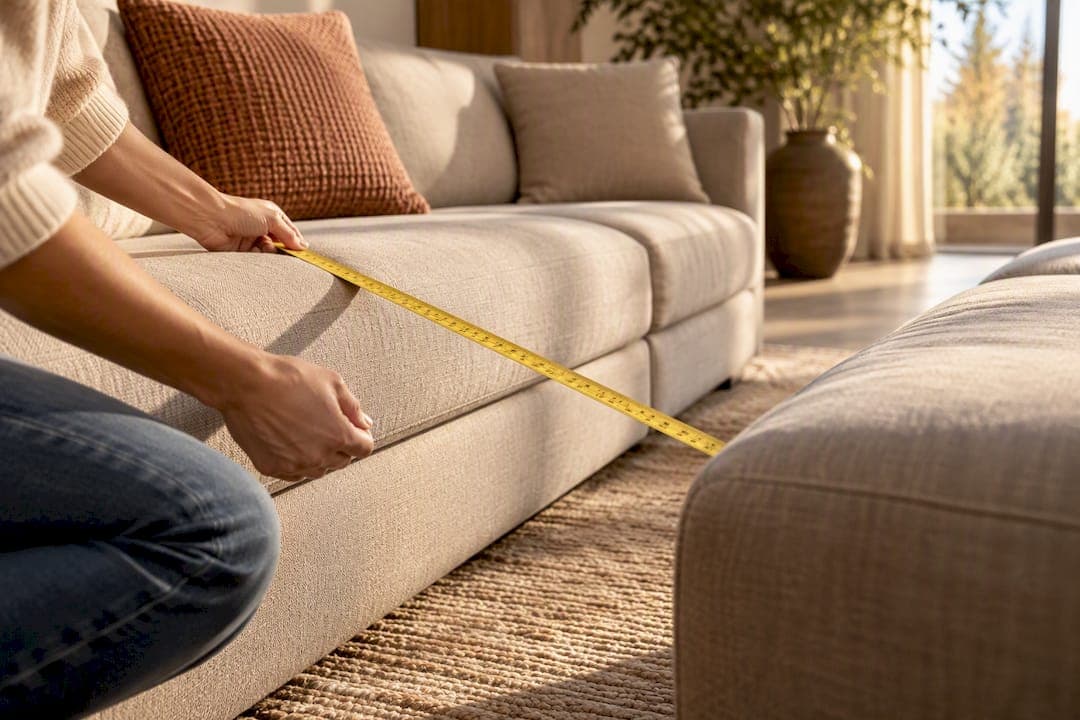
For most sectionals, a low profile square or round ottoman sized to about two-thirds the length of the sectional's usable seat run is the safest bet. It works as a footrest, a coffee-table substitute, and it suits nearly every layout, from a simple L-shape to a wide U-shaped configuration. Before you shop, grab a tape measure. That single step will save you from the most common ottoman mistake: buying one that looks right online but crowds the room in person.
TL;DR:
- Using an ottoman sized at about two-thirds the usable length of the sectional ensures a proportional and unobtrusive fit.
- Round ottomans suit U-shaped or curved sectionals, while square and rectangular styles work best with L-shaped configurations.
- Placement should include a gap of 14 to 18 inches from the seat edge and roughly 30 inches of clearance for comfortable movement.
- High-density foam cushions and materials like stain-resistant fabrics or leather provide durability and comfort for family use.
- Matching the ottoman's style to your sectional's design—such as modern, traditional, or mid-century—creates a cohesive and balanced room aesthetic.
Table of Contents
- Which Ottoman Shapes and Styles Pair Best With Sectionals?
- How Do You Size an Ottoman for a Sectional?
- How Far Should an Ottoman Sit From a Sectional?
- What Materials Hold Up Best on a Family Ottoman?
- Can You Use an Ottoman as a Coffee Table or Storage Piece?
- What Should You Budget for a Sectional-Friendly Ottoman?
- How Do You Match an Ottoman's Fabric and Color to Your Sectional?
- Which Ottoman Style Fits Modern, Traditional, or Mid-Century Sectionals?
- Ernesto's Perspective: Why Artisan Ottomans Are Worth Considering
- Create Decorus: Handcrafted Ottomans Built for Real Living Rooms
- Sources
- FAQ
Which Ottoman Shapes and Styles Pair Best With Sectionals?
The shape of your sectional should decide the shape of your ottoman before color or fabric ever enters the conversation. A sectional with sweeping curves wants a different companion than one built from hard right angles.
Round ottomans soften the visual weight of a room. If your sectional has a rounded chaise or you're centering a U-shaped layout, a round ottoman breaks up all those straight lines and gives your eye a place to rest.
Square and rectangular ottomans anchor L-shaped seating the way a true coffee table would. They echo the sectional's own geometry, which is why they read as intentional rather than accidental.
Storage and lift-top ottomans earn their keep in households juggling blankets, remotes, or kids' toys. When floor surface and hidden storage both matter, this style solves two problems with one piece of furniture.
Poufs and small ottomans flex into tight corners or serve as an accent seat when guests outnumber cushions. They're the most forgiving option when you're not sure exactly what you need yet.
Beyond shape, three details change how an ottoman feels in a room:
- Tufted tops add texture and a slightly more formal, traditional look.
- Skirted bases visually lower and soften an ottoman, while exposed legs make it feel lighter and more modern.
- A low profile ottoman tends to disappear into a sectional's silhouette, while a taller one competes with it for attention.
How Do You Size an Ottoman for a Sectional?
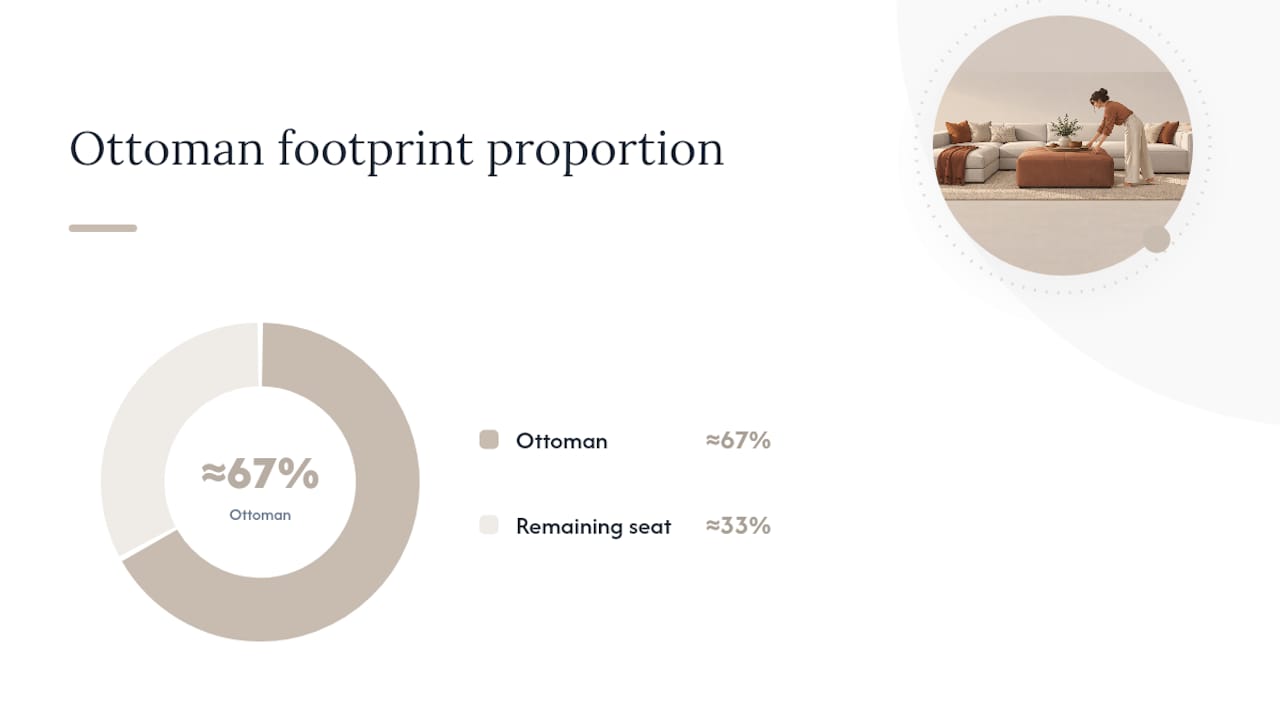
A widely used starting point is to size your ottoman to roughly two-thirds the length of the sectional's usable seat run. It's a guideline, not a rule carved in stone, but it consistently produces a proportion that looks balanced rather than accidental.
The key phrase there is "usable seat run." That's not the sectional's full advertised length. It's the specific stretch of seating the ottoman will actually serve, whether that's the main sofa run or the area facing your television. Measuring that zone directly, rather than eyeballing the whole piece, is what keeps the math honest.
Here's the sequence that works:
- Measure your seat height, from the floor to the top of the seat cushion.
- Measure the usable seat width, the specific span of sectional the ottoman needs to face.
- Calculate two-thirds of that width as a starting footprint.
- Cut a piece of cardboard or tape an outline on the floor at that footprint.
- Walk around it for a day before you commit to a purchase.
That last step matters more than people expect. Taping the footprint on your floor exposes problems a measuring tape alone won't: a door that no longer swings freely, a lamp cord suddenly underfoot, a walkway that feels tighter than the numbers suggested.
Deviate from two-thirds when your room is small and every inch counts, when you need a wider surface for serving trays and laptops, or when your layout is asymmetric and a centered ottoman would look off balance.
Pro Tip: Cut your test footprint from an old cardboard box instead of just taping an outline. A three-dimensional stand-in makes it far easier to judge whether the ottoman will visually crowd the room, since flat tape on the floor tends to underestimate how much space an object takes up.
How Far Should an Ottoman Sit From a Sectional?
Placement determines whether an ottoman feels like a natural extension of your seating or an obstacle course. Two numbers do most of the work here.
- For coffee-table-style placement, leave a gap of 14 to 18 inches between the sectional's seat edge and the nearest edge of the ottoman.
- Preserve roughly 30 inches of walking clearance for ordinary movement through the rest of the room for ordinary movement, and use about 36 inches as a planning benchmark for accessible routes needing wheelchair or walker clearance.
- Keep the ottoman's top level with your seat cushions, or one to two inches lower, if you want it to double convincingly as a coffee table.
- For a footrest, skip the ruler and do a seated comfort test instead. Sit down, kick your feet up, and trust how your knees and hips feel over strict numeric height rules.
Layout shapes their own quirks. In an L-shaped sectional, center the ottoman on the corner seat where people gather most. In a U-shaped configuration, a round ottoman in the middle keeps sightlines open on both sides. With a chaise, offset the ottoman toward the main seating run rather than centering it on the sectional's full footprint. That keeps the chaise's own entry point clear instead of boxing it in.
What Materials Hold Up Best on a Family Ottoman?
Upholstery choice matters more for an ottoman than for almost any other piece of furniture in your living room, because it takes the most direct contact: feet, drink glasses, kids climbing on, dogs settling in.
- Performance fabrics and stain-resistant weaves shrug off daily wear better than natural linen, though linen still wins on breathability and a softer hand feel.
- Velvet looks luxurious but shows crushing and watermarks faster, making it a better fit for lower-traffic formal rooms.
- Leather and vegan leather wipe clean in seconds and age with character, though leather needs conditioning to avoid cracking over time.
- High-density foam inside the cushion keeps a footrest firm enough to support real weight instead of collapsing flat.
- Solid bases and legs matter if the ottoman will regularly double as extra seating, not just a footrest.
- Lift-top storage ottomans need a stable, controlled mechanism. A textile partner like KA Design International is a useful reference point if you're comparing upholstery weights and durability before you commit to a fabric.
For care, spot clean spills immediately, apply a fabric protector on lighter colors, and consider a slipcovered ottoman if you want the option to swap or wash the cover entirely.
Can You Use an Ottoman as a Coffee Table or Storage Piece?
An ottoman earns dual duty status only if it passes a few practical checks first.
- Confirm a flat, stable top, or add a tray, so drinks and books actually sit level.
- Check the height against your seat cushions and test your reach from a seated position.
- Choose a stain-resistant or wipeable material if it will regularly hold drinks or snacks.
- For storage ottomans, verify the interior dimensions actually fit what you plan to store, along with the lid's weight capacity and hinge safety, especially if children will be around it.
- For occasional seating, press down on the cushion. If it bottoms out under your palm, it won't hold up under a full-grown adult.
Watch for red flags: an ottoman that narrows your walking path, a lid that slams instead of staying propped, or cushioning so soft it offers no real seating support. Any one of those is a sign to keep shopping.
What Should You Budget for a Sectional-Friendly Ottoman?
Ottoman prices swing widely based on size, materials, and construction, and that range is exactly why it pays to know what you're paying for before you compare listings side by side.
Mass-market poufs and small accent ottomans sit at the low end of the market, built from lighter frames and simpler fabrics. They're fine for occasional use but tend to show wear faster under daily foot traffic. Mid-range storage and coffee-table ottomans cost more because they add lift mechanisms, internal compartments, and sturdier frames capable of holding drinks and decor on top.
At the upper end, handcrafted ottomans command higher prices for a reason that goes beyond materials alone: labor. A hand-tufted top, a hand-loomed textile, or a solid hardwood base built by an artisan takes hours a factory line simply doesn't spend. That cost shows up in how the piece ages, too. A well-built ottoman with a solid frame and high-density foam will typically outlast a budget version by years, which makes the higher upfront price look different once you calculate cost per year of use rather than cost at checkout.
Set your budget by use case first. A piece that will absorb daily kicked-up feet and toddler climbing deserves a sturdier construction budget than an occasional accent ottoman in a formal sitting room.
How Do You Match an Ottoman's Fabric and Color to Your Sectional?
The safest styling move is picking one dominant tone from your sectional and letting the ottoman either match it closely or contrast it deliberately. Trying to split the difference, a color that's almost the same but slightly off, usually reads as a mistake rather than a design choice.
If your sectional is a neutral (gray, cream, taupe), you have the most freedom. A patterned or richly colored ottoman becomes a focal point rather than fighting for attention. If your sectional already carries a bold pattern or color, keep the ottoman in a complementary solid so the room doesn't feel busy.
Texture is just as important as color. Pairing a smooth performance fabric sectional with a textured, woven, or hand embroidered ottoman adds depth without adding visual noise. This is where handcrafted textiles tend to outperform mass-produced options. A woven pattern with slight irregularities catches light differently throughout the day, giving the room a sense of depth that a flat, printed fabric can't replicate.
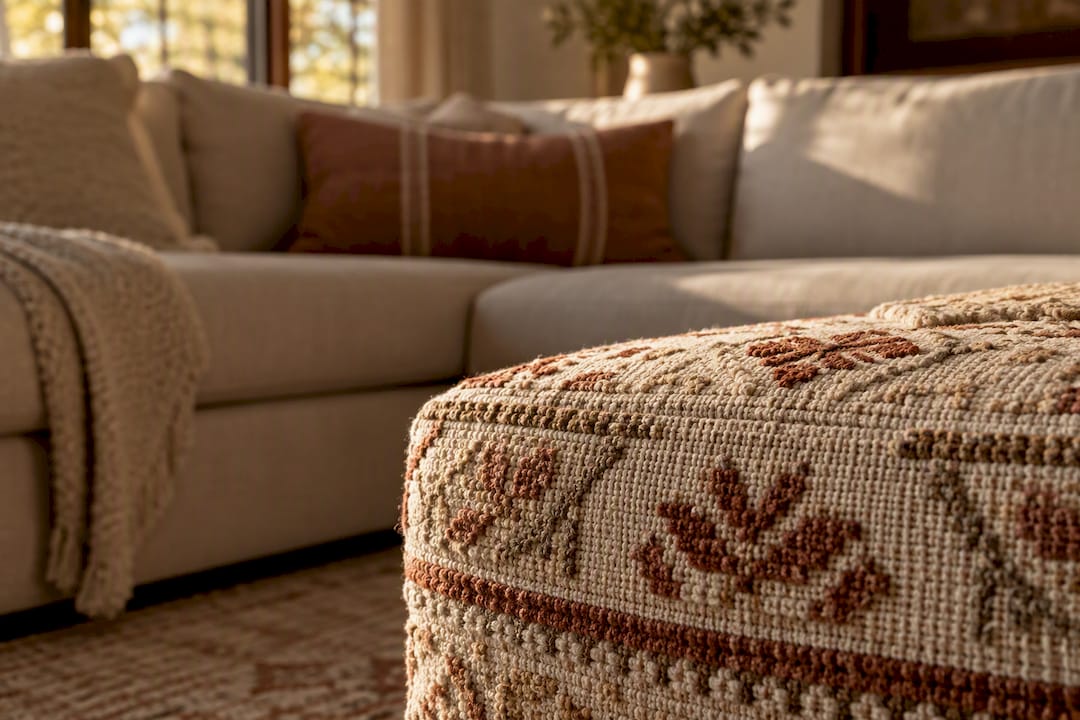
Don't forget the accent layer. Coordinating a cushion shape swap on the sectional itself, trading a square pillow for a lumbar shape, can tie the whole seating arrangement together once the ottoman is in place. Pattern-matching every textile in the room to perfection isn't the goal. One or two shared colors or textures between the ottoman and the sectional's pillows is usually enough to make the whole grouping look considered.
Which Ottoman Style Fits Modern, Traditional, or Mid-Century Sectionals?
Sectional style should guide your ottoman decision as much as its shape and size.
Modern sectionals with clean lines and low profiles pair best with an ottoman that echoes that restraint: exposed metal or wood legs, minimal tufting, and a solid color or subtle texture rather than a busy pattern.
Traditional sectionals, often skirted or rolled-arm, call for an ottoman with more visual weight. Deep tufting, a skirted base, and richer colors like burgundy, forest green, or warm terracotta feel at home here.
Mid-century sectionals favor tapered wooden legs and a slightly retro color palette: mustard, burnt orange, teal. An ottoman with the same leg style and a bold but period-appropriate color keeps the whole grouping cohesive rather than looking like two different eras collided in one room.
When in doubt, match the leg style first. A sectional and ottoman sharing the same leg finish and shape will look coordinated even if their fabrics differ.
Ernesto's Perspective: Why Artisan Ottomans Are Worth Considering
Handcrafted texture changes how an ottoman reads in a room. A hand-loomed weave or hand-tufted top catches light and shadow in ways a machine-printed fabric can't, which makes even a modestly sized piece feel more substantial. That perceived scale matters more than raw dimensions once you're actually living with the furniture.
The trade-off is real: artisan pieces cost more and take longer to arrive than a mass-produced ottoman pulled from a warehouse shelf. What you get in return is a build quality, and often a custom sizing option, that tends to outlast the difference in price.
— Ernesto
Create Decorus: Handcrafted Ottomans Built for Real Living Rooms
Create Decorus is the alternative to big box ottoman shopping for anyone who wants a piece that actually fits their space and their story, not just whatever dimension happened to be in stock. Every ottoman is handcrafted in Mexico using premium materials and traditional techniques, which means you're choosing from designs you won't find sitting on a warehouse shelf anywhere else.
The collection includes low profile styles built to sit level with sectional seat cushions, along with storage options for households that need function alongside form. Custom sizing is available if your usable seat run doesn't match a standard footprint, and every order ships vacuum-compressed for efficient delivery. Interior designers and boutiques can also apply for wholesale trade pricing on bulk orders.
Measure your seat run first, then browse the shop to find an ottoman sized and styled to match what you already have.
Sources
Placement and clearance guidance draws from CHITA LIVING's spacing guide for ottomans paired with sectionals, and sizing steps come from their companion guide on ottoman sizing. Storage ottoman examples referenced for dimensions and lift mechanisms include the Owen Square storage ottoman and the Avalon storage ottoman with serving trays.
- Ottoman size for a sofa: How to choose – CHITA LIVING
- Storage Ottoman Coffee Table | Owen Square – Simpli Home
FAQ
What Kind of Ottoman Works Best With a Sectional?
A low profile square or round ottoman sized to roughly two-thirds of the sectional's usable seat run works for most layouts. Round shapes suit curved or U-shaped sectionals, while square and rectangular ottomans anchor L-shaped configurations.
What Makes an Ottoman Comfortable for a Sectional Setup?
Comfort comes down to high-density foam that supports weight without collapsing, and a height that sits level with or slightly below the seat cushions. A seated comfort test, propping your feet up before buying, is more reliable than any fixed measurement.
Should an Ottoman Be Higher or Lower Than a Sofa?
An ottoman used as a coffee-table substitute should sit level with the seat cushions or one to two inches lower, so it's comfortable both as a footrest and a surface. Going noticeably taller than the seat height tends to look and feel off balance.
What Is an Ottoman for a Couch Used For?
An ottoman paired with a sectional typically serves three roles: footrest, coffee-table substitute, and occasional extra seating. Storage and lift-top versions add a fourth function, hidden storage for blankets, remotes, or toys, without taking up additional floor space.