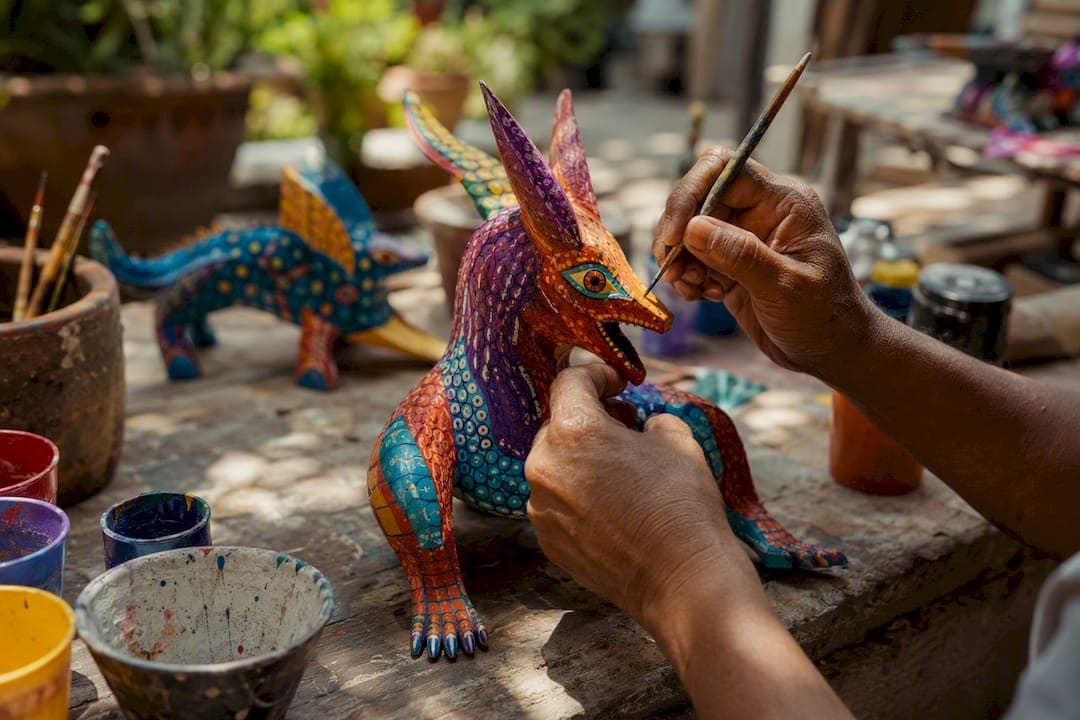
Alebrijes were invented by Pedro Linares, a cartonero (papercraft artisan) working in Mexico City in the 1930s, who first sculpted the fantastical hybrid creatures out of cartonería, a traditional dense papier-mâché. Decades later, artisans in Oaxaca adapted his surrealist vision into carved copal wood, giving the folk art form the two distinct traditions collectors know today.
Three facts explain nearly everything else you need to know about where alebrijes come from:
- Linares said the creatures first appeared to him during a feverish, dream-induced illness, chanting the word "alebrije" at him
- His original pieces used cartonería, a paper-and-paste sculpting technique he already practiced making piñatas and Judas figures
- Oaxacan woodcarvers later borrowed his designs and reimagined them in copal wood, creating the brightly painted animal figures now sold worldwide
What follows traces Linares' biography, the craft mechanics behind both traditions, how Oaxaca entered the story, and what the symbolism and market for alebrijes look like today.
Key Takeaways
Pedro Linares invented alebrijes as cartonería figures in 1930s Mexico City, and Oaxacan carvers later adapted the concept into the carved copal-wood tradition now sold worldwide.
| Point | Details |
|---|---|
| Origin is documented and specific | Pedro Linares created the first alebrijes in Mexico City in the 1930s after a fever dream. |
| Two distinct material traditions exist | Cartonería (hollow paper) and copal wood carving (solid) produce different weight, scale, and finish. |
| Oaxaca adapted, didn't originate | San Martín Tilcajete and Arrazola turned Linares' design into a wood-carving export starting in the 1960s and 1970s. |
| Symbolism layered on over time | Nahual and spirit-animal readings came after Linares' surrealist invention, not before it. |
| Authenticity has visible markers | Weight, grain, paint irregularity, and named artisan attribution separate genuine pieces from factory copies. |
Table of Contents
- What Alebrijes Look Like and the Two Craft Traditions Behind Them
- Pedro Linares: The Fever Dream That Started a Folk Art Movement
- How the Original Cartonería Alebrijes Were Built
- From Market Curiosity to Museum Piece: How Alebrijes Gained Legitimacy
- How Oaxacan Carvers Turned Alebrijes Into Wooden Art
- What Do Alebrijes Symbolize?
- Alebrijes Today: Festivals, Prices, and a Wood Supply Problem
- How to Tell an Authentic Alebrije From a Factory Copy
- Why Museums and Collectors Treat Alebrijes as Fine Art
- A Closer Look at Collecting Alebrijes Responsibly
- Frequently Asked Questions
- Sources
What Alebrijes Look Like and the Two Craft Traditions Behind Them
An alebrije is instantly recognizable by its impossible anatomy. A single figure might combine the body of a lizard, the wings of a bird, the horns of a bull, and the tail of a fish, all rendered in colors that have no basis in nature: electric blues, hot pinks, acid greens. Patterns matter as much as form. Every surface tends to be covered in dots, stripes, or crosshatching that turns the sculpture into something closer to a textile than a solid object.
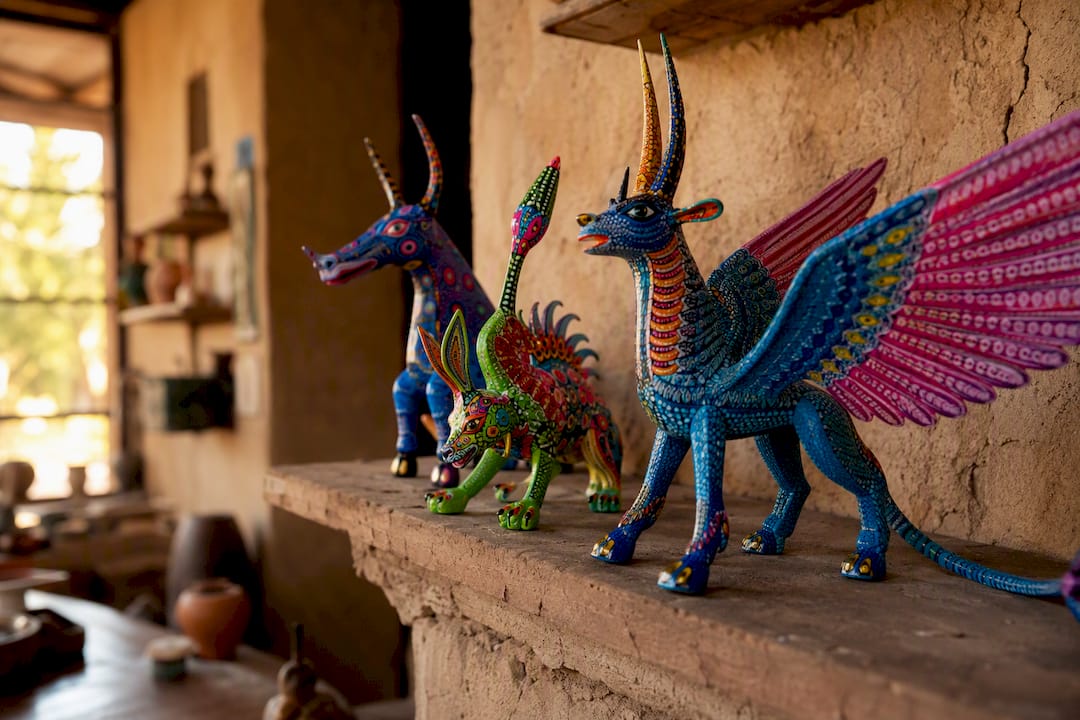
That visual density comes from two very different building processes, and understanding both helps explain why one alebrije might weigh a few ounces while another needs two hands to lift.
The first tradition, and the older one, is cartonería: cardboard and paper pulp built over a light internal frame, producing a hollow, lightweight figure. This is what Pedro Linares invented in Mexico City in the 1930s, and it's technically distinct from the looser papier-mâché many people picture. The second tradition is Oaxacan wood carving, where artisans shape solid copal wood into dense, heavier forms that hold far more surface detail per square inch.
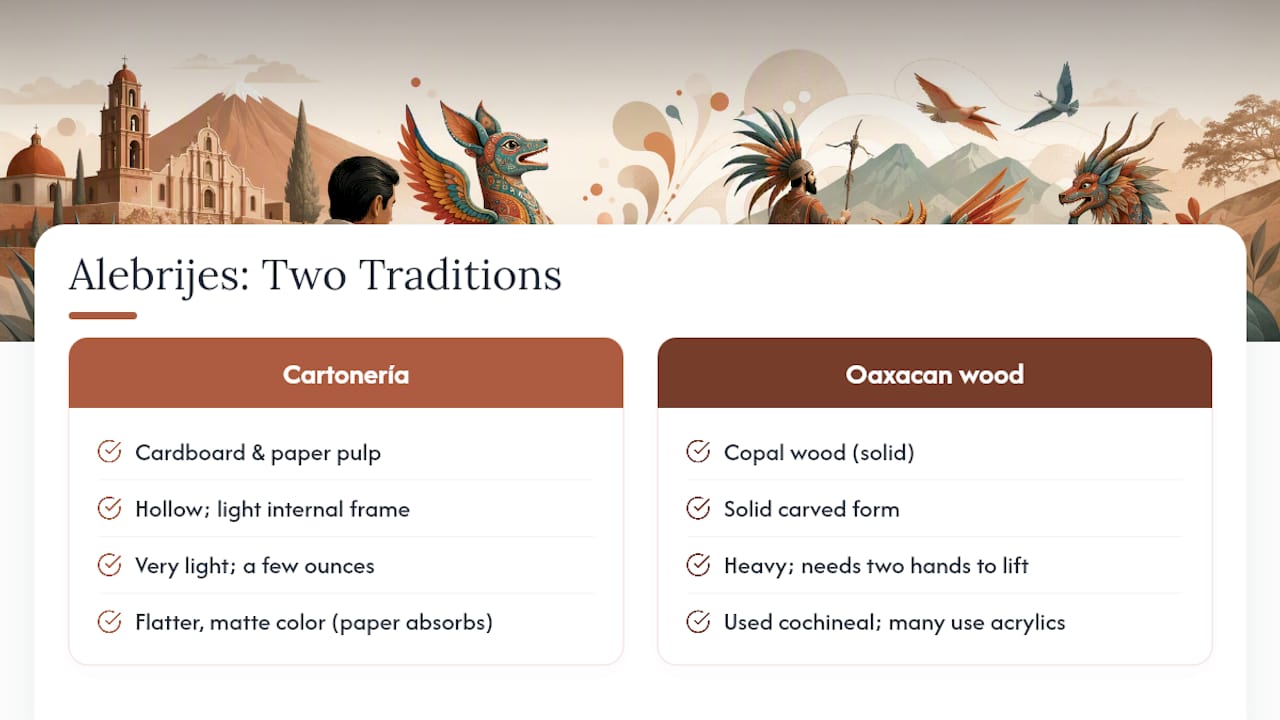
The material difference shows up in the paint, too. Oaxacan carvers have historically used natural pigments including cochineal, a dye made from a scale insect that produces deep reds, though many workshops have since shifted to more durable modern acrylics that survive shipping and handling better. Cartonería pieces, by contrast, tend to hold flatter, more matte color because the paper surface absorbs pigment differently than sanded wood.
Pedro Linares: The Fever Dream That Started a Folk Art Movement
Pedro Linares was not an artist looking to invent a new tradition. He was a working cartonero in Mexico City, building piñatas, carnival masks, and the paper-and-firecracker Judas figures burned during Holy Week processions. That trade gave him the exact skill set he'd need decades later, though he had no way of knowing it at the time.
The origin story, as Linares told it for the rest of his life, begins with a serious illness. Bedridden and running a high fever sometime in the 1930s, he slipped into a dream unlike anything he'd experienced. He described walking through a forest that turned into rock, then clouds, filled with strange creatures: a donkey with butterfly wings, a rooster with bull's horns, a lion with an eagle's head. They surrounded him, and they were chanting one word over and over.
That, according to Linares' own account, is the word's entire etymology. It meant nothing in Spanish before his dream. When he recovered, he set about recreating what he'd seen using the only technique he knew: cartonería.
A short timeline captures how the idea moved from sickbed to global folk art:
- 1930s: Linares falls ill, has the fever dream, and begins building the first cartonería alebrijes after recovering
- 1930s to 1940s: His work catches the attention of collectors and gallery owners in Mexico City, moving alebrijes out of the market stalls and into art circles
- Mid-20th century: Prominent patrons including Diego Rivera and Frida Kahlo commission and champion his pieces, lending them cultural legitimacy
- Later decades: Documentaries and museum exhibitions document his life and process, cementing the fever-dream story as the accepted origin narrative
- 1992: Pedro Linares dies, having lived to see his invention recognized as a national folk art tradition and adapted by an entirely new generation of Oaxacan carvers
Linares kept working in cartonería for the rest of his life, and his family continued the craft after him, a detail that matters because it means the Mexico City lineage of alebrijes never actually stopped. It just got overshadowed by the wooden version that came later.
How the Original Cartonería Alebrijes Were Built
Cartonería is unforgiving work, and understanding the process explains why original Linares-style pieces still command respect from collectors today. A cartonero starts by building a rough internal armature, often out of reed, wire, or wadded newspaper, that gives the final figure its basic proportions before any paper touches it.
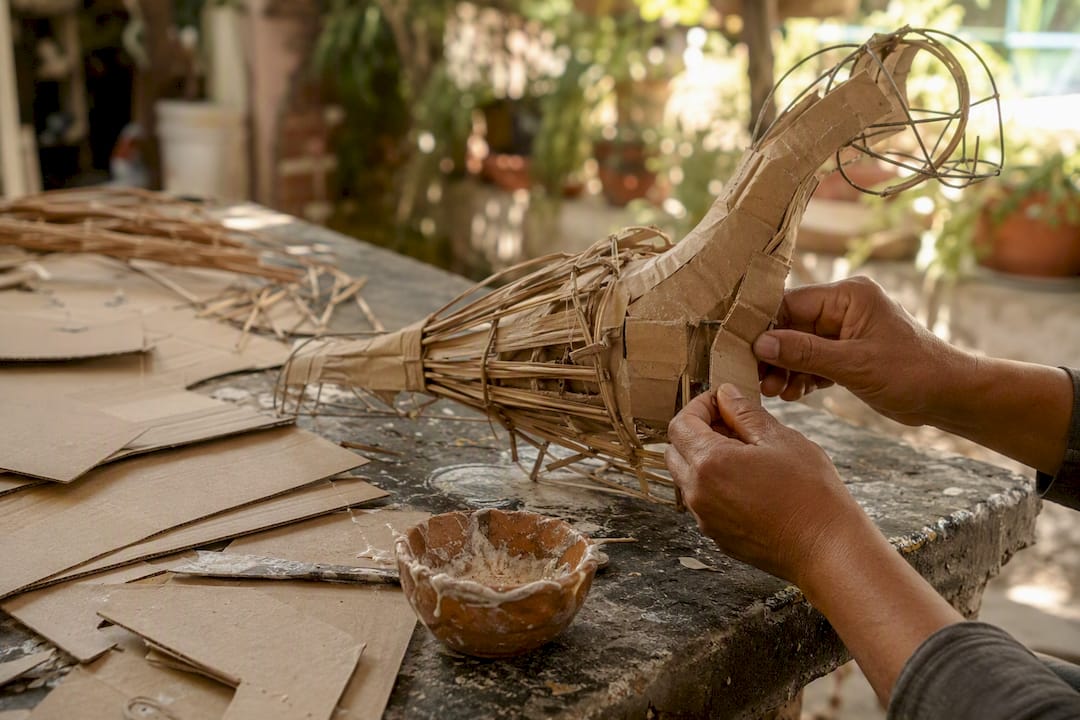
Layers of cardboard and paste come next. Linares and other cartoneros of his generation used a dense paper-and-glue technique, distinct from the thinner, softer papier-mâché many people associate with school craft projects. The layered cardboard dries into a shell strong enough to hold shape but light enough to lift with one hand, a structural logic that made these pieces easy to display, transport, and sell at Mexico City markets like La Merced.
Once the base shell dries, usually over several days depending on humidity and layer thickness, the piece gets a flat base coat. This step matters more than it sounds. Without an even undercoat, the acrylic or enamel paint applied afterward pools unevenly across the textured cardboard surface. The decorative painting is where an alebrije earns its character: the dots, scales, and stripe work that make each face unrepeatable.
Compared to their wooden cousins, cartonería alebrijes are more fragile and better suited to indoor display away from moisture. They're also generally larger in scale, since hollow paper construction lets an artisan build a dramatically sized creature without the weight a solid wood carving of the same size would demand.
From Market Curiosity to Museum Piece: How Alebrijes Gained Legitimacy
Linares' cartonería figures could easily have stayed a Mexico City novelty. What pushed them into recognized folk art status was a combination of patronage, exhibition, and public spectacle that unfolded over several decades.
- Gallery owners in Mexico City began marketing Linares' work to collectors beyond the traditional piñata and Judas-figure trade, treating the alebrijes as standalone art objects rather than craft goods
- Diego Rivera and Frida Kahlo both took interest in Linares' cartonería, and their patronage did what patronage from famous artists always does: it signaled to other collectors that this work deserved serious attention
- The Museo de Arte Popular in Mexico City later built out collections and exhibitions dedicated to cartonería and alebrijes, giving the tradition a permanent institutional home
- The annual Mexico City Alebrije Parade, which fills the streets with giant illuminated cartonería creatures, turned the craft into a recurring civic event rather than a museum artifact viewed only by specialists
Scholars studying the craft's history point out that this kind of institutional embrace happens in stages: a working artisan's output, artist patronage, museum acquisition, then public festival. Each stage widened the audience for alebrijes without changing what they fundamentally were. It's worth noting that this legitimization process ran almost entirely through Mexico City, years before Oaxaca entered the picture at all.
How Oaxacan Carvers Turned Alebrijes Into Wooden Art
The Oaxacan wood alebrije, the version most people picture when they hear the word today, didn't exist during Linares' early career at all. It emerged when woodcarvers in Oaxaca, a region with its own long tradition of carving religious and folk figures, encountered Linares' cartonería designs and adapted them to a completely different material.
The transformation followed a rough sequence that turned a Mexico City paper craft into a distinct regional wood industry:
- Design exchange: Oaxacan carvers came into contact with Linares-style cartonería figures, most likely through markets, exhibitions, or direct exposure to his growing reputation, and began reproducing the hybrid-animal concept in wood
- Village specialization: Two towns in particular, San Martín Tilcajete and Arrazola, became the central hubs of the new wood-carving tradition, with family workshops passing carving skills down through generations
- Material selection: Carvers settled on copal wood, a soft, fast-growing native tree that carves easily when fresh but hardens well after drying, making it ideal for detailed figures
- Branch-directed shaping: Rather than starting from a plain block, carvers often let a branch's natural curve or fork suggest the creature's pose, meaning the wood itself partly dictates the final form
- Drying and sanding: Freshly carved pieces dry slowly to avoid cracking, then get sanded smooth before any color touches the surface
- Base coat and detail painting: A solid undercoat goes down first, followed by the intricate dot-and-line work that has become the style's visual signature
Oaxaca's rise as an alebrije center wasn't purely organic. Research from the University of Kentucky documents that outside market demand during the 1960s and 1970s significantly accelerated adoption of the wood-carving form in these villages, turning what began as a design borrowed from Mexico City into a major export and a genuine source of rural income. Tourism did as much to shape the modern Oaxacan alebrije as artistic inspiration did.
That economic pressure also changed the paint. Early Oaxacan pieces leaned on water-based, natural pigments; over time, many workshops shifted toward more durable modern paints that hold up better to international shipping, a practical adjustment driven by the realities of selling to a global market rather than a strictly local one.
What Do Alebrijes Symbolize?
The symbolism attached to alebrijes is more layered, and more debated among scholars, than most gift shop descriptions let on. Linares' original vision was a surrealist invention, born from a fever dream, with no connection to any pre-existing indigenous belief system. That distinction matters for anyone trying to understand what the figures actually represent.
Once the tradition reached Oaxaca, though, artisans and buyers began reading the wooden figures through the lens of nahual, a Mesoamerican concept involving a person's spirit-animal counterpart. This reinterpretation happened after the fact. Scholarly analysis of the craft treats alebrijes as tools artisans use to negotiate a fragmented, modern identity rather than as objects that directly continue an ancient ritual practice. In other words, the nahual association layered onto a twentieth-century invention; it wasn't recovered from one.
Color plays into this symbolic reading as well. Oaxacan artisans often assign meaning to specific pigments: black for night and mystery, red for passion, green for the natural world, and yellow to honor the sun and corn. Whether every carver consciously applies these meanings or whether the framework developed later as a way to explain the work to buyers is genuinely unclear, and that ambiguity is worth sitting with rather than glossing over. Alebrijes are best understood as a fusion: Linares' surrealist imagination fused with Mesoamerican symbolic language that Oaxacan carvers layered on afterward.
Alebrijes Today: Festivals, Prices, and a Wood Supply Problem
Alebrijes have grown from a regional curiosity into an international commodity, and that growth has created both opportunity and strain. The Mexico City Alebrije Parade remains the highest-profile public celebration of the craft, drawing large crowds and giving cartonería makers a yearly showcase. In Oaxaca, gallery exposure and steady tourist traffic keep demand for wood carvings consistently high.
A few factors drive what a given piece costs:
- Size and complexity: A small, simply painted figure sells for far less than a large piece with dense detail work across every surface
- Material: Copal wood carvings generally carry different pricing than cartonería pieces, reflecting the labor difference between carving solid wood and building a hollow paper shell
- Artisan reputation: Work from established family workshops in San Martín Tilcajete or Arrazola commands a premium over unattributed pieces
- Pop culture visibility: Films like Coco, which featured alebrijes prominently, introduced the art form to audiences who'd never encountered it, adding another layer of demand
That demand has a downside. Copal trees have faced increased harvesting pressure as the wood-carving trade has grown, and while local reforestation and resource-management efforts exist, recovery has been slow. It's a reminder that a folk art tradition's popularity carries real consequences for the ecosystem that supplies it.
How to Tell an Authentic Alebrije From a Factory Copy
If you're buying, a few checks separate a genuine village-carved or cartonería piece from a mass-produced imitation.
- Check the weight and hollowness: A cartonería piece should feel light and hollow; a wood carving should feel solid, with visible grain running through the surface
- Look for hand-painted irregularity: Genuine detail work has small inconsistencies from one dot or line to the next; perfectly uniform patterns often signal machine or template-based painting
- Ask where it was made: A seller who can name the specific town, whether that's Mexico City cartonería or a village like San Martín Tilcajete, is generally more credible than one who says only "Mexico"
- Ask about the artisan or workshop: Family-run workshops are common in Oaxaca, and many carvers sign their work or attach a card with their name
- Watch for red flags: Suspiciously low prices for large, detailed pieces, glossy uniform factory finishes, and vague origin claims are all signs the piece likely wasn't made by an individual artisan
Why Museums and Collectors Treat Alebrijes as Fine Art
The shift from folk curiosity to collectible art wasn't accidental. Market demand during the 1960s and 1970s, documented by University of Kentucky researchers, gave Oaxacan villages an economic reason to refine technique and scale production, while museum patronage in Mexico City did the same for cartonería. Institutions don't typically build permanent collections around objects they consider disposable crafts.
That dual legitimization, market and museum, changed outcomes for artisans directly. Family workshops that once produced alebrijes as a side trade now build entire livelihoods around it, and some carvers have adjusted style choices specifically to appeal to tourist and export buyers. The craft's elevation to fine art status runs through two channels working together: institutional validation and sustained commercial demand.
A Closer Look at Collecting Alebrijes Responsibly
Handcrafted Mexican work carries a story that mass production simply can't replicate, and alebrijes are one of the clearest examples of that. What draws us to a piece like this isn't just the color or the strange, wonderful anatomy. It's knowing that a real person, working in a real family workshop, made specific decisions about form and pattern that no machine template could reproduce. That's the same respect we try to bring to every handcrafted piece we work with.
Pro Tip: When you're building a collection, prioritize provenance over price. A piece with a known artisan name or workshop attached will hold its meaning, and often its value, far better than an unattributed import.
Buying directly from artisans or through sellers who can verify a piece's origin supports the people actually keeping this tradition alive, not just the tradition itself.
If you're looking to bring that same artisan authenticity into other parts of your home, Create Decor's handcrafted pillows and accents follow the same principle: made in Mexico, by hand, with the maker's craft left visible rather than smoothed away.
Frequently Asked Questions
What is alebrijes folk art origin, in one sentence? Alebrijes originated with Pedro Linares, a cartonero who created the first hybrid-animal figures out of cartonería in Mexico City during the 1930s after a fever-dream vision.
Who created alebrijes, and why are they associated with dreams? Pedro Linares created alebrijes. He said the creatures first appeared to him during a serious illness, in a dream where hybrid animals chanted the word "alebrije" at him repeatedly.
Are alebrijes originally from Oaxaca or Mexico City? Mexico City. Linares invented the cartonería form there in the 1930s; Oaxacan carvers adapted the concept into carved copal wood decades later, which is why both traditions exist today.
What's the difference between cartonería and wood alebrijes? Cartonería alebrijes are hollow, lightweight, and built from layered cardboard and paste; wood alebrijes are solid, carved from copal wood, and generally heavier with deeper surface detail.
Do alebrijes have a connection to Aztec or Mayan mythology? Not originally. Linares' vision was a modern, surrealist invention. Oaxacan carvers later associated the figures with the Mesoamerican concept of nahual, a reinterpretation that developed after the craft form already existed.
Why did alebrijes become popular after the 1960s? Growing tourist and export demand in Oaxaca during the 1960s and 1970s turned wood carving into a major regional industry, giving artisan families a strong economic incentive to refine and scale production.
Sources
- Alebrije - Wikipedia
- Alebrijes - Creatures of a Dream World · University Libraries Digital Exhibits
- Alebrijes of Oaxaca, Mexico | University of Kentucky Research | UKnowledge
- Alebrijes explained: The meaning behind Oaxaca’s magical creatures
- Academia