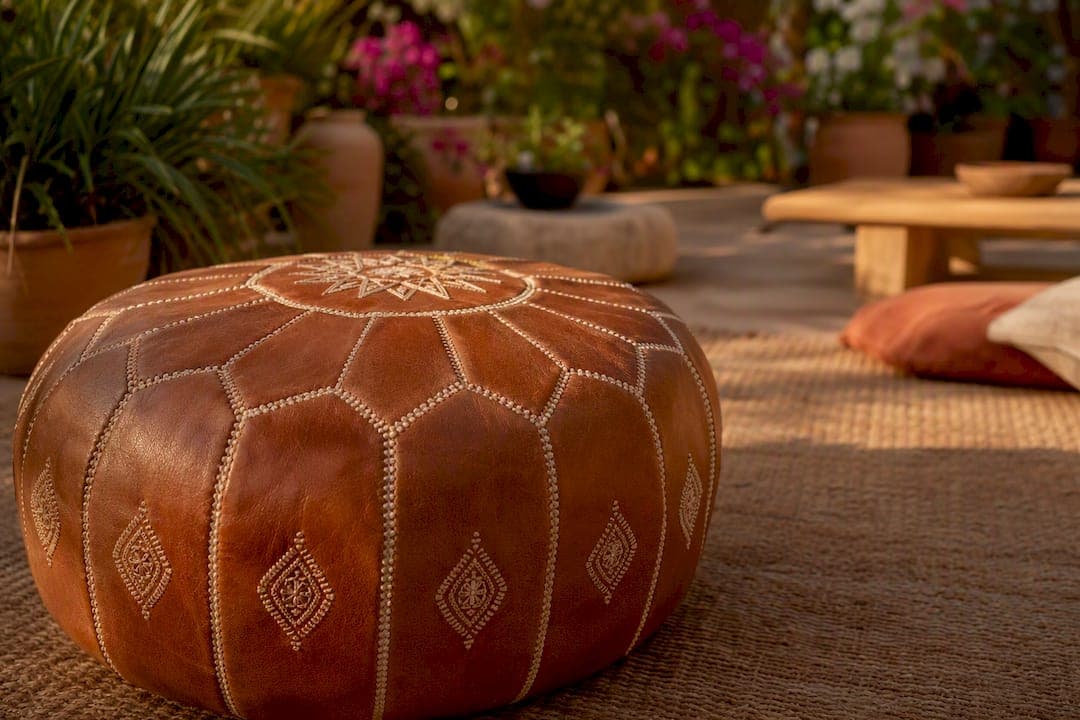
The best handcrafted ottomans share three traits: materials that will outlast a decade of daily use, joinery or stitching done by hand rather than assembled from a kit, and a shape suited to how you'll actually live with it. A solid-wood frame joined with mortise-and-tenon construction, vegetable-tanned leather stitched by hand, or a hand-woven rattan seat all signal the same thing: someone who knows the material made deliberate choices with it. Createdecorus builds its ottomans and home accents around exactly this standard, using traditional Mexican craftsmanship rather than mass-produced shortcuts.
This guide walks through the major categories of artisan ottomans, what separates genuine craftsmanship from a convincing imitation, and a compact checklist you can use before buying.
- Materials: solid wood, vegetable-tanned leather, handwoven natural fiber
- Construction: hand-stitching, mortise-and-tenon joinery, reinforced seams
- Use-case fit: footrest, extra seating, or coffee-table substitute, sized to your space
Key Takeaways
The best handcrafted ottomans combine solid materials, visible hand-construction, and a shape matched to real use, not marketing language alone.
| Point | Details |
|---|---|
| Check the frame first | Solid wood joined with mortise-and-tenon construction outlasts plywood and staple assembly. |
| Verify leather type | Vegetable-tanned leather develops patina and lasts longer than bonded or heavily processed leather. |
| Ask about fill | Natural latex and down-wrapped fill resist sagging far better than standard polyurethane foam. |
| Expect longer lead times | Made-to-order artisan pieces often take weeks to months to produce and ship. |
| Consider Createdecorus | Createdecorus offers handcrafted, made-in-Mexico ottomans and accents with custom orders and trade pricing available. |
Table of Contents
- 1. Moroccan Leather Pouf
- 2. Solid-Wood Framed Upholstered Ottoman
- 3. Tufted Upholstered Ottoman With Natural Fill
- 4. Woven Rattan Ottoman
- 5. Low-Floor Pouf or Textile-Wrapped Ottoman
- Building a Buying Checklist Before You Buy an Artisan Ottoman
- Why Materials and Traditional Construction Actually Matter
- Keeping an Artisan Ottoman Looking Its Best for Years
- Createdecorus and What Our Ottomans Bring to This Standard
- The Ottoman's Long History as a Cultural Object
- Sustainability and Ethics Behind Handmade Ottoman Production
- What Actually Drives the Price of a Handcrafted Ottoman
- Where to Find Genuine Artisan Ottomans
- Sources
1. Moroccan Leather Pouf
The Moroccan leather pouf remains one of the most recognizable handcrafted ottoman styles, built from goat leather with hand-stitched panels and often finished with embroidered detailing. Genuine pieces show visible needle marks along the seams, a slightly uneven dye finish that comes from vegetable tanning, and a supple texture rather than the stiff, plastic-like feel of bonded leather. Marketplace listings for these poufs frequently note that they ship without their fill, a practical choice that keeps shipping costs down and lets you pack the shape yourself once it arrives.
These poufs work best in bohemian or eclectic interiors where you want flexible, movable seating rather than a fixed anchor piece. Keep scale in mind: a pouf under 16 inches tall tends to disappear next to a standard sofa, while an 18 to 20 inch pouf reads as an intentional low seat or footrest.
2. Solid-Wood Framed Upholstered Ottoman
A wood-framed ottoman is built to stay in your living room for a generation, not a few seasons. Look for a solid hardwood frame, beech, walnut, oak, or ash are common, joined with mortise-and-tenon construction rather than staples and glue. Ondarreta's beech-framed ottoman is a good reference point for what a properly specified product listing should include: named wood species, upholstery choices, and a stated production lead time. Studios like Studio Noorderfabriek go further, offering the same design in multiple wood species, oak, walnut, maple, treating the wood choice itself as a meaningful design decision rather than an afterthought.
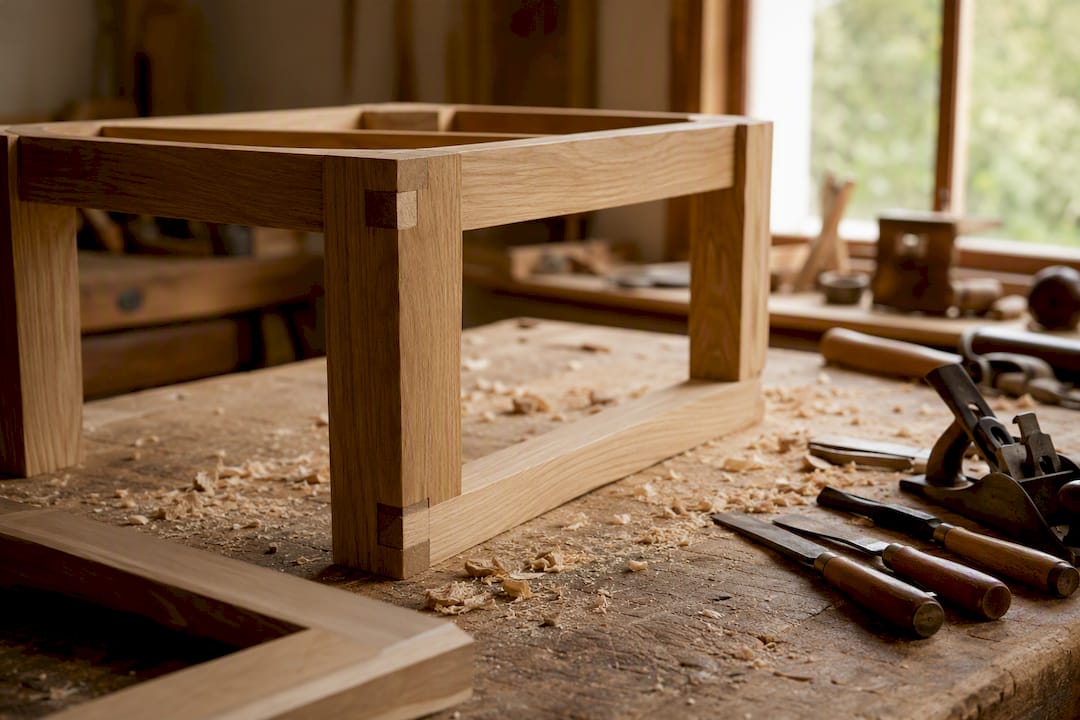
This category is your best pick if you want an ottoman that doubles as a coffee table or anchors a seating arrangement for years. Check that the legs are substantial enough for the top's dimensions. A wide upholstered top on thin, spindly legs is one of the fastest tells of a cost-cut design.
Pro Tip: Ask the maker for a photo of the unfinished frame before upholstery goes on. A confident artisan workshop will have this on hand, and it tells you more about longevity than any marketing description.
3. Tufted Upholstered Ottoman With Natural Fill
Hand-tufting, the diamond or button pattern you see pulled taut across an ottoman's top, is done by hand-guiding thread through the padding at each intersection point. Machine-tufted knockoffs exist, but they tend to look flatter and less crisp at the button depressions. What separates an artisan version further is the fill: natural latex or down-wrapped foam holds its shape and bounce far longer than commodity polyurethane, which compresses and goes flat within a couple of years of regular use. A removable, zippered cover, ideally with a quality closure like YKK, means you can actually clean or replace the cover without discarding the whole piece.
This style suits formal living rooms and spaces where the ottoman functions as a visual centerpiece rather than a workhorse. Pair a larger tufted ottoman with substantial furniture, a slim mid-century sofa will look mismatched next to a heavily tufted, oversized piece.
4. Woven Rattan Ottoman
Hand-woven cane or rattan ottomans bring texture and warmth that upholstered pieces can't replicate. The tell of genuine hand-weaving is irregularity: slightly varied spacing between strands, natural color variation across the cane, and visible knots where the weaver tied off a new length of material. A rattan piece that looks perfectly uniform, with identical spacing throughout, was likely machine-woven or molded from synthetic resin rather than hand-worked cane.
Rattan ottomans fit naturally in sunrooms, coastal interiors, and any space leaning toward organic, textured decor. Because rattan is lighter than upholstered wood frames, size up slightly if you want the piece to feel substantial rather than incidental in the room.
5. Low-Floor Pouf or Textile-Wrapped Ottoman
This category covers ottomans built around a soft, low profile and wrapped in hand-embroidered or vintage textiles, think kilim-covered ottomans or pieces using huipil or other traditional embroidered cloth. The fill tends to be softer, sometimes a blend of cotton batting and foam, prioritizing casual comfort over structured support. Authentic pieces show slight asymmetry in the embroidery pattern and construction seams that echo the textile's original use, a repurposed rug or garment panel rather than fabric printed to imitate one.
These work well as flexible, layered seating: stack two together, tuck one under a console, or use several as casual floor seating for gatherings. Because they read as soft and informal, keep them out of spaces where you need a stable surface for setting down drinks or trays.
Building a Buying Checklist Before You Buy an Artisan Ottoman
Knowing the categories only gets you halfway. The other half is knowing what questions to ask before you commit to a purchase, especially for higher-priced, made-to-order pieces where you can't physically inspect the item first.
Start with materials. Solid wood species (ash, beech, walnut) outperform engineered composites for longevity, and vegetable-tanned leather ages into a richer patina than chrome-tanned or bonded leather, which tends to crack or peel within a few years. For woven pieces, ask whether the material is natural rattan or a synthetic substitute, both have their place, but they carry very different price points and durability profiles.
Construction is where the real quality gap shows up:
- Mortise-and-tenon or dovetail joinery instead of staples, brackets, or glue-only assembly
- Reinforced seams and structural lining inside upholstered pieces, not just on visible surfaces
- Quality zippers, YKK is the recognized standard, on any removable cover
- A cover that actually is removable, which matters enormously for long-term cleaning and durability
Fill choice affects how the ottoman feels under actual daily use. Natural latex resists compression and holds its shape for years; down-wrapped foam gives a plush initial feel but requires occasional re-fluffing; high-density foam sits in between, offering firm support at a lower cost than latex. A worthwhile note from artisan sourcing practice: natural fills like latex and wool tend to hold their loft substantially longer than commodity polyurethane foam, which is why higher-end pieces lean toward them despite the added cost.
Sizing matters more than most buyers expect. For a footrest, aim for a height roughly 2 inches below your seating surface. For a coffee-table substitute, match the height of your sofa's arm or slightly below it, and leave at least 14 inches of walking clearance around it.
Before buying, ask the maker three direct questions: What is the frame made of? Is the cover removable and washable? What fill is used, and does it carry any warranty? A workshop that answers clearly and specifically, rather than with vague marketing language, is generally one worth trusting with a larger order.
One logistics tip worth knowing: many artisan sellers, particularly for leather poufs, ship the piece without its fill to cut shipping costs and reduce package volume. This isn't a shortcut. It's a deliberate practice that lets you customize firmness once the piece arrives, and it often lowers your total cost meaningfully compared to shipping a fully stuffed piece internationally.
Why Materials and Traditional Construction Actually Matter
A plywood frame assembled with staples and glue can look identical to a solid-wood, joined frame in a product photo. The difference shows up after 18 months of use, when the plywood piece starts to wobble or crack at stress points while a properly joined frame holds tight. Traditional joinery methods distribute weight and stress across interlocking wood, not adhesive, which is why mortise-and-tenon and dovetail construction have survived centuries of furniture-making largely unchanged.
Leather tells its own story if you know what to look for. Vegetable-tanned leather develops a warm, deepening patina over years of use and shows subtle grain variation from hide to hide. Heavily processed or bonded leather, by contrast, often has an unnaturally uniform surface and starts to peel or flake within a few years, especially with regular sun exposure.
Textile signals matter just as much on woven or embroidered pieces:
- Hand-embroidery shows slight irregularities in stitch spacing and tension
- Vintage or repurposed textiles carry visible signs of their prior use, a faded section, an old repair
- Tighter weave density in woven fabrics generally means better resistance to wear and pilling
Fill materials round out the durability picture. Natural latex resists sagging far longer than standard foam. Down-wrapped cores feel plush immediately but need occasional maintenance. Wool batting, though less common, offers natural resilience and breathability that synthetic fill can't match. When comparing specs, ask sellers directly about internal lining and stitching, reinforced lining and double-stitched seams are the two easiest indicators of a piece built to be used hard, not just displayed. If you want a deeper look at what separates authentic craftsmanship from a convincing copy, Createdecorus's guide on spotting handwork quality walks through the visual and tactile cues in more detail.
Keeping an Artisan Ottoman Looking Its Best for Years
Care routines differ by material, so match your approach to what the piece is actually made of.
- Respond to spills immediately. Blot leather with a dry cloth, then apply a leather conditioner once it's dry. Blot textile surfaces rather than rubbing, which pushes stains deeper into the weave.
- Condition leather periodically. Every six to twelve months, depending on climate, is a reasonable interval for keeping vegetable-tanned leather supple and preventing cracking.
- Vacuum woven surfaces gently using a low-suction attachment, and rotate poufs or cushions every few weeks so wear distributes evenly.
- Watch sunlight and humidity. Direct sun fades leather and textiles unevenly, while high humidity can warp solid-wood frames over time, so keep pieces a few feet from direct window exposure where possible.
- Know when to call in a repair. If fill has flattened significantly or a seam has given way, a maker who works in natural materials can usually reupholster or restuff the piece rather than requiring a full replacement.
Pro Tip: Keep the original care instructions or maker contact info filed away. Reupholstery and re-stuffing are far more affordable than most buyers assume, and a piece with a solid wood frame can outlast two or three cover changes.
Createdecorus and What Our Ottomans Bring to This Standard
Every category above reflects the standard Createdecorus builds toward with its handcrafted home accents, made in Mexico using artisan-inspired textiles, sustainable production practices, and premium fill options including memory foam and polyester blends chosen for comfort and resilience. Our pieces are vacuum-compressed for shipping, which keeps freight costs down without compromising the finished shape once unpacked at home.
- Custom orders available for buyers who want specific dimensions, textiles, or fill firmness
- A trade program for interior designers and boutiques sourcing at volume
- Traditional Mexican artistry applied to each accent piece, not just decorative pillows
If you want to see how these principles translate into finished pieces, our guide to choosing luxury ottomans walks through specific buying scenarios, and our handwork authenticity guide goes deeper into the visual cues covered above.
The Ottoman's Long History as a Cultural Object
Ottomans trace their lineage to the low, footstool-like seating found across the historical Ottoman Empire, where cushioned platforms and floor seating shaped how households furnished a room long before the Western upholstered version existed. The form traveled through European decorating trends in the 18th and 19th centuries, where it was adapted into the tufted, upholstered piece most people picture today.
In Morocco and across North Africa, the leather pouf carries its own distinct lineage, tied to nomadic and Berber craft traditions where portable, stackable seating made practical sense for households that moved with the seasons. The embroidery patterns found on many poufs and textile ottomans aren't arbitrary decoration. They often carry regional or familial motifs passed down through generations of makers.
In Mexico, textile and leatherwork traditions bring their own layered history to ottoman-style pieces, drawing on techniques and motifs that predate industrial furniture-making by centuries. An ottoman built with hand-tooled leather or a woven textile isn't just a functional piece. It's a small, livable artifact of craft traditions that have been refined and passed down far longer than most furniture styles on the market today. Choosing a handcrafted piece over a mass-produced one is, in a small way, choosing to keep that lineage active rather than letting it fade into a purely decorative footnote.
Sustainability and Ethics Behind Handmade Ottoman Production
Handcrafted ottomans generally carry a lighter environmental footprint than mass-manufactured furniture, largely because artisan workshops produce in smaller batches, use natural materials that biodegrade rather than synthetic composites, and rely on hand labor instead of energy-intensive industrial assembly lines. Solid wood sourced responsibly, natural latex, wool fill, and vegetable-tanned leather all break down far more gently at end of life than polyurethane foam or PVC-based synthetic leather.
The ethical dimension matters just as much as the environmental one. Artisan production, done well, supports skilled makers directly rather than routing profit through several layers of distributors and factories. It also tends to preserve techniques, embroidery patterns, tanning methods, weaving styles, that would otherwise fade as mass production replaces hand skill with machine output.
That said, "handmade" alone isn't an ethics guarantee. Ask where the workshop is located, whether makers are paid fairly for the hours a piece actually takes, and whether materials are sourced responsibly, sustainably harvested wood, or leather from tanneries that manage water and chemical runoff responsibly. A maker or brand that can answer these questions specifically, rather than leaning on the word "artisan" as a marketing label, is generally the more trustworthy source. Createdecorus builds its production around sustainable practices and traditional Mexican craftsmanship for exactly this reason: authenticity has to be verifiable, not just claimed.
What Actually Drives the Price of a Handcrafted Ottoman
Handcrafted ottoman prices vary widely, and the spread usually comes down to a handful of specific factors rather than random markup. Smaller, simpler pieces like a basic leather pouf sit at the lower end of the range, while larger, wood-framed, custom-upholstered ottomans command significantly more. Global artisan marketplaces show this spread clearly. A smaller Peruvian leather-and-wood ottoman sits well below the cost of a large, made-to-order, wood-framed piece from a design studio offering multiple wood species and custom upholstery.
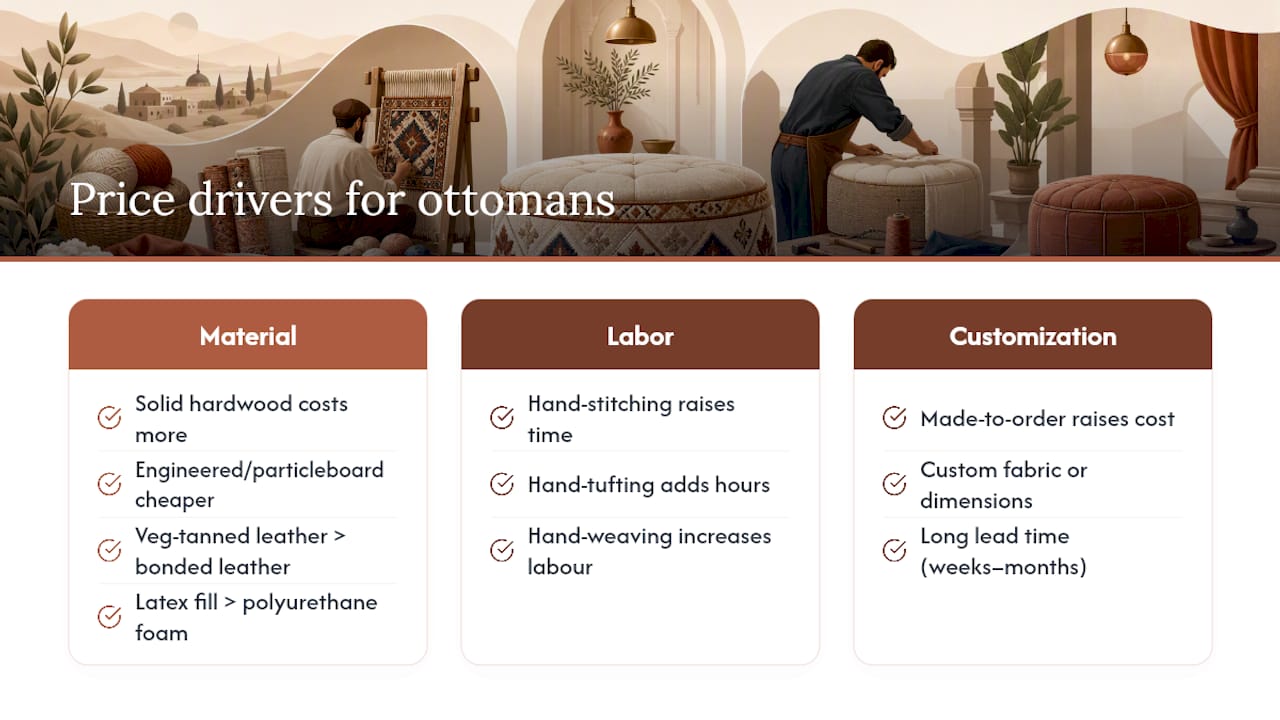
Material choice is the biggest single driver. Solid hardwood costs more than engineered wood or particleboard, vegetable-tanned leather costs more than bonded leather, and natural latex fill costs considerably more than standard polyurethane foam. Labor is the second driver: hand-stitching, hand-tufting, and hand-weaving simply take longer than machine assembly, and that time gets reflected in the price.
Customization adds another layer. A made-to-order piece in a specific fabric, dimension, or wood species costs more than a stocked, standard-size item, partly because of the materials involved and partly because of the extended production lead time, often weeks to months, that comes with genuine made-to-order craftsmanship. If you see a "handcrafted" ottoman priced identically to a mass-produced big-box option, that's usually a signal worth questioning rather than a bargain worth celebrating.
Where to Find Genuine Artisan Ottomans
Authentic handcrafted ottomans show up in a few reliable places, each with different tradeoffs. Local artisan markets and craft fairs let you inspect materials and construction directly before buying, which is the most reliable way to judge quality firsthand, but selection is limited to whatever makers happen to be present that day.
Direct workshop relationships, buying straight from a maker or small studio, tend to offer the best transparency about materials and construction, since you can ask detailed questions and sometimes request custom specifications. This route usually means longer wait times but a piece built specifically to your space.
Online platforms fill the gap between those two options. Marketplaces like Etsy's Mexican storefronts list handcrafted wooden ottomans with descriptions aimed at Spanish-speaking buyers, giving you a sense of typical pricing and presentation, though listing quality and seller reliability vary considerably from shop to shop. Direct-to-consumer brands that manufacture their own pieces, rather than reselling from third-party makers, tend to offer more consistent quality control since they oversee production from material sourcing through final assembly. That consistency is one of the clearer advantages of buying from a brand that makes its own pieces rather than a marketplace aggregating many small sellers.
Curator's Note: Choosing Pieces That Age Well
The pieces that hold up best in my experience reviewing artisan furniture aren't always the most ornate. They're the ones where the maker chose honest materials and let the joinery or stitching do the talking instead of hiding it under trend-driven design.
Pro Tip: When styling, pair a heavily textured ottoman, rattan or embroidered textile, with a smooth-surfaced sofa. Mixing textures at different scales reads as intentional; matching everything in the same material flattens the room.
— Ernesto
Bring One Home Through Createdecorus
If the categories above have you picturing a specific spot in your living room, Createdecorus makes that easy without the guesswork of an unfamiliar marketplace listing. Every piece is handcrafted in Mexico using artisan-inspired textiles and premium fill, and you can either shop what's currently available or request a custom order sized to your space.
Browse the full range on our shop page, or start at our main site to explore the full collection and request a custom piece. Interior designers and boutiques can apply for trade pricing through our wholesale program. Every order ships vacuum-compressed to keep freight costs reasonable, and custom requests are welcome for buyers who want a specific textile, wood tone, or fill firmness.
Sources
- Otomán en madera de haya Lana Ondarreta | Mobel 6000 | Seismil Studio
- Puf otomano de cuero bordado a mano | Diseño marroquí — Ankorstore
- Otomana de madera artesanal — Etsy Mexico (search results)