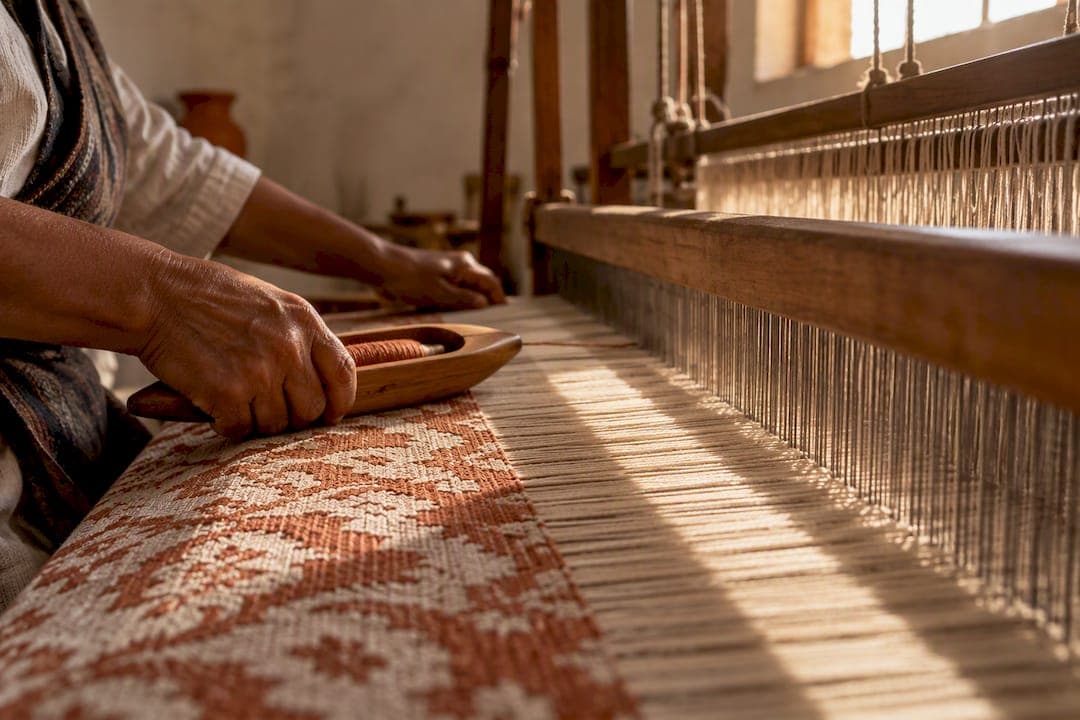
Jacquard is a weaving mechanism that creates patterns woven directly into cloth, not a fiber or a printed design. The technique lets a loom lift individual warp threads in precise sequences, so the motif becomes part of the fabric's structure and often shows, sometimes inverted, on the reverse side. It works across silk, cotton, wool, and countless blends. The mechanism traces back to Joseph-Marie Jacquard in the early 1800s, and that origin explains why so many patterned textiles carry his name today.
TL;DR:
- Jacquard weaving uses punched cards or digital files to control individual warp threads, enabling complex patterns woven directly into fabrics like silk, cotton, or wool.
- The pattern is woven into the fabric's structure, creating textured relief and often a reversible design, distinguishing it from printed textiles.
- Durability and resistance to fading depend on fiber type and weave density; high rub-resistance ratings are recommended for upholstery applications.
- Authentic jacquard fabric can be identified by checking for a reverse pattern on the back, textured feel, and presence of floats or metallic threads.
- Prices vary based on fiber, pattern complexity, and finishing, making swatch samples essential for accurate evaluation before purchase.
Table of Contents
- The early history of Joseph-Marie Jacquard's loom
- How the Jacquard mechanism controls every thread
- How to tell jacquard apart from brocade, damask, and prints
- Fabric characteristics across different fibers
- Where jacquard fabric works best in decor and apparel
- What to check before you buy jacquard fabric
- Jacquard-inspired craftsmanship in handcrafted home accents
- A textile technique worth understanding before you shop
- Bring jacquard-inspired texture into your own home
- Where to learn more about jacquard weaving
- Sources
- FAQ
The early history of Joseph-Marie Jacquard's loom
Joseph-Marie Jacquard demonstrated his improved drawloom in 1801, building on decades of experimentation by Lyon weavers who had already introduced mechanical aids like the semple and other removable pattern devices, according to the Met's history of European silk production. Those earlier tools laid the groundwork, but Jacquard's punched-card attachment, patented in the early 1800s, changed the scale of what a single weaver could produce.
The adoption curve moved fast for the era. Within a decade, patterned weaving shifted from a slow, hand-guided craft to something closer to industrial production.
- Jacquard demonstrated his drawloom improvements in 1801.
- He patented the punched-card mechanism in the early 1800s.
- By 1812, there were 11,000 Jacquard looms operating in France, according to engineering history from the University of Houston.
The loom reduced the labor once required to weave elaborate motifs, freeing weavers from manually tracking every thread lift and making complex designs commercially viable rather than reserved for the wealthiest patrons.
How the Jacquard mechanism controls every thread
The original system relied on a chain of punched cards, one card for each pass of the weft. Holes punched into a card told the loom which warp threads to raise and which to leave down, and stringing dozens or hundreds of cards together let a weaver repeat an entire design automatically. According to the Wikipedia entry on the Jacquard machine, this per-thread control is what separated Jacquard weaving from simpler looms that could only alternate threads in fixed, repetitive patterns.
- Each card corresponded to one row of the finished design.
- A hole meant a warp thread lifted; no hole meant it stayed down.
- Chaining cards together let the loom reproduce long, intricate motifs without a weaver recalculating each pass.
Modern mills have replaced punched cards with digital pattern files, according to the same Wikipedia overview of the mechanism's evolution, which means designers can swap a motif in minutes instead of rethreading physical cards. That shift makes short production runs and custom, one-off patterns far more practical than they were even a few decades ago.
The lineage matters beyond textiles. Jacquard's punched-card logic is often cited as an early influence on later punched-card computing systems, a connection worth noting cautiously rather than overstating, since the loom itself was never a computer.
How to tell jacquard apart from brocade, damask, and prints
Jacquard describes the weaving method itself, not a single fabric. Brocade and damask are both jacquard-woven fabrics with their own distinct looks: brocade uses supplementary weft threads to raise the motif above the base cloth, while damask relies on contrasting weave structures within the same yarn, which is why damask often looks reversible while brocade does not.
Telling a woven jacquard from a printed imitation takes only a few checks:
- Flip the fabric over. A true jacquard shows the pattern, often in reverse or muted tones, on the back; a printed pattern sits flat on one side only.
- Feel for texture. Woven motifs create subtle relief you can trace with a fingertip, while prints stay perfectly smooth.
- Look for floats or metallic threads. Loose threads that skip across sections, or metallic yarns woven into the design, point to a jacquard construction rather than a print.
- Check the edges of the motif. Printed designs often have crisp, uniform edges from the printing process, while woven patterns show slight, organic thread transitions.
According to a fabric guide comparing jacquard, brocade, and damask, this confusion is common enough among shoppers that clarifying it upfront saves a lot of buyer's remorse.
Fabric characteristics across different fibers
Jacquard adapts to nearly any fiber, which is part of why it shows up in so many different products. Silk jacquard drapes with a soft sheen suited to eveningwear, cotton jacquard holds its shape for upholstery, and wool jacquard adds warmth and body to heavier goods. Viscose and polyester blends bring cost efficiency and easier care, while metallic yarns woven into a jacquard base add shimmer without a printed finish.
- Silk: lightweight, lustrous, best for garments and decorative accents.
- Cotton: sturdy, breathable, common in upholstery and cushions.
- Wool: warm, textured, suited to heavier home goods.
- Viscose and polyester blends: budget-friendly, easier to clean.
- Metallic yarn accents: add shine without sacrificing the woven structure.
Because the pattern is built into the weave rather than applied afterward, jacquard resists fading in ways a printed fabric cannot match. Rub-resistance ratings, often measured on the Martindale scale for upholstery fabrics, give a useful benchmark for how a jacquard will hold up under regular use, and buyers furnishing high-touch pieces should ask for that number before committing to a yardage.
Pro Tip: Hold a swatch up to a window. If the light passes through unevenly along the pattern lines, you're looking at a genuine woven jacquard rather than a printed surface.

Where jacquard fabric works best in decor and apparel
Jacquard earns its place on pieces that get touched, sat on, or seen up close every day. Upholstery, decorative pillows, drapery, and patterned wallcoverings all benefit from a motif that will not crack, peel, or fade the way a printed surface eventually does. In apparel, structured garments and eveningwear rely on jacquard's body and drape to hold a silhouette that flatter fabrics cannot.
- Upholstery and cushions: cotton or cotton-blend jacquard for durability under regular contact.
- Drapery and wallcoverings: silk or viscose jacquard for a refined, light-catching finish.
- Structured apparel: silk or wool jacquard where the fabric needs to hold its own shape.
Choosing the integrated woven pattern over a printed one matters most on surfaces that see friction and sunlight, since the design lives inside the yarn rather than on top of it.
What to check before you buy jacquard fabric
Buying jacquard well means asking a few pointed questions before the fabric arrives at your door.
- Request a swatch first. A small sample lets you check hand, weight, and color accuracy against your space, a step covered in more depth in this guide to ordering and evaluating fabric swatches.
- Confirm fiber content. Blend ratios affect cleaning method, stretch, and long-term wear.
- Ask for a Martindale rating on upholstery pieces. Higher numbers generally mean better resistance to abrasion over years of use, a detail explored further in this breakdown of cushion fabrics and rub tests.
- Check backing and lining on upholstery weight fabric. A stable backing helps the weave hold its pattern under tension.
Price tends to track fiber quality, weave complexity, pattern repeat size, and finishing treatments, so a densely patterned silk jacquard will always cost more than a simple cotton blend. Wash care depends entirely on fiber: cotton and polyester blends often tolerate machine washing on gentle cycles, while silk and wool jacquard usually call for professional cleaning, especially on upholstery-weight pieces. A colorfastness test on an inconspicuous corner before deep cleaning any jacquard piece saves a lot of disappointment.
Pro Tip: Keep leftover swatches labeled by room. A pattern that looks perfect under showroom lighting can read completely differently once it's on your own cushions at home.
Jacquard-inspired craftsmanship in handcrafted home accents
We work with richly textured weaves that draw on the same principle jacquard perfected: letting the pattern live inside the cloth rather than sit on top of it. Decorative pillows and accents handcrafted using artisan traditions carry the texture and depth that woven patterning brings to a room.
- Handcrafted construction preserves the tactile quality that woven patterns are known for.
- Wholesale programs may serve interior designers and boutiques seeking these textures at scale.
- Ordering a swatch first helps judge scale: a bold, large-repeat motif often reads better on an oversized cushion than a small one.
A textile technique worth understanding before you shop
Jacquard rewards a little patience. The pattern woven into a piece will almost always outlast a printed equivalent, and once you know how to check for that reverse-side motif, you'll never mistake a flat print for the real thing again. I always flip a fabric over before I buy it, a habit that has saved me from more than one disappointing purchase.
— Ernesto
Bring jacquard-inspired texture into your own home
Create Decorus offers decorative pillows, wall art, and rugs that bring the same woven depth and cultural craftsmanship discussed throughout this piece into everyday spaces. Each piece is handcrafted with the kind of attention to texture and pattern that distinguishes a woven design from a flat one, whether you're drawn to bold jacquard-style motifs or subtler woven textures.
If you want to feel the difference before you decide, browse our decorative pillow collection or explore the animal print pillow collection for a bolder statement piece. Designers and retailers furnishing multiple spaces can request pricing through our wholesale trade program.
Where to learn more about jacquard weaving
- University of Houston, Engines of Our Ingenuity: the loom's invention and adoption timeline.
- Wikipedia, Jacquard machine: the punched-card mechanism explained.
- The Met, Textile Production in Europe: Silk: the Lyon innovations that preceded Jacquard.
- Cambridge Dictionary: the standard definition of the term.
Sources
- Jacquard and the punched card loom (University of Houston Engines of Our Ingenuity)
- Jacquard machine — Wikipedia
- Textile Production in Europe: Silk, 1600–1800 — The Met
- Cambridge Dictionary — jacquard
FAQ
¿Qué tipo de tela es la jacquard?
Jacquard is not a single type of fabric but a weaving method that can be applied to silk, cotton, wool, viscose, and various blends. The technique produces patterned textiles like brocade and damask, so "jacquard fabric" really means any cloth woven on a Jacquard mechanism, according to the Cambridge Dictionary's definition.
¿Qué tan buena es la tela jacquard?
Jacquard fabric tends to hold up well over time because the pattern is woven into the structure rather than printed on the surface, which means it resists fading and cracking better than printed alternatives. Durability still depends on the fiber used and the weave's density, so checking a Martindale rating on upholstery-weight jacquard gives a clearer sense of how it will wear.
¿Qué son las telas tipo jacquard?
Jacquard-type fabrics are textiles woven on a Jacquard loom or its modern digital equivalent, where individual warp threads are controlled to build a motif directly into the cloth. Brocade and damask are the two most recognized examples, each distinguished by how the supplementary threads or weave contrast create the visible pattern.
¿Cuál es el precio de la tela jacquard?
Jacquard fabric pricing varies by fiber content, weave complexity, pattern repeat size, and finishing, so a densely patterned silk jacquard will cost considerably more than a simple cotton blend. There is no single fixed price across the market, so requesting a swatch and quote directly from a supplier remains the most reliable way to know what a specific jacquard will cost.