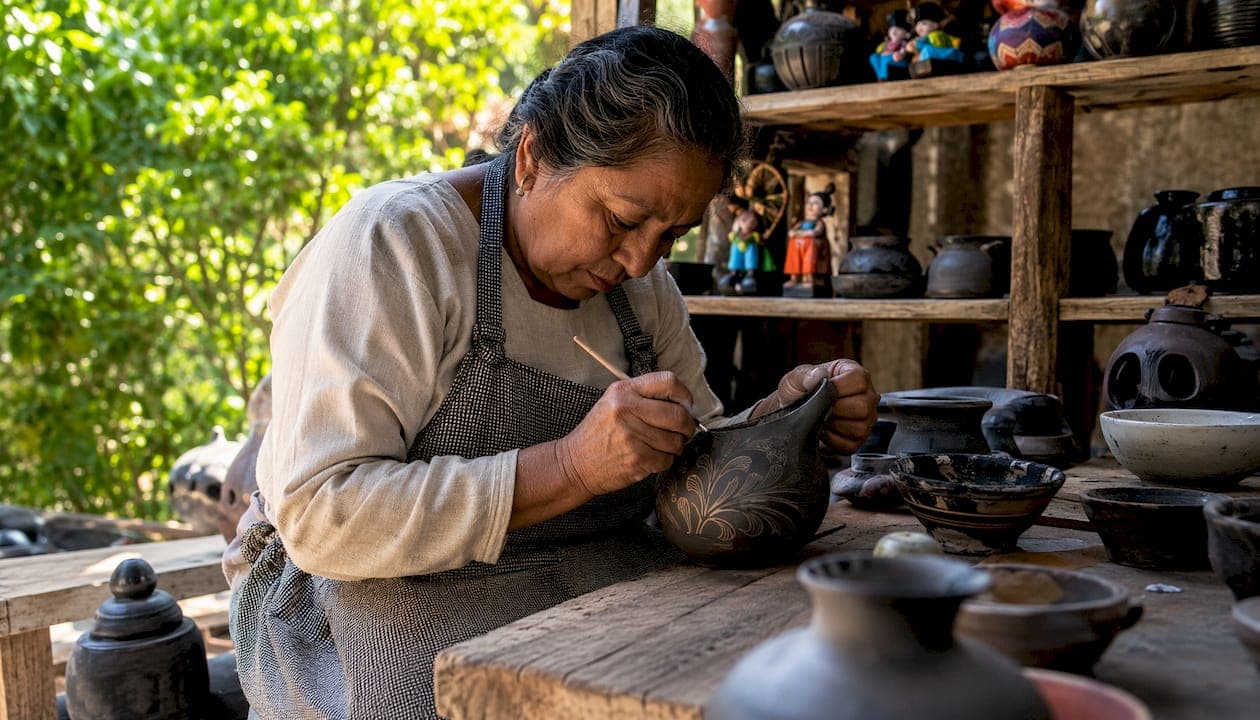
Mexico's most celebrated regions for traditional handcrafts are Oaxaca, Michoacán, the State of Mexico, Guerrero, and the silver city of Taxco. Each carries a distinct artisan identity shaped by centuries of indigenous knowledge, colonial exchange, and community pride. Here is a quick orientation before we go deeper:
- Oaxaca holds the highest concentration of artisans in all of Mexico, particularly in the Central Valleys, producing barro negro pottery, Zapotec textiles, and painted alebrijes wood carvings.
- Michoacán organizes its craft output by region, with the Lacustre zone around Lake Pátzcuaro offering lacquerware, embroidery, and guitar making, while Santa Clara del Cobre sustains a copper tradition dating to 600 AD.
- State of Mexico is anchored by Metepec, home to over 300 artisans who produce the iconic "Tree of Life" ceramic sculptures, now legally protected by a denominación de origen.
- Guerrero blends pre-Hispanic pottery, amate bark painting, lacquerware from Olinalá, and the world-renowned silverwork of Taxco.
- Jalisco, Durango, and Nayarit are home to the Huichol people, whose intricate beadwork and yarn paintings carry deep spiritual symbolism rooted in indigenous cosmology.
These regions are not just geographic labels. They are living workshops where craft traditions pass from grandparent to grandchild, where a single village can define a global aesthetic.
What craft types define Mexico's main artisan regions?
Mexico's regional handcrafts are far more specific than the broad categories of "pottery" or "textiles" suggest. Each tradition carries a technique, a material, and often a single town that owns it.
Pottery: barro negro, punteado, and the Tree of Life
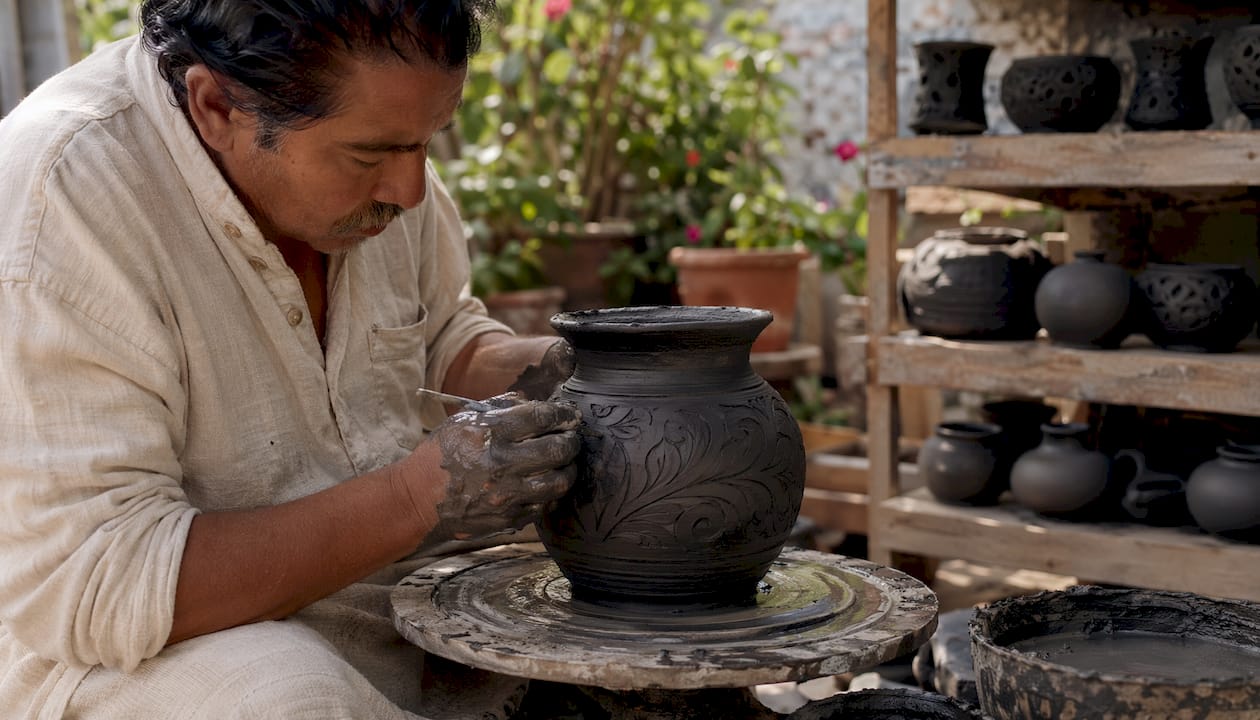
Oaxaca's barro negro, produced primarily in San Bartolo Coyotepec, is fired without glaze to achieve its signature dark metallic sheen. The technique relies on burnishing the clay with a quartz stone before firing in low-oxygen kilns, a method that has remained largely unchanged for generations. Guerrero's pottery centers, including Zacoalpan and Tixtla, mix cotton fiber directly into the clay to strengthen it, a pre-Hispanic practice still in use today.
Metepec, in the State of Mexico, takes a different path entirely. Its Tree of Life sculptures began as allegories for the Garden of Eden and have since expanded into Day of the Dead themes, pottery-making scenes, and more. Most pieces are painted in magenta, red, blue, and yellow, though some are left unpainted for a more austere effect.
Textiles: Zapotec looms and indigenous identity
Oaxacan textile weaving, particularly in the Tlacolula Valley towns of Teotitlán del Valle and Santa Ana del Valle, uses backstrap and pedal looms to produce wool rugs and garments with geometric designs drawn from Zapotec cosmology. The patterns are not decorative choices. They identify the weaver's community, lineage, and sometimes spiritual role. In Michoacán's Meseta Purépecha, weavers in communities like Angahuan produce rebozos in cotton and wool, some finished with an intricate knotted fringe technique.
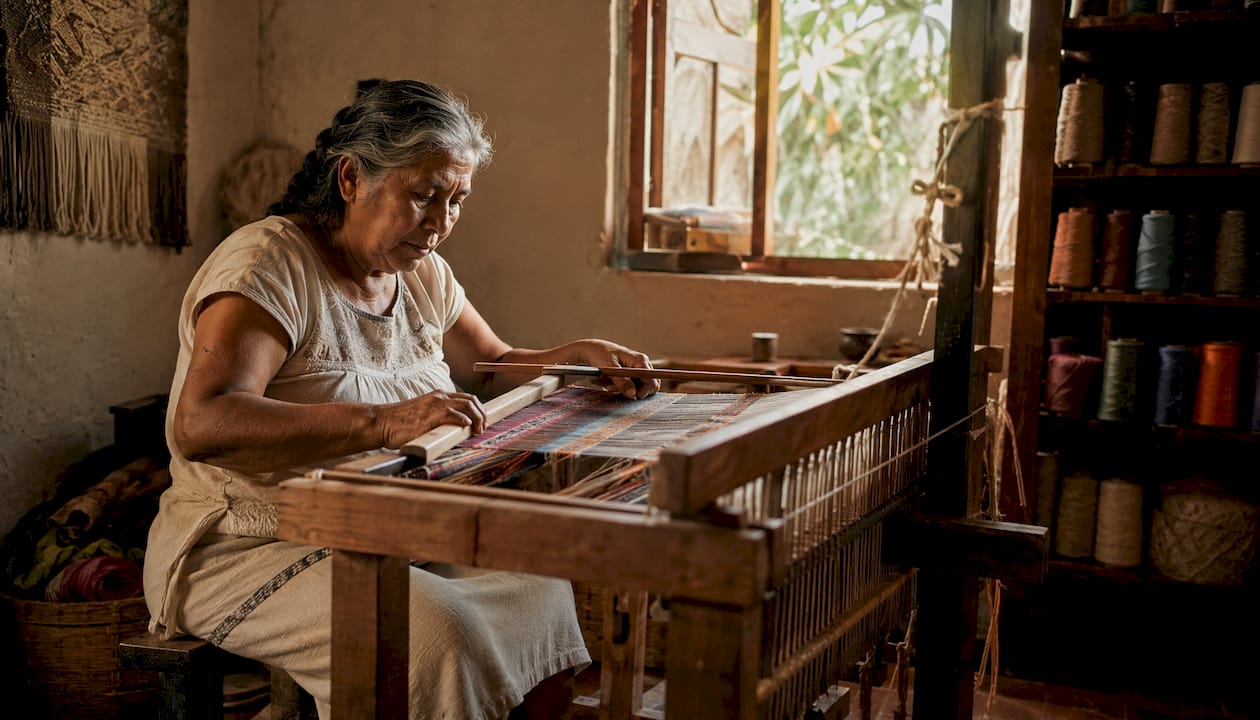
Pro Tip: When shopping for Oaxacan textiles, look for slight irregularities in the weave pattern. Hand-loomed pieces will never be perfectly uniform, and that variation is exactly what you are paying for.
Copper: Santa Clara del Cobre's living forge
Santa Clara del Cobre, a small town in Michoacán's Lacustre region, has maintained its copper craft tradition since 600 AD. Today, a large number of active workshops hammer copper sheets into bowls, vases, and decorative panels without the use of molds. The sound of hammering fills the town's streets on any given morning. If you are drawn to the warmth of copper in home decor, the role of copper craft in Mexican artisanship runs deeper than aesthetics.
Silverwork: Taxco's colonial legacy
Taxco, in Guerrero, became the center of Mexican silversmithing in the 20th century, partly through the influence of American expatriate William Spratling, who arrived in the 1920s and helped revive the local silver trade. Today the town's narrow streets are lined with silver workshops and galleries, producing everything from delicate filigree earrings to bold sculptural pieces. The craft draws on both pre-Hispanic metalworking traditions and colonial Spanish techniques, and the result is a style that is distinctly Taxqueño.
Wood carving: alebrijes from Oaxaca's villages
The painted fantastical animal figures known as alebrijes come primarily from two Oaxacan villages: San Antonio Arrazola and San Martín Tilcajete. Carvers use copal wood, which is soft enough to shape with simple tools yet durable once dried. Each piece is carved by one family member and painted by another, often in patterns that reference local flora, Zapotec symbols, or pure imagination. These are highly collectible wood crafts that have found their way into design collections far beyond Mexico.
How did Mexican handcraft traditions develop over centuries?
The artisan traditions you find across Mexico today are not static relics. They are the result of layered histories, where pre-Hispanic techniques absorbed colonial influences and then kept evolving on their own terms.
Most craft knowledge in indigenous communities passes through family and community lineage rather than formal instruction. A child in Teotitlán del Valle grows up watching a parent work the loom, absorbing color combinations and pattern logic long before touching the threads. This is what the term artesano captures: a maker whose skill is inseparable from the community that shaped it. The craft is a living dialogue between past traditions and present creativity, not a frozen replica of the past.
The Huichol people of Jalisco, Durango, and Nayarit offer one of the most striking examples of indigenous spiritual expression in craft form. Their beadwork and yarn paintings depict visions from peyote ceremonies, sacred animals like the deer and eagle, and cosmological maps of the world as they understand it. Every bead placed is an act of prayer as much as craft. The Zapotec weavers of Oaxaca similarly encode community identity into their textiles, using geometric motifs that predate the Spanish arrival by centuries.
Colonial contact added new materials and techniques without erasing what came before. Spanish missionaries introduced pedal looms, glazing techniques for ceramics, and new metalworking methods. In Michoacán's Lacustre region, the towns around Lake Pátzcuaro show this layering clearly: lacquerware that began in pre-Hispanic times absorbed European decorative motifs during the colonial period, and today carries both influences simultaneously. Geographic isolation played a significant role in preserving the most distinct techniques. Communities in the Sierra Norte of Oaxaca or the high Meseta Purépecha developed their crafts in relative self-sufficiency, which kept outside commercial pressures at bay long enough for deep specializations to take root.
Why do handcrafts matter economically, and how are they being protected?
Handcraft production is not a cultural side project in these regions. For many communities, it is the primary economic activity, and the distinction between craft and livelihood is essentially nonexistent.
Metepec's pottery industry supports over 300 artisans and 270 families, making it the municipality's main economic driver. In Guerrero, isolated indigenous communities rely on craft sales for most or all of their income, which is why the state's handcraft traditions retain such a strong indigenous character. Oaxaca's artisan concentration in the Central Valleys functions as an economic engine for villages that have few other industries.
The pressure from industrialization and mass tourism is real. Tourist markets in Acapulco, Zihuatanejo, and Taxco have pushed some Guerrero potters toward faster, cheaper production methods, including the increasing use of glaze on traditionally unglazed wares. The same dynamic plays out wherever craft meets high-volume retail demand.
Legal protections offer one line of defense. The Metepec Tree of Life received a denominación de origen in 2009, protecting it from mass-produced imitations the way Champagne or Roquefort are protected in France. This kind of designation signals to buyers that a piece comes from a specific place and tradition, not a factory floor. Cooperatives and markets in Oaxaca and Michoacán support artisan communities by giving makers access to wider markets without requiring them to abandon their methods. The Casa de las Artesanías de Michoacán plays a particularly active role, organizing the state's craft output by region and helping artisans connect with buyers who understand what they are purchasing.
How do artisan communities practice sustainability and protect cultural authenticity?
Sustainability in Mexican artisan communities is not a marketing position. It is a survival mechanism built into the craft process itself.
Oaxacan wood carvers who produce alebrijes from copal trees have developed active replanting programs to ensure the raw material does not disappear. The Palo que Habla bioconservation project in Oaxaca is one documented effort to replant copal and protect the forests that supply carving communities. Potters in several regions recycle kiln heat to reduce fuel consumption, a practice that predates any modern sustainability framework. These are not trends adopted from outside. They are adaptations communities made because their craft depends on the land staying healthy.
Oaxaca holds the highest concentration of artisans in Mexico, with the Central Valleys serving as the country's most productive handcraft zone and a primary economic driver for dozens of villages.
Cultural authenticity flows from the same source as sustainability: community. When a craft is taught within a family, the knowledge stays specific. A weaver in Teotitlán del Valle learns not just how to use a loom but which color combinations belong to her community's tradition, which patterns carry ceremonial meaning, and which shortcuts would compromise the piece's integrity. Geographic isolation has reinforced this specificity in places like the Sierra Norte of Oaxaca, where communities developed unique craft techniques precisely because they were not exposed to homogenizing commercial pressures.
Pro Tip: To find genuinely authentic pieces, visit family-run workshops rather than market stalls. Artisan workshops consistently produce higher-quality work, and you will often meet the maker directly, which adds a layer of meaning that no souvenir shop can replicate.
If you are drawn to how these textile traditions translate into contemporary interiors, Oaxacan weaving in modern design offers a thoughtful look at how these patterns carry into living spaces today.
Where can you find authentic handcrafts across Mexico's artisan regions?
Knowing where to look is half the work. Mexico's best craft markets and cooperatives are not always in the most obvious tourist locations.
Oaxaca City and the Central Valleys anchor the country's most accessible craft scene. The Mercado de Artesanías in Oaxaca City carries a broad selection, but the real depth is in the villages themselves. Teotitlán del Valle for rugs and textiles, San Bartolo Coyotepec for barro negro pottery, and San Martín Tilcajete for alebrijes are each a short drive from the city. Many workshops welcome visitors, and buying directly from the maker means the full price goes to the artisan family.
Pátzcuaro, Michoacán functions as the hub for the Lacustre region's craft output. The town's main plaza hosts a daily market where lacquerware, copper pieces from Santa Clara del Cobre, and embroidered textiles from surrounding villages are sold side by side. The Casa de las Artesanías de Michoacán maintains a permanent exhibition and sales space in Morelia, organized by the state's distinct craft regions, making it one of the most useful single destinations for understanding Michoacán's full artisan range.
Metepec, State of Mexico is compact enough to walk in an afternoon. The streets near the San Juan Bautista parish church are lined with workshops and storefronts selling Tree of Life sculptures, painted ceramics, and decorative pieces. Because the denominación de origen protects the Tree of Life designation, pieces sold here carry a geographic guarantee that mass-produced versions cannot claim.
Taxco, Guerrero is the place for silver. The town's Mercado de Artesanías and the workshops clustered around the Plaza Borda offer everything from everyday jewelry to collector-grade sculptural pieces. Asking to see a silversmith's workshop is common practice here, and most are happy to show the process.
Tlaquepaque and Tonalá, Jalisco deserve mention as regional craft markets that aggregate work from across western Mexico, including Huichol beadwork, blown glass, and talavera-style ceramics. These towns function as curated wholesale and retail destinations for buyers who want variety in one place.
The common thread across all of these destinations is that the closer you get to the maker, the better the piece. Cooperatives help artisans reach markets they could not access alone, and markets create the foot traffic that keeps workshops viable. But the most memorable pieces, and the ones that carry the most cultural weight, come from sitting across a workbench from the person who made them.
At Createdecorus, we believe that same principle applies to every piece in our collection. Each handcrafted luxury accent we carry traces back to the artisan traditions of these regions, bringing the warmth and cultural depth of Mexican craftsmanship into your home with intention and care.

Key Takeaways
Mexico's most significant handcraft regions each hold a distinct artisan identity rooted in indigenous heritage, community lineage, and place-specific materials that no factory can replicate.
| Point | Details |
|---|---|
| Oaxaca leads in artisan concentration | Oaxaca holds the highest concentration of artisans in Mexico, centered in the Central Valleys. |
| Metepec's Tree of Life is legally protected | A denominación de origen granted in 2009 shields the Metepec Tree of Life from mass-produced imitations. |
| Santa Clara del Cobre's copper tradition | Over 250 active workshops sustain a copper craft tradition in Michoacán dating to 600 AD. |
| Family lineage transmits craft knowledge | Most artisan skills pass through family and community without formal training, keeping techniques community-specific. |
| Workshops outperform markets for authenticity | Family-run workshops consistently produce higher-quality pieces than tourist market stalls selling mass-produced goods. |