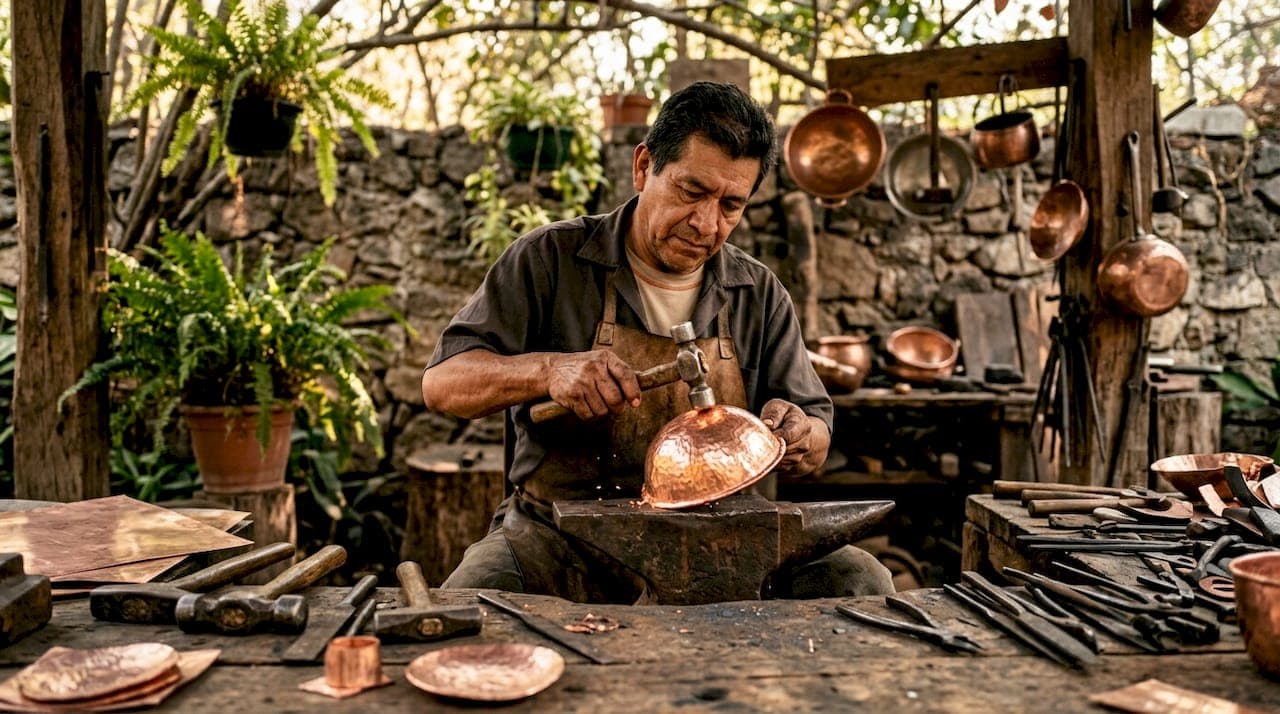
Copper craft is defined as the practice of shaping raw or recycled copper into functional and decorative objects through hand techniques passed down across generations. The role of copper craft in Mexican artisanship is foundational. It connects pre-Hispanic metallurgical traditions to a living, breathing economy centered in Michoacán, where the Purépecha people first mastered the metal centuries before Spanish contact. Today, communities like Santa Clara del Cobre sustain this tradition through cold hammering, repujado en frío, and artisan certification systems that distinguish handmade work from industrial imitation. Createdecorus draws on this same heritage, honoring the cultural depth that makes Mexican metalwork unlike anything produced elsewhere.
What is the role of copper craft in Mexican artisanship?
Copper craft is the single most defining metalwork tradition in Mexican artisanship, rooted in pre-Hispanic culture and still economically vital today. The Purépecha civilization of Michoacán developed a sophisticated copper metallurgy long before European contact, producing tools, ornaments, and ceremonial objects with refined skill. That foundation was never erased. It was adapted, layered with colonial influence, and carried forward by families who treat the craft as both livelihood and identity.
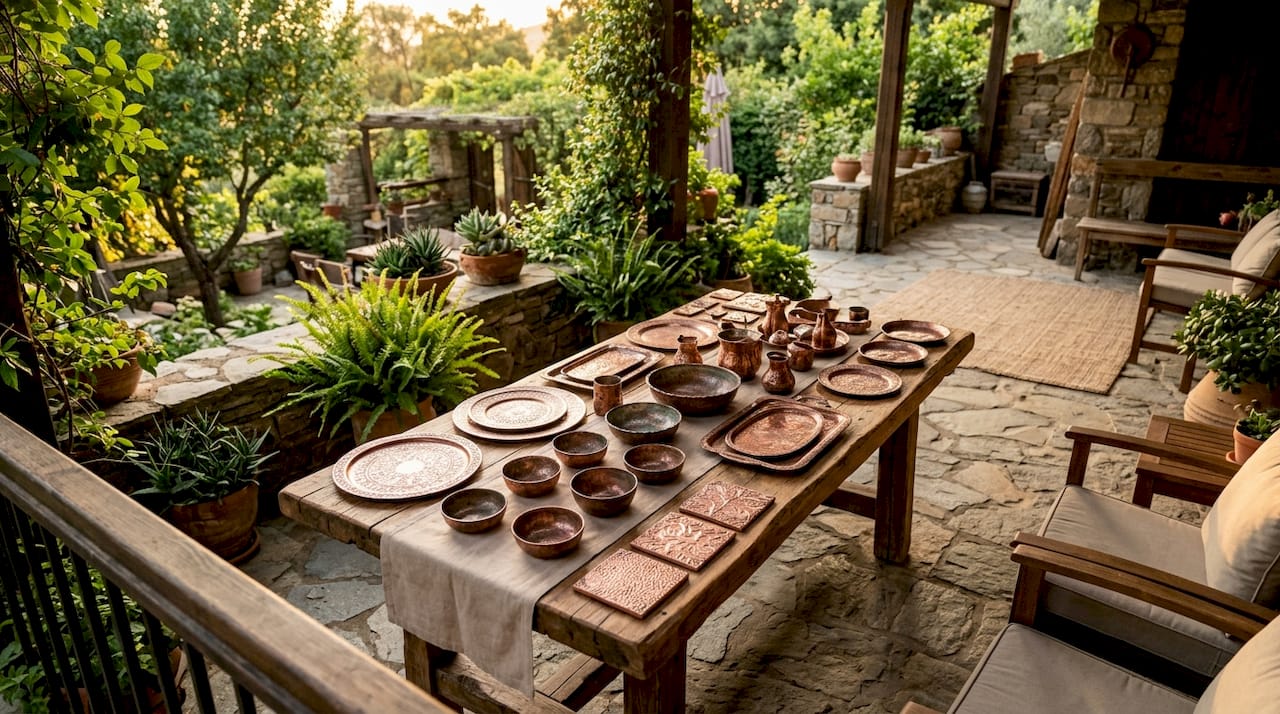
The cultural significance of copper in Mexican art goes beyond aesthetics. Copper objects carry encoded meaning, from the hammered textures that signal a maker's hand to the motifs drawn from indigenous cosmology. For art historians, this makes each piece a primary source. For craft enthusiasts, it makes each object worth understanding on its own terms, not just admiring from a distance.
How did copper craftsmanship in Mexico develop historically?
The history of copper craftsmanship in Mexico unfolds in three clear phases: pre-Hispanic mastery, colonial transformation, and modern adaptation.
-
Pre-Hispanic origins. The Purépecha were among Mesoamerica's most accomplished metalworkers. They smelted copper ore, shaped it into axes, bells, and ornamental pieces, and traded it across regional networks. Their metallurgical knowledge was not primitive experimentation. It was a mature technical tradition built over centuries.
-
Colonial intervention. In the 1500s, the Spanish bishop Vasco de Quiroga reorganized indigenous communities in Michoacán and assigned specific crafts to each town. He introduced the bellows to Santa Clara del Cobre, which accelerated production by improving the smelting process. This was a meaningful technological addition, but it did not originate the craft. Local artisans affirm that colonial tools modernized what was already a sophisticated indigenous practice.
-
Modern material shift. By the late 20th century, virgin copper ore became scarce and expensive. Artisans adapted by sourcing recycled electrical wire and telecommunication cable instead. This shift required new smelting approaches to restore the metal's malleability for fine hand hammering. The adaptation preserved the tradition without compromising its quality.
"Colonial influences introduced important tools, but the deep indigenous roots and sophistication of Mexican copper craft existed long before colonization." — Local artisans of Santa Clara del Cobre
This arc matters for art historians because it shows a tradition that absorbed external pressure without losing its core identity. The craft did not survive despite change. It survived through it.
What techniques do Mexican artisans use in copper craft?
Hand-hammered copper work requires a specific set of skills that take years to develop. The primary technique is cold hammering, known in Spanish as repujado en frío. The artisan works the copper at room temperature using stone hammers and hand tools, shaping the metal through repeated, controlled strikes rather than heat alone.
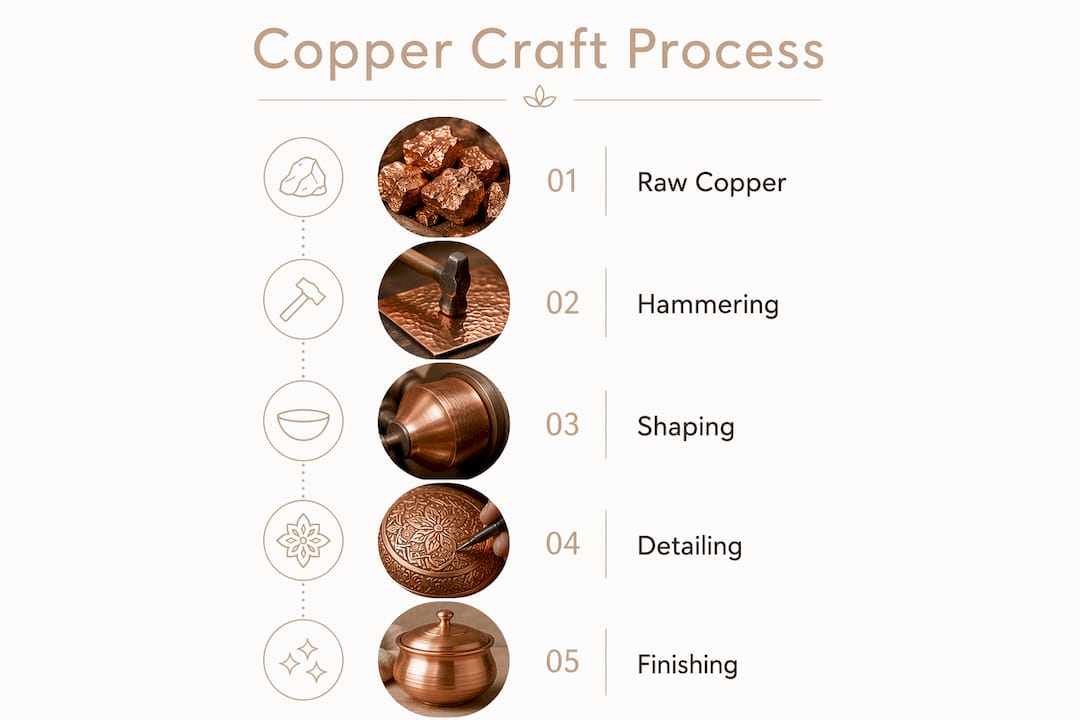
The physical demands are significant. A single vessel can require up to 2,000 hammer strikes and up to 200 hours of manual labor. That level of effort produces subtle surface irregularities that collectors and historians recognize as proof of authentic handwork. Machine-made pieces are smooth and uniform. Authentic hand-hammered copper carries the maker's rhythm in its surface.
Key elements of the process include:
- Stone hammer work. Artisans use stone hammers of varying sizes to shape and refine the copper surface, building form from flat sheet to three-dimensional object.
- Recycled copper preparation. Raw material sourced from recycled copper wire must be smelted and prepared carefully to achieve the right malleability before hammering begins.
- Artisan signatures. Authentic pieces carry the maker's mark, a signature or stamp that functions as both a quality guarantee and a provenance record for collectors.
- Motif carving. Many pieces incorporate carved or repousse designs drawn from pre-Hispanic iconography, flora, fauna, and regional symbolism.
Pro Tip: When evaluating a copper piece for authenticity, look for slight surface variation in the hammered texture. Perfectly uniform surfaces indicate machine production. The irregularity is the point.
The artisan craft tradition behind these techniques is not taught in schools. It passes from parent to child, from master to apprentice, in workshops where the knowledge lives in the hands as much as the mind.
How does copper craft sustain Santa Clara del Cobre?
Santa Clara del Cobre is the undisputed center of copper craftsmanship in Mexico. Approximately 82% of the town's population works in copper craft, with around 250 active workshops operating as of 2026. That concentration makes the craft not just a cultural tradition but the economic backbone of an entire community.
| Indicator | Detail |
|---|---|
| Workforce in copper craft | Approximately 82% of Santa Clara del Cobre's population |
| Active workshops | Around 250 as of 2026 |
| Annual Copper Fair | Held since 1946, focused on decorative artisan pieces |
| Collective output example | 12 artisan families produced 500 unique pieces in six months |
The annual Copper Fair, held in Michoacán since 1946, has played a direct role in shifting the craft from purely utilitarian production toward decorative and artistic work. That shift matters economically. Decorative pieces command higher prices, attract collectors, and create a market that industrial manufacturers cannot easily replicate. The Fair incentivizes artisans to push beyond functional objects and invest in creative expression.
Community collaboration reinforces this resilience. When 12 artisan families joined forces to produce 500 unique copper pieces within six months, they demonstrated that traditional techniques scale through cooperation, not automation. That model sustains both quality and cultural continuity in a way that individual workshops working in isolation cannot.
Industrial competition remains a real pressure. Mass-produced copper goods from factories undercut handmade prices significantly. The community's response has been to double down on authenticity, certification, and the story behind each piece, qualities that factory production structurally cannot offer.
Why does copper craft remain relevant in contemporary Mexican art?
Contemporary Mexican copper artisanship is not a museum exhibit. Master artisans see their work as dynamic and current, proving that traditional copper craftsmanship remains viable and prestigious amid modern mass production. The distinction between nostalgia and living practice is one the artisans themselves insist upon.
"Artisans emphasize their copper work as a living reinterpretation of ancestral techniques, not nostalgia, challenging mass production's efficiency." — Artisans of Santa Clara del Cobre
Several forces drive this contemporary relevance:
- Collector certification. Less than 1% of workshops in Santa Clara del Cobre hold "Great Masters" status. That rarity makes provenance and artisan signatures critical for serious collectors. A certified master's piece carries documented authenticity that increases both cultural and market value.
- Museum and cultural integration. Copper works from Michoacán appear in ethnographic collections and cultural exhibitions across Mexico and internationally, positioning the craft within art history rather than folk craft alone.
- Story-driven design. Modern pieces increasingly incorporate narrative motifs, scenes from pre-Hispanic mythology, regional landscapes, and contemporary Mexican life, making each object a visual argument for cultural continuity.
The Mexican heritage in home design movement has also elevated copper craft's profile in interior design circles. Collectors and designers now seek pieces that carry cultural weight, not just decorative appeal. That demand creates a market where authenticity commands a premium.
Key Takeaways
Copper craft in Mexican artisanship is a living tradition sustained by pre-Hispanic technique, community economy, and artisan certification that no industrial process can replicate.
| Point | Details |
|---|---|
| Pre-Hispanic foundation | The Purépecha developed sophisticated copper metallurgy centuries before Spanish contact. |
| Labor intensity | A single piece can require up to 200 hours and 2,000 hammer strikes to complete. |
| Community economy | Around 82% of Santa Clara del Cobre's population depends on copper craft for income. |
| Authenticity markers | Cold hammering, artisan signatures, and "Great Masters" certification distinguish genuine work. |
| Living tradition | Artisans reinterpret ancestral techniques with new motifs, keeping the craft current and collectible. |
Why I believe copper craft deserves more serious attention
I have spent years studying Mexican artisan traditions, and copper craft consistently surprises me. Not because of its beauty, though that is undeniable, but because of how deliberately artisans resist the narrative that their work is disappearing.
Most coverage of traditional crafts frames them as endangered. The artisans of Santa Clara del Cobre reject that framing entirely. They are not preserving a relic. They are practicing a living discipline that demands physical endurance, metallurgical knowledge, and artistic vision simultaneously. That combination is rare in any craft tradition, anywhere in the world.
What strikes me most is the certification system. The "Great Masters" designation exists precisely because the market needs a way to separate authentic work from imitation. That is not a sign of a dying craft. That is a sign of a craft mature enough to have developed its own quality standards. The artisan crafts for home decor market is growing, and the artisans who hold master status are positioned to benefit from that growth in ways that factory producers simply are not.
The challenge is visibility. Too many collectors and art historians still treat Mexican copper work as regional folk art rather than as a technically sophisticated metalwork tradition with deep pre-Hispanic roots. Changing that perception is not just a matter of cultural justice. It is a matter of historical accuracy.
— Ernesto
Createdecorus and the art of authentic Mexican craft
At Createdecorus, we believe that a home filled with authentic artisan work carries something that mass-produced decor cannot offer: the presence of a maker's hand and a culture's story.

Our collection draws on the same artisan heritage that defines Mexican copper craft, celebrating the textures, colors, and cultural pride that make handmade objects worth living with. Every piece we curate reflects the tradition of craftsmanship passed down through generations in communities like Santa Clara del Cobre. If you are ready to bring that depth of meaning into your home, explore our handcrafted luxury decor and find pieces that honor the artisan traditions behind them.
FAQ
What makes Mexican copper craft culturally significant?
Mexican copper craft carries centuries of Purépecha metallurgical tradition and serves as the primary economic livelihood for communities like Santa Clara del Cobre, where around 82% of residents work in the craft.
How is copper used in Mexican artisanship?
Artisans shape recycled or raw copper through cold hammering, known as repujado en frío, using stone tools to produce hand-finished vessels, decorative panels, and ornamental objects with distinctive surface textures.
How long does it take to make a hand-hammered copper piece?
A single piece can take 15 days to a full month to complete, requiring up to 200 hours of manual labor and as many as 2,000 individual hammer strikes.
What is the Copper Fair in Michoacán?
The Copper Fair is an annual event held in Michoacán since 1946 that encourages artisans to produce decorative copper works beyond utilitarian objects, sustaining both the craft economy and artistic innovation.
How can collectors verify authentic Mexican copper work?
Authentic pieces carry the artisan's signature or stamp, and the highest tier of quality is the "Great Masters" designation, held by less than 1% of workshops in Santa Clara del Cobre.