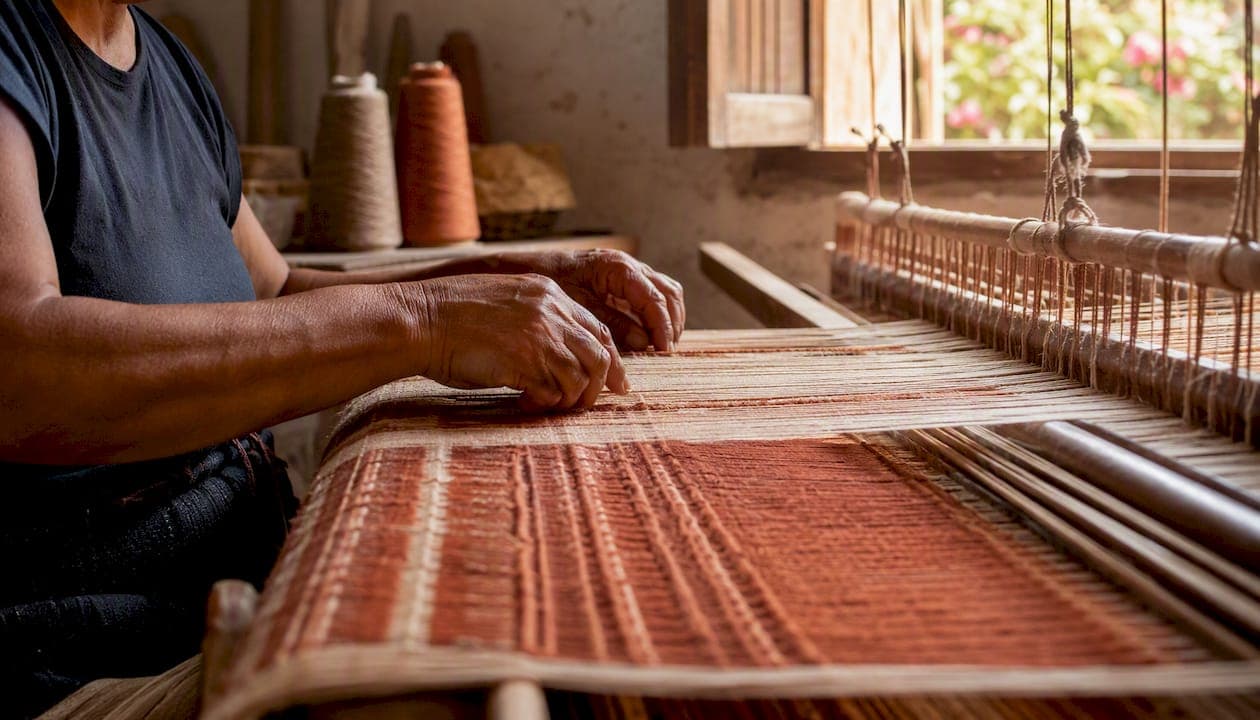
Fair trade home accessories are decorative pieces, from woven baskets to hand-loomed pillows, made under verified conditions of fair pay, safe workshops, and traceable sourcing that let a portion of the sale return to the artisan or cooperative who made it. That distinction matters because a piece you can trace back to a real maker tends to be better built, holds more meaning on your shelf, and keeps money moving toward the hands that shaped it rather than disappearing into a supply chain nobody can see.
Before you buy, run this in under a minute on any product page:
- Check for a named certifier or standard. Look for WFTO, Fairtrade International, the Fair Trade Federation, or B Corp, not just the words "ethically made."
- Look for a named producer or cooperative. A real supply chain has a name attached to it, not a vague "our artisans."
- Scan for material and origin disclosure. The listing should tell you what it's made of and where, specifically.
A quick gut check on certifiers: WFTO verifies entire organizations through audits and producer interviews, Fairtrade International certifies specific products or ingredients, and B Corp measures a company's broader social and environmental performance rather than one item's origin.
Key Takeaways
Fair trade home accessories combine fair wages, traceable sourcing, and artisan benefit, and verifying that combination takes less than a minute once you know what to check.
| Point | Details |
|---|---|
| Definition anchors on three things | Fair labor, traceability, and community reinvestment define fair trade, not the word "handmade" alone. |
| Certifications cover different scopes | WFTO verifies organizations, Fairtrade certifies products, and B Corp scores whole companies, know which one you're seeing. |
| Verification takes five steps | Named certifier, named cooperative, provenance photos, material disclosure, and a transparency report cover the basics. |
| Price premiums have real causes | Smaller batches, fair wages, durable materials, and auditing costs explain most of the price gap versus mass retail. |
| Createdecorus fits the checklist | Its handcrafted Mexican-made pillows and accents disclose materials and artisan production, meeting the verification standards outlined here. |
Table of Contents
- What Is Fair Trade for Home Accessories, Specifically?
- How Do Fair Trade Certifications Actually Work?
- What Do You Actually Gain by Buying Fair Trade Decor?
- What Do Fair Trade Accessories Look and Feel Like?
- How Do You Verify a Fair Trade Claim Before You Buy?
- Why Do Fair Trade Accessories Cost More, and Is It Worth It?
- Where Should You Buy Fair Trade Home Accessories?
- How Createdecorus Meets This Verification Standard
- Why Fair Trade Changes How a Room Actually Feels
- Start With a Piece That Already Meets the Checklist
- Frequently Asked Questions
- Sources
What Is Fair Trade for Home Accessories, Specifically?
Fair trade in home decor means three things happening at once: artisans get paid fairly for their labor and skill, working conditions meet basic safety standards, and the supply chain is traceable enough that a buyer (or an auditor) could follow the piece back to the person who made it. WFTO's Code of Practice frames this as a relationship, not a transaction: producer groups agree to fair wages and safe conditions, and buyers commit to long-term purchasing rather than one-off orders that leave artisans guessing about next season's income.
That's a different standard than food or agriculture, where fair trade often centers on a single commodity price floor for something like coffee or cacao. Home accessories involve dozens of small decisions, thread quality, dye source, loom technique, packaging, so fair trade claims here tend to be broader and harder to reduce to one number.
Here's where it gets murky for shoppers. A brand can say "handmade" and mean almost anything, because the word describes a production method, not a labor standard. "Artisan-made" is similarly undefined on its own. What actually matters is whether that claim sits behind a certification, a named cooperative, or a documented sourcing relationship. Marketing language describes the product. Certification and traceability describe the conditions it was made under, and those are two very different promises.
Product categories that most commonly carry fair trade claims include:
- Textiles — pillow covers, throws, and table runners, often woven or embroidered by hand.
- Baskets — natural fiber storage and decorative pieces, frequently palm, seagrass, or reed.
- Ceramics — hand-thrown bowls, vases, and tableware with visible glaze variation.
- Wall art — woven tapestries, carved panels, or framed textile work.
- Lighting accents — hand-blown glass shades or woven pendant fixtures.
How Do Fair Trade Certifications Actually Work?
A typical fair trade supply chain runs from an individual artisan or a small production household into a cooperative, which aggregates output, handles quality control, and negotiates with exporters or direct buyers. That cooperative structure is what makes auditing possible at scale. Instead of inspecting a thousand individual weavers, a certifier can review one cooperative's practices, wage records, and safety protocols.
Buyer commitments matter more than most shoppers realize. A retailer that agrees to purchase a fixed volume over a year, rather than placing sporadic orders, gives a cooperative the stability to plan wages and invest in equipment. Premiums, the extra amount paid above market price, usually get built into that long-term agreement rather than tacked on at the point of sale.
Four names show up most often in fair trade sourcing, and each covers different ground:
| Standard | What it verifies | Where it applies |
|---|---|---|
| WFTO (World Fair Trade Organization) | Organization-level accountability through site visits, producer interviews, and documented practices | Entire producer groups or brands, not single SKUs |
| Fairtrade International | Product- or ingredient-level certification against defined labor and pricing criteria | Specific products or commodities, often food-adjacent but expanding into crafts |
| Fair Trade Federation | Membership-based verification of trade practices for North American wholesalers and retailers | Member companies' overall sourcing relationships |
| B Corp | Broader social and environmental performance scoring across a whole company | The company as a business, not any one product line |
WFTO's Fair Trade Standard requires member organizations to make a documented, reasonable effort to source the majority of their core inputs through audited channels, and to keep records of site visits and producer interviews on file. That's meaningfully different from a company simply stating it "believes in fair trade" on its About page.
Material certifications fill a separate gap. GOTS (Global Organic Textile Standard) and FSC (Forest Stewardship Council) speak to what a product is made of and how that material was harvested or grown, not to the labor conditions of the person who assembled it. A piece can carry a GOTS certification for its organic cotton and still say nothing about the wage the weaver earned. Buyers who want the full picture usually need both a labor standard and a material standard, not one or the other.
Pro Tip: Ask for product- or batch-level documentation rather than accepting a brand-wide statement. The most reliable verification traces back to a specific site visit or producer interview tied to that exact item, not a general mission statement on a homepage, a distinction WFTO's annotated Fair Trade Standard spells out clearly.
What Do You Actually Gain by Buying Fair Trade Decor?
The benefits split into three groups, and it helps to see them separately rather than as one vague "feel good" category.
For artisans and their communities, fair trade purchasing often funds things far beyond the workshop itself. Programs like Mujeres Sembrando la Vida reinvest revenue into local infrastructure, education, and healthcare access, turning a single pillow purchase into support for a broader community system.
For the environment, the overlap with sustainability is real but not automatic. Many fair trade artisan pieces use natural fibers, recycled materials, or low-toxicity dyes, and a well-made handwoven basket tends to outlast a mass-produced equivalent by years, which cuts down on landfill turnover. But sustainability and fair trade measure different things: one tracks carbon and material impact, the other tracks labor conditions. A product can be eco-friendly without being fair trade, and vice versa, so don't assume one label implies the other.
For you as the buyer, the case is straightforward:
- You get a piece with genuine design variation, no two hand-thrown ceramic bowls glaze exactly alike.
- You get materials and construction built to outlast a decorating trend cycle.
- You get a cultural story attached to the object, not just a SKU number.
- You spend in line with values you already hold, without having to compromise on how the piece actually looks in your home.
Our guide to handcrafted luxury decor goes deeper on how artisan-made pieces compare to disposable retail furnishings over a five-year ownership window.
What Do Fair Trade Accessories Look and Feel Like?
Recognizing fair trade decor on a shelf or scroll comes down to trusting your hands as much as the label. Certain textures and irregularities are signatures of hand production, and once you know what to look for, mass-produced imitations become obvious.
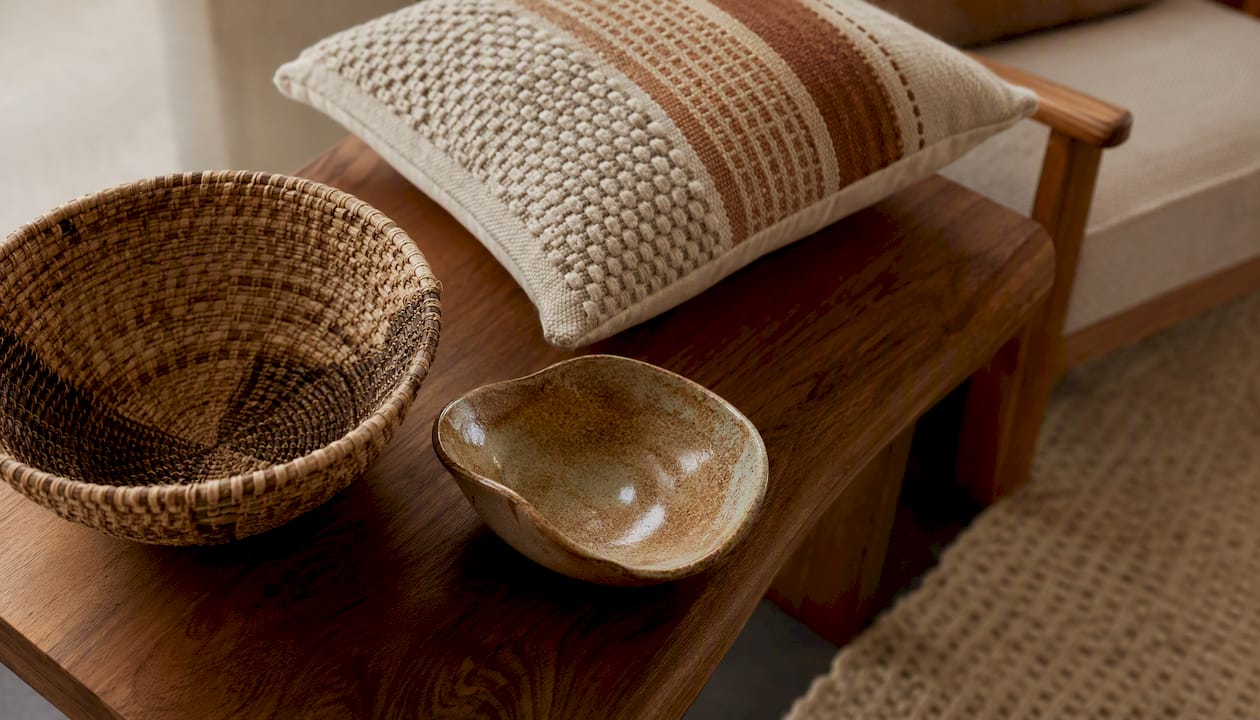
Baskets carry a visible weave pattern with slight variation row to row, since no two hands press a fiber exactly the same way twice. Pillows and throws often show a subtle nap or slub in the weave, especially with hand-loomed cotton or wool, giving the fabric a texture that feels warmer and less uniform than machine-finished textiles. Ceramics display irregular glaze pooling, a bowl thrown on a wheel by hand will have a rim that's slightly imperfect in a way that reads as intentional rather than flawed. Woven rugs tend to show knot density variation at the edges, a tell that separates artisan looms from power looms. Wall hangings often combine natural fiber cording with hand-tied macramé or embroidery detail. Hand-blown glass accents carry small air bubbles or asymmetry in the base, marks of the blowing process rather than defects.
Textiles and ceramics most commonly carry product-level material certifications like GOTS for organic cotton, while baskets and wood accents are more likely to show FSC sourcing documentation when the brand discloses it. Our practical guide to cultural home accents walks through more of these visual and tactile signals category by category.
How Do You Verify a Fair Trade Claim Before You Buy?
Here's a five-step workflow you can run on any product page in about five minutes:
- Read the product description for a named certifier. WFTO, Fairtrade International, Fair Trade Federation, or B Corp should appear explicitly, not implied.
- Search for a named cooperative or producer group. A brand that's proud of its sourcing usually names the people behind it.
- Look for provenance photos. Real workshop or artisan photos, not stock imagery, signal a brand willing to show its supply chain.
- Check for batch or material disclosure. Specific fiber content, dye process, or region of origin beats a generic "sustainably sourced" tag.
- Scan for an impact report or transparency page. Brands serious about fair trade usually publish something concrete about where money goes.
When you're evaluating a seller directly, ask these questions or look for the answers already posted:
- Does the listing name the artisan or cooperative, or just say "our partners"?
- Is there a certificate scan or certification number you can look up?
- Does the seller disclose what percentage of the price returns to the maker?
Watch for these red flags in seller copy:
- Vague phrasing like "ethically sourced" with no certifier named anywhere on the site.
- Pricing that undercuts comparable handmade goods by a wide margin, a sign the labor claim likely doesn't hold up.
- Stock photography standing in for real workshop or artisan images.
Shopping guides that cover this space consistently make the same point: vague language like "ethically made" isn't enough on its own. You need a name, a standard, or a document behind the claim, not just an adjective.
Why Do Fair Trade Accessories Cost More, and Is It Worth It?
Expect to pay more for fair trade home decor, often noticeably more than a mass-retail equivalent, and there are specific reasons behind that premium rather than vague "quality" language. Batch sizes are smaller because a cooperative can only produce so much by hand in a season. Wages are higher because fair labor standards set wage floors above what unregulated production often pays. Materials tend to be more durable, natural fibers and hand-finished ceramics simply cost more to source than synthetic mass-market substitutes. And auditing itself, the site visits and documentation that back up a certification, adds cost that gets absorbed somewhere in the chain.
Before paying that premium, run through a short value checklist:
- Durability — does the material and construction suggest years of use, not one season?
- Traceability — can you find the cooperative or artisan behind the piece?
- Material certification — is there a GOTS, FSC, or comparable material standard attached?
- Named artisan or cooperative — is there a specific group you could look up independently?
- Transparency reporting — does the brand publish anything about impact or sourcing?
If budget is tight, start small. A single statement pillow or a hand-thrown ceramic vase lets you test the fair trade premium on one piece before committing a whole room to it. Growing consumer demand for sustainable and ethical home decor has pushed more retailers into this space, which means the entry price point for a first fair trade piece keeps getting more approachable than it was even a few years back.
Where Should You Buy Fair Trade Home Accessories?
Four main channels carry fair trade home goods, and each comes with its own way of proving legitimacy.
Verified marketplaces aggregate multiple certified sellers under one roof, usually filtering by certification type. Look for a filter or badge system tied to a named standard, not just a "sustainable" category tag. Direct artisan cooperatives sell straight from the source, often through a dedicated website or a partnership with a single retailer. These tend to offer the deepest traceability, since there's no reseller layer obscuring the origin. Certified retailers hold membership in a body like the Fair Trade Federation and typically disclose that membership on an About page. Curated ethical marketplaces and roundup sites can be a useful starting point for discovery, though brand roundups still require you to verify individual product claims rather than trusting the curation alone.
A few habits make any of these channels easier to navigate:
- Search using certifier names directly ("WFTO baskets" or "Fair Trade Federation pillows") rather than generic terms like "boho decor."
- Check the return policy, legitimate sellers with traceable supply chains tend to offer clear, generous return windows because they stand behind their sourcing claims.
- If you're an interior designer or work with a boutique, ask about trade accounts or bulk pricing, many artisan-backed brands offer this. Programs like the designer trade program at One Day Doors & Closets show how trade-focused purchasing works in adjacent home categories, and similar structures exist across ethical decor.
- Product pages that show real producer photos and named cooperatives are a strong positive signal, prioritize those over generic lifestyle staging shots.
How Createdecorus Meets This Verification Standard
Createdecorus makes handcrafted luxury pillows, ottomans, and home accents in Mexico, working with artisan-inspired textile techniques passed down through generations rather than outsourcing to anonymous mass production. That production model exists specifically to answer the traceability question raised throughout this guide: where was this made, and by whom.
Run the verification checklist against what Createdecorus discloses, and here's how it maps:
- Material transparency — each piece specifies its textile construction and premium fill, including memory foam and polyester blends, so you know exactly what you're bringing into your home.
- Artisan relationships — the production process centers Mexican artisan craftsmanship rather than treating it as a marketing footnote.
- Sustainable production practices — the brand builds sustainability into its manufacturing approach rather than layering it on after the fact.
- Direct product access — you can inspect the full pillow collection yourself rather than relying on secondhand claims.
For readers who want the fuller argument on why ethical sourcing changes what "luxury" means, our buyer's guide to ethical luxury home accessories walks through the reasoning in more depth, and our piece on how handmade decor supports local ecosystems covers the community side of that equation.
Why Fair Trade Changes How a Room Actually Feels
I've come to think the verification checklist matters less as a shopping tool and more as a filter for intention. Most people don't decorate a room hoping it looks like everyone else's. They want it to feel like theirs. A piece with a traceable origin, a named cooperative, a material you can point to and explain, does something a mass-produced equivalent can't: it gives the room a story that holds up under questioning. Someone asks about the pillow on your couch, and you have an answer beyond the store name.
What gets underestimated in most coverage of this topic is how much the verification habit itself changes buying behavior for the better. Once you start asking "who made this and how," you naturally buy fewer things, and you buy them with more attention. That's not a sacrifice. It's closer to how people decorated before mass retail made replacement cheaper than repair. Fair trade home accessories aren't a moral upgrade tacked onto interior design. They're a return to buying the way most of human history actually worked, from someone, not from nowhere.
Start With a Piece That Already Meets the Checklist
Every verification step covered here, named material, artisan craftsmanship, traceable production, points toward the same kind of purchase: a piece you can stand behind because you know where it came from. Createdecorus builds its pillows and accents in Mexico using artisan textile techniques and premium, clearly disclosed materials, which means you're not starting your fair trade search from zero. You're starting from a product page built to answer the exact questions this guide just taught you to ask.
A hand-loomed pillow or a plush ottoman makes a low-risk first purchase if you're testing the fair trade premium for the first time, durable enough to anchor a room for years, distinctive enough that it won't blend into a big-box catalog. Browse the current pillow collection and look for the material and craftsmanship details on each listing, then apply the five-minute verification workflow from this guide before you check out.
Frequently Asked Questions
What is fair trade home accessories, in one sentence? Fair trade home accessories are decorative items made under verified conditions of fair pay, safe labor, and traceable sourcing, with a portion of the sale benefiting the artisan or cooperative directly.
Are fair trade and sustainable home decor the same thing? Not exactly. Fair trade measures labor conditions and pay, while sustainability measures material and environmental impact, and a product can meet one standard without the other, as Submaterial explains.
How can I tell if a product is really fair trade or just marketed that way? Look for a named certifier like WFTO or Fairtrade International, a specific producer or cooperative name, and provenance photos, rather than relying on adjectives like "ethical" or "handmade" alone.
Why are fair trade home accessories more expensive? Smaller production batches, higher artisan wages, more durable materials, and the cost of independent auditing all contribute to the price difference versus mass-produced decor.
Where is the best place to start if I want to buy my first fair trade piece? A single statement item, a pillow, throw, or ceramic vase, lets you evaluate the premium and the craftsmanship on a smaller scale before committing to furnishing an entire room.
Sources
- WFTO Code of Practice (WFTO)
- Mujeres Sembrando la Vida (Natik)
- Sustainable home decor market research (Persistence Market Research)