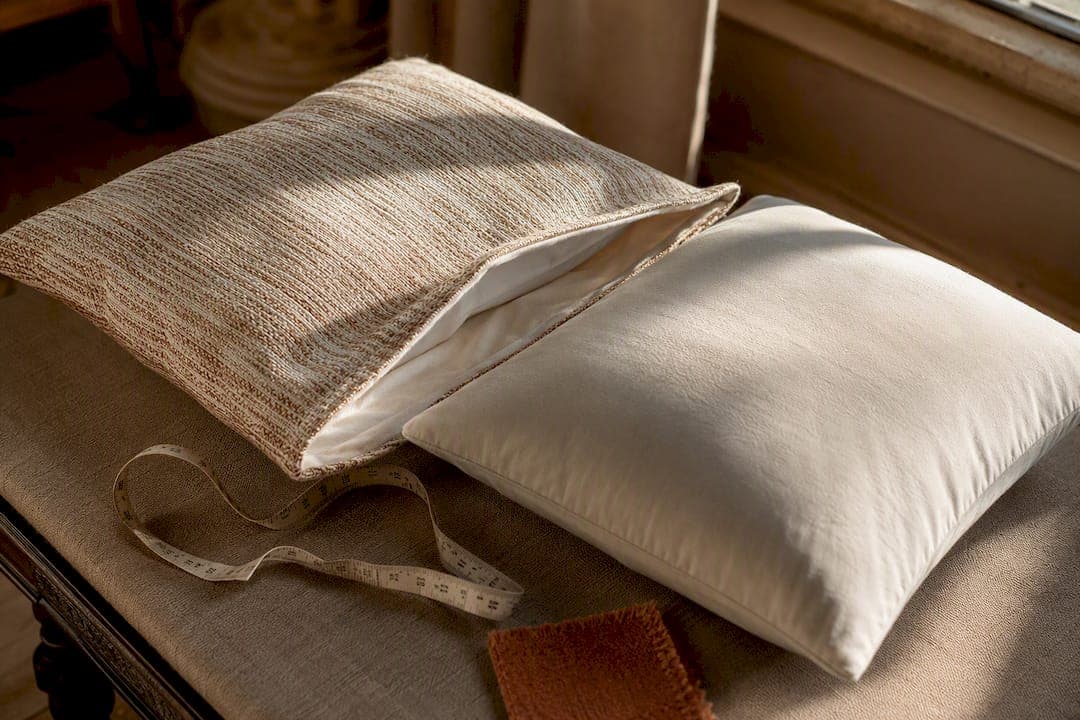
Choosing artisan cushions comes down to three checks: prioritize natural fibers with visible handcraft, size the insert 1 to 3 inches larger than the cover, and mix no more than 2 to 3 patterns per grouping. Get those right and everything else, from color to placement, falls into place. The sections ahead walk through how to inspect workmanship, pick the right fill, and keep these pieces looking new for years.
TL;DR:
- Using inserts that are 1 to 3 inches larger than the cover ensures cushions maintain a full, sculpted shape rather than appearing flat or sagging.
- Natural fibers like linen, cotton, wool, or silk, with visible handcraft details and dense construction, signal authentic artisan quality and durability.
- Pattern mixing should be limited to two or three pieces with a shared tone and balanced sizing from largest to smallest to achieve a cohesive look.
- Feather and down-blend fills offer plushness and reshaping ability but require regular fluffing, while foam provides firm support with less maintenance.
- Regular cleaning involves vacuuming, rotating cushions, and avoiding prolonged sun exposure to prolong the life and appearance of artisan cushions.
Table of Contents
- Cómo Elegir Cojines Artesanales: What to Check in Materials and Craftsmanship
- What Size Insert Should You Use for a Cushion Cover?
- How Do You Mix Patterns Without Cluttering a Room?
- Down, Down-Alternative, or Foam: Which Fill Should You Choose?
- Three Cushion Arrangements You Can Copy Today
- How Should You Clean and Store Artisan Cushions?
- Why Createdecorus Cushions Meet Every Craftsmanship Check
- What the Selection Advice Gets Wrong
- Bring Artisan Craftsmanship Home With Createdecorus
- Sources
- FAQ
Cómo Elegir Cojines Artesanales: What to Check in Materials and Craftsmanship
Natural fibers are the backbone of every genuine artisan cushion. Linen, cotton, wool, and silk take dye beautifully, soften with wear instead of pilling, and develop a texture over time that synthetic blends never achieve. That aging process is part of the appeal. A linen cover creases and relaxes; a polyester one just looks tired.

Craft signs separate handmade from mass-produced, and you can spot most of them before you buy. Look for small irregularities in a handwoven textile (perfectly uniform weave usually means a machine made it), raised embroidery with visible thread depth, seams that run straight without puckering, and zippers tucked out of sight rather than stitched across a visible edge.
A cushion's artisan character comes from limited production runs and slight variation between pieces, not from identical uniformity. That is a feature, not a flaw.
- Check fabric weight (gramaje) by feel. Heavier, denser cloth generally signals higher-quality fiber and tighter weaving.
- Ask about Martindale abrasion ratings when buying upholstery-weight fabric for high-traffic seating.
- Inspect the underside of the seam, not just the front, for loose threads or gaps.
Quality signal: Handcrafted cushions with tidy seams, well-defined corners, and discreet closures tend to feel noticeably heavier in hand than mass-market equivalents, a direct result of denser fabric and tighter construction.
What Size Insert Should You Use for a Cushion Cover?
Buy your insert 1 to 3 inches larger than the cover. A 20 inch cover gets a 22 inch insert. This oversize rule is what gives a cushion its plump, sculpted look instead of the flat, deflated appearance that comes from matching sizes exactly. Designers routinely size up inserts, using a 26 inch insert in a 24 inch cover, specifically to keep that fuller shape intact through daily use.
Matching size to furniture matters just as much as the oversize rule itself. Here are dependable pairings:
- Standard sofas: two 20 to 22 inch squares, or one 24 inch square paired with a 16x20 inch lumbar.
- Sectionals: three to five cushions in graduated sizes, largest at the corners and tapering toward the middle.
- Armchairs: a single 18 to 20 inch square, occasionally paired with a smaller 14 inch accent.
- Beds: two Euro shams (26 inch) behind two standard shams, finished with a lumbar or decorative square in front.
Layer cushions from largest in back to smallest in front, with each layer stepping down by 2 to 4 inches. That progressive sizing is what gives a grouping a professional, finished look rather than a scattered one. Symmetrical pairs suit formal rooms; odd numbers (three or five) read more relaxed and collected.
Pro Tip: When in doubt on quantity, count the depth of your sofa's back cushion. If your throw cushions compete with it for space, you have one too many.
How Do You Mix Patterns Without Cluttering a Room?
Stick to 2 to 3 patterns per grouping: one hero pattern, one smaller-scale companion, and one solid or textured piece to let the eye rest. This is the same rule interior stylists lean on when mixing pillow covers, and it works because it gives every pattern room to be seen instead of fighting for attention.
A shared tone is what makes the mix cohere. Pick one color that repeats across all your patterns, whether it is a rust thread running through an embroidered piece or the same indigo showing up in a striped weave and a solid velvet. That thread of color is what a room needs to feel intentional rather than accidental.
Texture changes how a pattern reads and what season it suits.
- Handwoven cotton and linen feel light and airy, ideal for spring and summer rooms.
- Chenille and bouclé add warmth and softness, well suited to fall layering, though chenille needs careful, non-damp cleaning to hold its texture.
- Embroidered wool or velvet reads formal and substantial, good anchors for winter groupings.
Bright, large-scale patterns work best when they echo something else in the room, a rug, a piece of art, or an accent chair, so the cushion feels tied to the space rather than dropped into it.
Down, Down-Alternative, or Foam: Which Fill Should You Choose?
Feather and down-feather blends are the choice for cushions you plan to style, plump, and reshape by hand. They compress under a light punch (the technique known as "the chop") and spring back, which is exactly why designers reach for down-feather inserts on statement pieces. The trade-off is maintenance: they need regular fluffing to stay full.
Down-alternative fills hold their shape with less upkeep and suit households with feather sensitivities, though they lose some of that soft, moldable feel over time. Foam inserts offer firm, consistent support, useful for back and lumbar cushions that need to hold a shape without daily fluffing, but they rarely achieve the same plush drape as a feather blend.
Construction details matter regardless of fill:
- Reinforced seams at stress points prevent early blowouts.
- Boxed or well-defined corners signal careful cutting and sewing.
- A concealed zipper protects the design line instead of interrupting it.
- Denser, heavier fabric generally means a longer-lasting cushion.
Three Cushion Arrangements You Can Copy Today
A formal sofa calls for symmetry. Place a 24 inch square at each end, a 22 inch square just inside those, and a 16x20 inch lumbar centered between them. This mirrored layout suits living rooms meant for entertaining, where balance reads as polished.

A casual sofa benefits from asymmetry and odd numbers. Try a 22 inch statement cushion on one end, a 20 inch companion pattern beside it, and a single 16 inch accent on the opposite end standing alone. That uneven count is what keeps a casual space from looking overly staged.
A bed layers by size, largest to smallest, back to front. Start with two 26 inch Euro shams against the headboard, add two 20x26 inch standard shams in front of those, and finish with one 16x20 inch lumbar or a square accent front and center. The 2 to 4 inch step-down between each layer is what makes the arrangement look considered instead of piled.
Scale check: No cushion should crowd out usable seating or look lost against the furniture. If a cushion needs to move before someone sits down, it is either too large or there are too many.
How Should You Clean and Store Artisan Cushions?
Care depends on fiber content and construction, so check the label before doing anything else. Vacuum cushions weekly with an upholstery attachment to lift dust before it settles into the weave, and rotate reversible cushions on a weekly basis to prevent one side from wearing or fading faster than the other.
- Air natural-fiber cushions outdoors periodically, out of direct sun, to release moisture and odor.
- Spot-clean stains by testing a hidden area first, using minimal solvent, and dabbing rather than rubbing.
- Send delicate embroidery, silk, or heavily beaded pieces to a professional cleaner rather than risking a home wash.
- Keep cushions out of direct, prolonged sunlight to prevent uneven fading across the fabric surface.
Following the manufacturer's care label consistently does more to extend a cushion's life than any single cleaning trick.
Why Createdecorus Cushions Meet Every Craftsmanship Check
Every selection rule covered so far, natural fiber, visible handwork, reinforced seams, oversized inserts, is the standard Createdecorus builds around. Each piece is handcrafted in Mexico using traditional techniques passed down through generations of artisans, which is precisely the kind of visible, slightly irregular handwork that signals authenticity rather than mass production.
That production approach shows up in the details a careful buyer checks first: substantial fabric weight, tidy seam work, and fills chosen for shape retention rather than the cheapest option available. Learning why artisan pillows are worth the investment makes clear that the price difference reflects labor and material, not markup for its own sake. For anyone applying the checklist in this guide, Createdecorus pieces are built to pass it.
What the Selection Advice Gets Wrong
Most cushion guides treat sizing and pattern rules as the whole story, and they undersell the one thing that actually separates a cushion you keep for a decade from one you replace in two years: what you can see and feel in the seams. A gorgeous print on a thin, loosely stitched cover will look tired within a year, no matter how well you sized the insert.
The conventional advice also oversells matching. Homeowners get told to find a cushion that matches their sofa fabric or wall color exactly, which produces flat, forgettable rooms. The pattern-mixing rule works precisely because it resists that instinct. A hero pattern with real handwork carries more visual interest than three perfectly coordinated solids ever will.
If you take one thing from this guide, prioritize inspection over instinct. Feel the fabric weight, check the seam on the underside, confirm the insert is oversized before you commit. Everything else, color, arrangement, quantity, is easier to get right once the foundation is solid.
— Ernesto
Bring Artisan Craftsmanship Home With Createdecorus
Handcrafted artisan cushions often feature natural fibers, reinforced construction, and traditional techniques, so you are not left guessing whether a listing photo matches the real thing.

Where big-box retailers offer identical prints across thousands of units, Createdecorus works in limited runs that carry the visible handwork and cultural detail this guide teaches you to look for, from embroidered textiles to hand-loomed weaves. If you found the pattern-mixing and sizing rules useful, the fastest way to put them into practice is to browse the current collection of decorative pillows and build a grouping around one hero piece. Interior designers and boutiques buying in volume can also apply for trade pricing through the wholesale program.
Sources
- Shea McGee just revealed the ultimate pillow sizing guide | Homes and Gardens
- Care guidelines for fabric home furnishings | NMSU Extension
- Designers say this is how to style throw pillows for an elevated home | House Beautiful
- How to Mix Pillow Covers Like a Pro | Julie Blanner
FAQ
What Is the Best Fabric for Handmade Cushions?
Natural fibers like linen, cotton, wool, and silk are the top choices because they age gracefully, take dye well, and show the handcraft details that define genuine artisan work. Synthetic blends look uniform out of the box but tend to pill and flatten faster with regular use.
What Is the Best Fill for a Cushion?
Feather and down-feather blends offer the plushest feel and let you reshape the cushion by hand, including techniques like "the chop," which is why designers favor them for statement pieces. Down-alternative and foam fills need less maintenance but hold a flatter, firmer shape over time.
What Are the Different Types of Cushions?
Cushions typically fall into square throw cushions, lumbar cushions for lower back support, Euro shams for bed layering, and bolster or round accent cushions. Artisan versions of each add handwoven textiles, embroidery, or hand-dyed patterns not found in mass-produced lines.
How Do You Choose Cushions for a Living Room?
Start with your sofa size, then follow the oversize insert rule of adding 1 to 3 inches beyond the cover measurement for a full look. Mix 2 to 3 patterns around a shared tone, and use progressive sizing from back to front so the arrangement looks layered rather than scattered.
Does Createdecorus Sell Ready-Made Artisan Cushions?
Yes. Createdecorus offers a catalog of handcrafted decorative pillows made in Mexico, alongside wallpaper, wall art, and rugs. Current prices are listed directly on the site, and wholesale accounts can request trade pricing through the dedicated program.