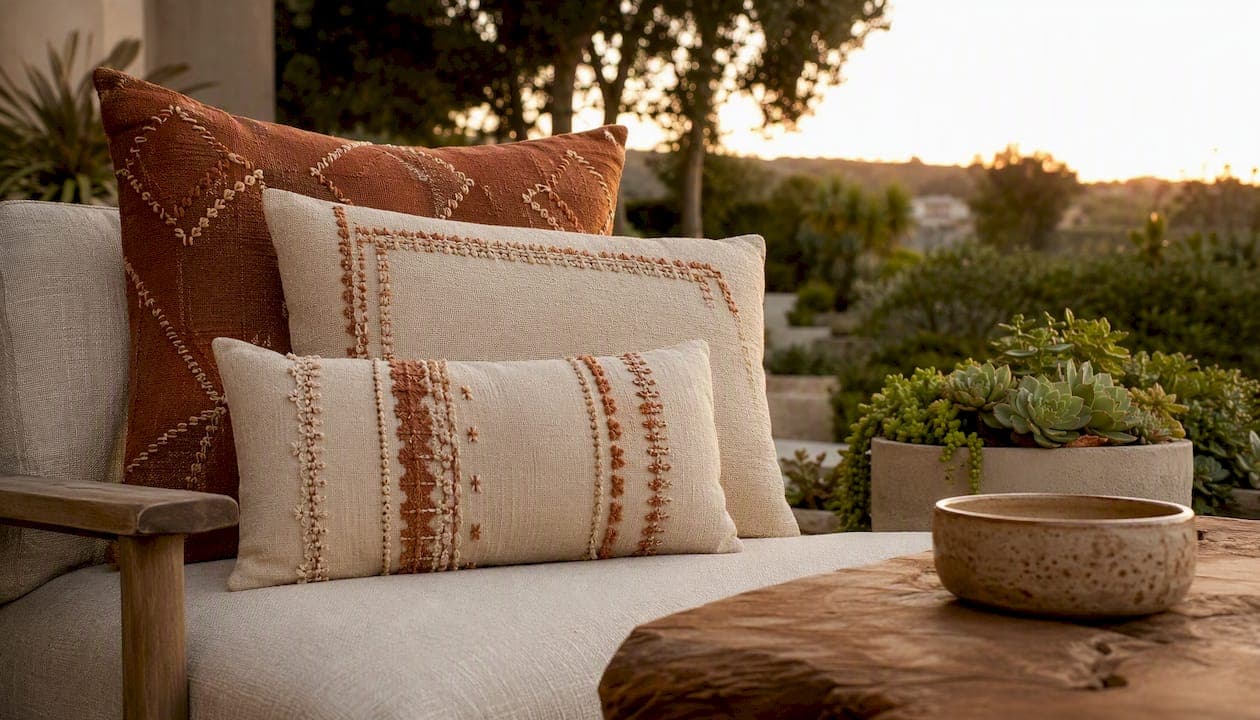
The most common decorative cushion sizes are 45×45 cm (18×18 in), 50×50 cm (20×20 in), 30×50 cm (12×20 in), and 60×60 cm (24×24 in). Of these, 45×45 cm is the most versatile — it works on a two-seat sofa, a reading chair, or a guest bed without looking out of place. The single rule that holds across every room: match cushion scale to furniture scale. A compact loveseat calls for 45×45 cm cushions; a generous sectional earns 60×60 cm anchors with layered mediums.
Quick reference before we go deeper:
- 45×45 cm / 18×18 in — the go-to size for most sofas, armchairs, and beds
- 50×50 cm / 20×20 in — slightly fuller presence; ideal for three-seat sofas and queen beds
- 30×50 cm / 12×20 in — the lumbar rectangle; adds lower-back support and visual rhythm
- 60×60 cm / 24×24 in — statement anchor for sectionals, king beds, and large outdoor benches
To convert centimeters to inches, divide by 2.54. To go the other way, multiply inches by 2.54. At Createdecorus, we work in both systems daily because our handcrafted pillows ship across the U.S. to homes that measure in feet and to designers who spec in centimeters.
Key Takeaways
The single most important rule in cushion sizing is this: match the cushion's scale to the furniture's scale, then oversize the insert by 5–7 cm to keep the cover full and the corners crisp.
| Point | Details |
|---|---|
| Universal anchor size | 45×45 cm (18×18 in) works on most sofas, chairs, and beds — start here when unsure. |
| Insert oversize rule | Choose an insert 5–7 cm larger than the cover's seam-to-seam measurement for a full, tailored look. |
| Layer three size tiers | Anchor with large (55–60 cm), add medium (45–50 cm), finish with a lumbar (30×50 cm) for depth. |
| Sectionals need larger anchors | Sectionals and large sofas call for 55×55 or 60×60 cm cushions as the primary layer. |
| Createdecorus custom sizing | Handcrafted covers with piping or flange borders require measuring the inner opening — the team advises on the right insert offset for each finish. |
Table of Contents
- What are the standard cushion sizes in cm and inches?
- How do cushion sizes change by furniture type?
- How do you combine cushion sizes for a balanced arrangement?
- How do you measure a cushion and pick the right insert?
- What are the best sizes for lumbar, round, and bolster cushions?
- How do you arrange cushions on a bed by size?
- How do fabric and fill affect the apparent size of a cushion?
- Createdecorus artisan tips for handcrafted pillow sizing
- Handcrafted pillows from Createdecorus, sized to your space
- Sources
What are the standard cushion sizes in cm and inches?
The table below covers the sizes you will encounter most often when shopping for covers or ordering custom inserts. The insert column reflects the standard oversize rule: choose an insert slightly larger than the cover to achieve a full, plump appearance rather than a flat, deflated one.
The oversize rule is not decorative preference — it is structural. A cover stuffed with a same-size insert will look flat at the corners and lose its shape within weeks. Going 5 cm larger on each dimension keeps the seams taut and the corners crisp.
How do cushion sizes change by furniture type?
Sofas and sectionals
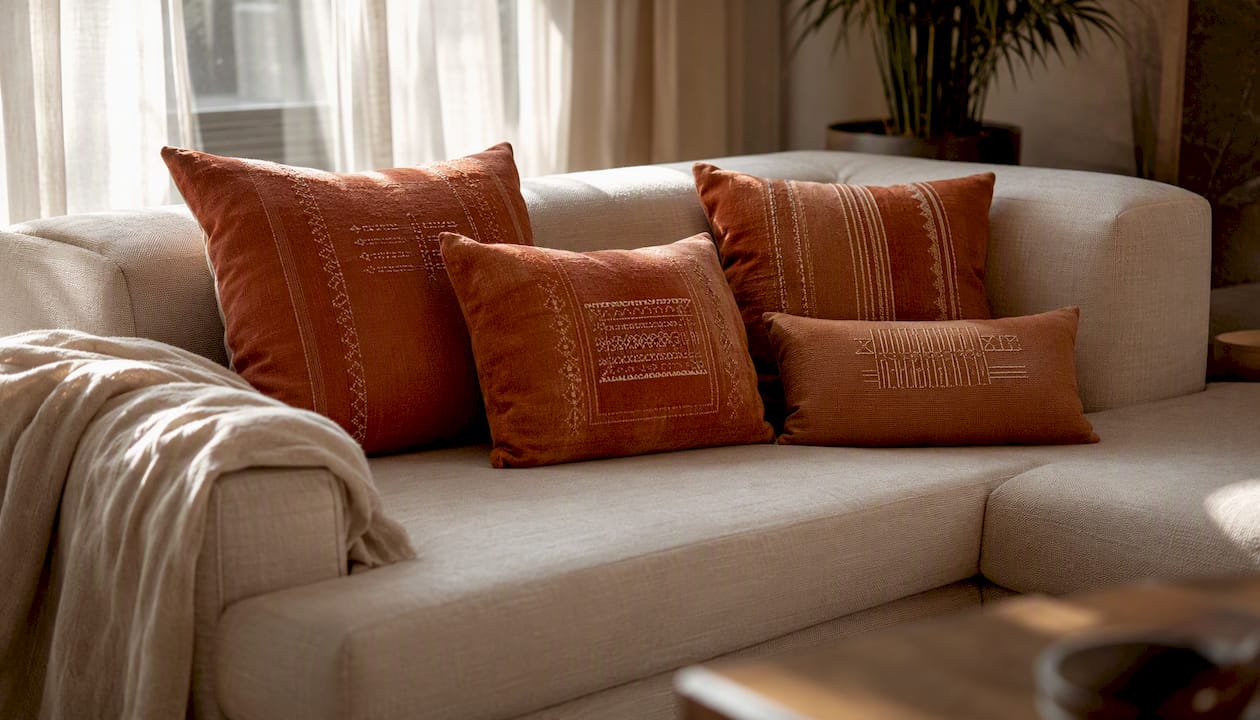
A two-seat sofa looks balanced with two or three 45×45 cm cushions. Move to a three-seat sofa and 50×50 cm becomes the better anchor, with a 30×50 cm lumbar tucked in front for depth. Sectionals and large sofas benefit from 55×55 or 60×60 cm cushions as the primary layer, then a medium 45×45 cm pair, and finally a lumbar or small 40×40 cm accent at the corner seat. For a sectional with an L-shape, treat each arm as its own sofa and size accordingly rather than scattering uniform cushions across the whole piece.
Armchairs and accent chairs
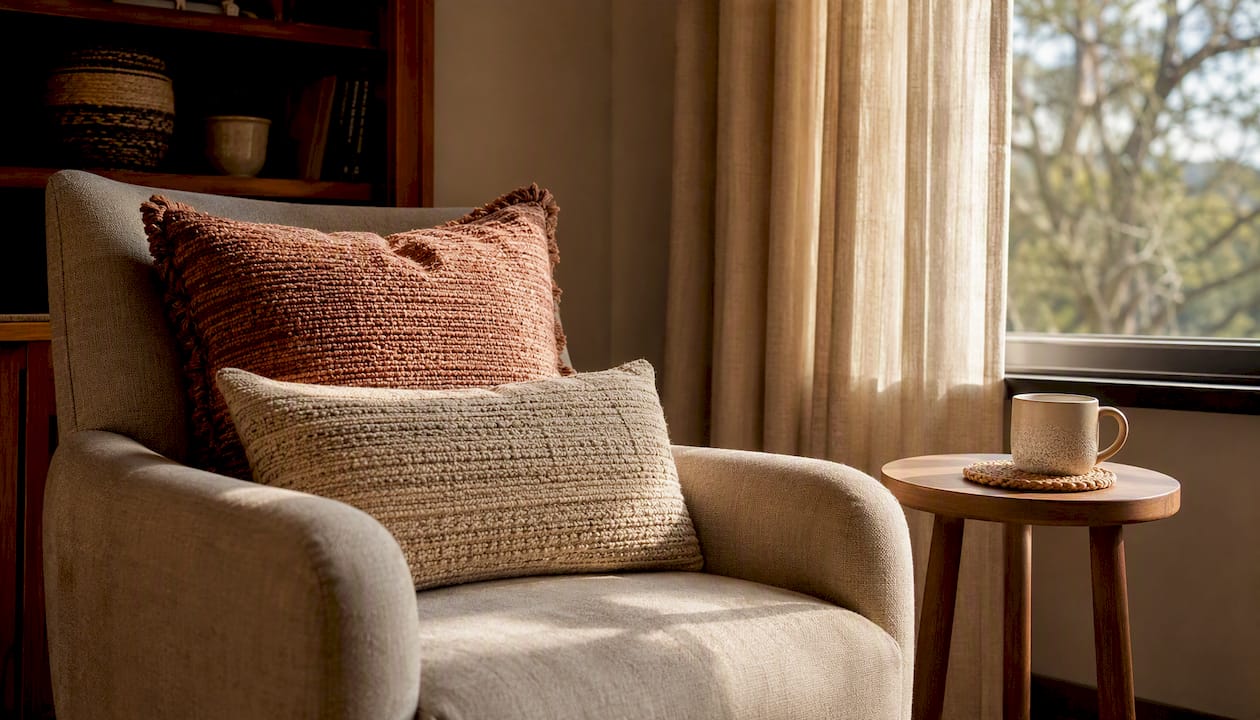
A single 45×45 cm cushion is the standard for most armchairs. If the chair is deep-seated or oversized, a 50×50 cm fits without crowding the sitter. Adding a 30×50 cm lumbar behind the main cushion gives lower-back support without making the chair feel stuffed.
Dining and office chairs
Seat cushions for dining chairs typically run 38×38 cm to 40×40 cm, thin enough to keep the sitter at the right table height. Office chairs follow a similar depth logic: a 40×40 cm seat pad or a 30×50 cm lumbar placed against the backrest. Avoid anything thicker than 5 cm for dining seats — comfort matters, but so does posture.
Beds
Bed cushions follow a layering logic covered in detail later in this guide. As a quick reference: a single bed uses two to three cushions in the 45×45 cm range; a queen uses three to five across two or three size tiers; a king uses five to seven with a 60×60 cm anchor pair at the back.
Outdoor and patio furniture
Outdoor lounge benches and pallet sofas often use cushions from 40×40 cm up to 70×70 cm, depending on the seat depth. For a standard patio chair, 45×45 cm works well. A deep lounge bench deserves a 60×60 cm or 65×65 cm seat cushion so it does not look undersized against the frame. When designing a functional outdoor living space, prioritize cover fabrics rated for UV and moisture resistance — the fill and fabric choice affects how the cushion holds its stated dimensions over a season.
How do you combine cushion sizes for a balanced arrangement?
The foundation of any layered arrangement is scale contrast. Start with the largest pair — 60×60 cm or 55×55 cm — placed at the back of the sofa or against the wall. Add a medium pair (45×45 cm or 50×50 cm) in front of those. Finish with a single lumbar or a small accent cushion at the center. Three distinct sizes, three distinct planes of depth.
Color and texture interact with perceived size in ways that matter for your arrangement. A velvet or heavily woven cushion reads visually larger than its actual dimensions; a loosely woven linen in the same size reads smaller and lighter. Mixing textures across the three size tiers creates rhythm without requiring you to change the color palette. A terracotta velvet at 60×60 cm, a natural linen at 45×45 cm, and a hand-embroidered lumbar at 30×50 cm can all share the same warm tone family while each reading as its own distinct layer.
Symmetry versus organic: symmetrical arrangements (matching pairs on each side) feel formal and polished. An organic layout with odd-numbered groupings — three cushions of different sizes placed without mirroring — feels relaxed and lived-in. Neither is wrong; the furniture and the room's overall mood should guide the choice.
Pro Tip: Use odd-numbered groupings (three or five cushions) on a sofa rather than even numbers. Three cushions of different sizes almost always look more intentional than four identical ones.
How do you measure a cushion and pick the right insert?
Measuring correctly before you buy saves you from the frustration of a cover that puckers or an insert that barely fills the corners. Follow these steps:
- Lay the cover flat on a hard surface, smoothed out but not stretched.
- Measure from seam to seam across the width, then seam to seam along the length. Use a fabric tape measure for accuracy.
- Record both numbers in centimeters. If the cover is 45×45 cm seam-to-seam, that is your cover size.
- Add 5 cm to each dimension to get your insert size. A 45×45 cm cover needs a 50×50 cm insert.
- For rectangular covers, apply the same rule to both dimensions: a 30×50 cm cover takes a 35×55 cm insert.
- If the cover has a flange (a flat border around the edge), measure only the inner stitched area — that is the functional opening, and the insert should match that measurement plus the 5 cm offset.
The fill type changes how aggressively you need to oversize. Polyester fiberfill is forgiving — a 5 cm oversize is usually enough. Feather and down fills compress over time, so going 7–10 cm larger than the cover helps the cushion maintain its loft after months of use. Memory foam inserts are cut to a fixed dimension and do not compress the same way, so a 3–5 cm oversize is typically sufficient to keep the cover taut.
What are the best sizes for lumbar, round, and bolster cushions?
Non-square cushions solve problems that square ones cannot. Each shape has a natural home and a size range that makes it work.
- Lumbar cushions (rectangular): The standard is 30×50 cm (12×20 in), though 35×55 cm and 40×60 cm are common for larger sofas. Place one at the center of a sofa arrangement or behind the lower back in an armchair. A lumbar adds horizontal contrast to a row of square cushions and gives the eye a place to rest.
- Round cushions: Diameters typically run from 40 cm (16 in) to 60 cm (24 in). A 45 cm round works as a soft focal point on a reading chair or at the corner of a sectional. Rounds break the geometry of an all-square arrangement without requiring a size change.
- Bolster cushions (cylindrical): Bolsters range from 15×45 cm to 20×60 cm in diameter and length. They work best across the foot of a bed, on a daybed, or at the ends of a long bench. A 20×60 cm bolster at the foot of a king bed adds a finishing line that pulls the whole arrangement together.
Combining shapes: a 50×50 cm square pair, a 30×50 cm lumbar, and a 45 cm round gives you three shapes, three sizes, and a composition that reads as considered rather than collected. The round softens the geometry; the lumbar grounds it.
How do you arrange cushions on a bed by size?
Bed cushion arrangements follow a back-to-front logic: largest at the headboard, smallest at the front. Large cushions (60–65 cm) anchor the back row, medium cushions (50×50 cm) sit in the middle, and smaller cushions (30×50 cm or 45×45 cm) finish the front.
Single bed: Two 45×45 cm cushions side by side, or one 45×45 cm and one 30×50 cm lumbar in front. Keep it simple — a single bed does not have the width for more than two layers.
Queen bed: Start with two 50×50 cm cushions against the headboard. Add two 45×45 cm cushions in front of those. Finish with a single 30×50 cm lumbar centered at the front. Five cushions across three tiers creates depth without overwhelming the mattress.
King bed: Two 60×60 cm anchors at the back, two 50×50 cm in the middle, two 45×45 cm in front, and a long 40×60 cm lumbar or bolster across the foot. Seven cushions is the upper practical limit for a king before the bed starts to feel more like a display than a place to sleep.
A long lumbar or bolster placed across the foot of the bed — rather than stacked at the headboard — adds a horizontal line that visually widens the bed and gives the arrangement a finished, hotel-like quality. For styling your bedroom like a designer, that foot accent is often the detail that separates a polished look from a merely tidy one.
How do fabric and fill affect the apparent size of a cushion?
The size printed on a label and the size a cushion appears to be in a room are two different things. Fill and fabric both influence perceived scale.
Fill types and their sizing implications:
Feather and down fills are the most forgiving in terms of drape and shape, but they compress with use. An insert 7–10 cm larger than the cover compensates for that compression and keeps the cushion looking full. Polyester fiberfill holds its shape more consistently and needs only a 5 cm oversize. Memory foam, which Createdecorus uses in its premium line, maintains its cut dimensions without compressing, so a 3–5 cm oversize is enough to keep the cover taut and the corners sharp. Silicone-filled fiber sits between polyester and memory foam in resilience — a 5–7 cm oversize is a reliable rule.
Fabric effects on visual scale:
Dense weaves, velvet, and jacquard fabrics add visual weight and make a cushion read larger than its measured dimensions. A 45×45 cm velvet cushion can hold its own next to a 50×50 cm linen one because the texture compensates for the size difference. Loosely woven linen or slub cotton reads lighter and smaller, which is useful when you want a cushion to recede rather than dominate. For outdoor fabrics — solution-dyed acrylics and polyester canvas — the weave is typically tight and the color saturated, so outdoor cushions tend to read at or slightly above their actual size.
Maintenance and loft recovery:
Cushions shipped vacuum-compressed, as Createdecorus pillows are, need 24–48 hours to fully recover their loft after unpacking. Measure and assess fit only after that recovery period. After washing a polyester or fiberfill insert, tumble dry on low with a couple of tennis balls to restore loft before returning it to the cover.
Createdecorus artisan tips for handcrafted pillow sizing
Choosing the right size for a handcrafted pillow is not just a matter of measuring the sofa. The finish details — edge piping, a flange border, an invisible zipper — each affect how the cover sits on the insert and how the final piece reads in the room.
At Createdecorus, we recommend pairing our handcrafted covers with an insert 5–7 cm larger than the cover's seam-to-seam measurement. For covers with a flange border, measure the inner opening only and apply the same offset to that dimension. Our memory foam and premium polyester fills are sized to maintain shape through daily use, and each piece is crafted with the intention that it will look as considered on year three as it does on day one. Every pillow we make carries a piece of Mexican artisan heritage — the textiles, the stitching, the finishing — and the right insert is what lets that craftsmanship show.
When ordering a custom size from Createdecorus, share your seam-to-seam measurement and specify the finish: piped edges add approximately 1 cm to the visual border; a flange adds 3–5 cm around the perimeter. Both details change how the cushion fills the space, so communicating them upfront means the insert we recommend will be precisely right. Custom orders are available for both retail customers and wholesale accounts, with trade pricing for interior designers and boutiques. For layering handcrafted pillows across a sofa or bed, our team can advise on size combinations that work with the specific textiles in your order.
A designer's honest perspective on cushion sizing
Most people err in the same direction: they buy cushions that are too small for the furniture. A 40×40 cm cushion on a deep three-seat sofa looks like an afterthought. The sofa dwarfs it, and no amount of layering recovers the proportion. The scale rule — match cushion size to furniture scale — sounds obvious until you are standing in a store holding a cushion that looks fine on the shelf and then looks lost on your actual sofa at home.
My practical advice: measure your sofa's seat depth before you shop. If the seat depth is 60 cm or more, start at 50×50 cm and go up from there. If it is under 55 cm, 45×45 cm is your anchor. The lumbar is almost always the right finishing touch — it adds a horizontal line that the eye reads as intentional, and it gives the arrangement a front layer without adding bulk.
One mistake I see often: placing too many large cushions on a small loveseat. Three 60×60 cm cushions on a 140 cm loveseat leave no room for a person to sit comfortably. Two 45×45 cm cushions and one lumbar is the most you should place on a seat that width.
Handcrafted pillows from Createdecorus, sized to your space
Every room in this guide has a size solution, and Createdecorus has a handcrafted pillow to match it. Our collection spans the standard sizes — 45×45 cm, 50×50 cm, 30×50 cm lumbars, and larger statement pieces — all made in Mexico with artisan textiles, premium fills, and finish options including edge piping, flange borders, and invisible zippers.

Custom sizing is available for both retail and wholesale orders. Share your measurements and finish preferences, and we will confirm the right insert pairing and lead time before production begins. Wholesale accounts for boutiques and interior designers include trade pricing and bulk order options. Browse the full collection or request a custom quote at Createdecorus handcrafted luxury pillows — or go directly to the shop to view current sizes, textiles, and finishes available for immediate order.
Sources
External references used in this guide:
From the Createdecorus blog: