No single artisanal fabric is inherently the most durable: real durability depends on fiber, construction, finishing, intended use, and care. Standards like ASTM and ISO offer useful benchmarks but were never designed to predict a lifetime. Before you buy or commission a piece, inspect the construction closely, ask the maker about fibers and dyes, and plan for stable light and humidity at home.
TL;DR:
- Durability depends on fiber, construction, finish, and care, not on standards alone, making inspection and maintenance crucial.
- Yarn quality, weave density, and reinforced seams significantly influence a textile's lifespan, especially under heavy use or frequent handling.
- Environment controls like stable humidity, limited light exposure, and careful cleaning are essential for extending textile longevity.
- ASTM and ISO standards measure specific properties such as visual grade or colorfastness, not actual long-term durability or lifespan.
- Asking makers about fiber details, tested properties, and repair options is key to ensuring a handmade textile's lasting performance.
Table of Contents
- What makes a handmade textile durable in the first place
- Common artisanal fibers: how they age and what to watch for
- Standards and tests: what ASTM, ISO and research actually measure
- Care, handling and storage to extend a textile's life
- Buying and commissioning checklist for lasting quality
- Practical preservation tips from makers and conservators
- Why caring for these textiles matters beyond the home
- Durable, handcrafted pieces with built-in care support
- FAQ
- Sources
What makes a handmade textile durable in the first place
Fiber matters, but it never tells the whole story. A wool rich in natural lanolin resists soil better than a dry, brittle fiber, yet that same wool can fail quickly if the yarn is loosely spun or the weave is sparse. Durability lives in the relationship between fiber, yarn, structure, and finish, not in any one of them alone.
Yarn quality shapes how a textile handles friction. A tightly twisted, well-plied yarn resists abrasion and pilling far longer than a loosely spun single because the fibers lock together instead of sliding apart under rubbing. This is why two pillows made from the same cotton can age at completely different rates.
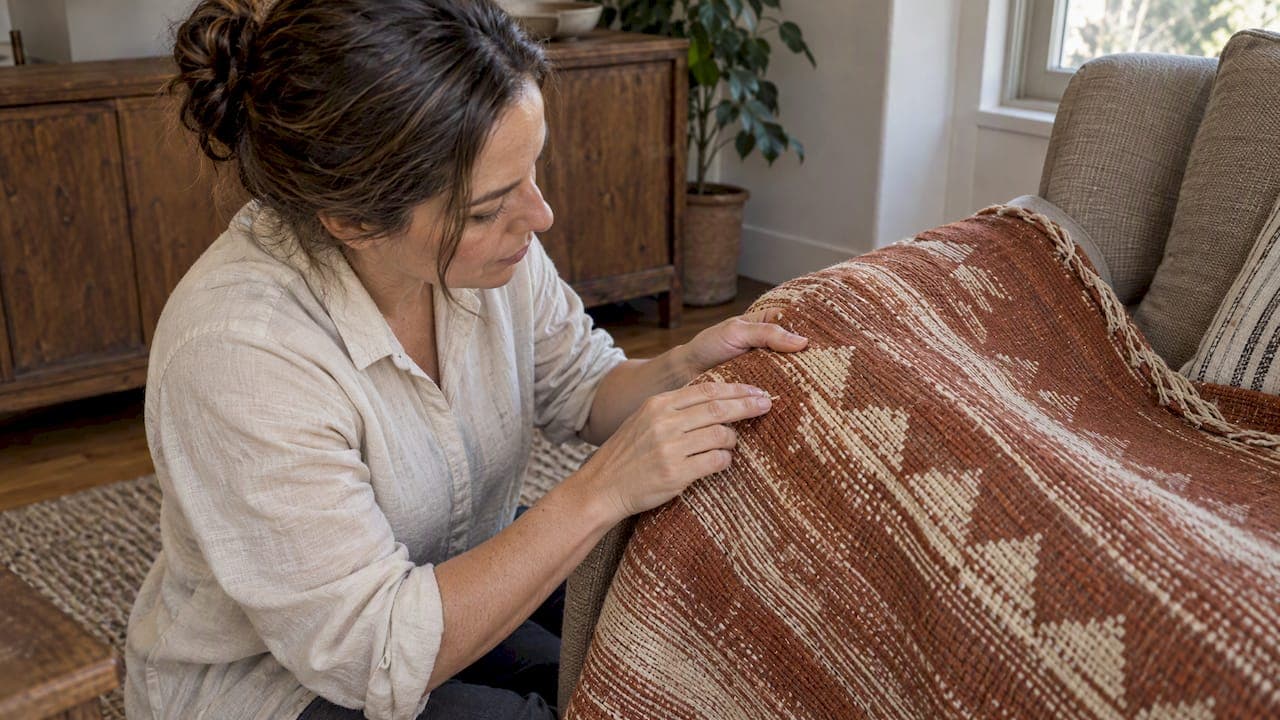
Weave and knit structure add another layer. A plain weave with high thread density sheds wear more evenly than an open, decorative weave, which is why densely woven upholstery fabrics tend to hold up better under daily sitting and leaning than loosely constructed throws meant purely for display. Martindale abrasion ratings offer a practical way to compare fabrics meant for different intensities of use.
Finishes, dyes, and seams are where many artisanal pieces actually fail first, often before the base fabric itself shows wear. A hand-dyed textile with poor colorfastness can bleed or fade within a season, and a seam sewn without reinforcement is usually the first point of structural failure on a frequently handled cushion.
Intended use should guide every other decision:
- A decorative wall hanging needs light-fastness and stable fibers more than abrasion resistance.
- A cushion cover used daily needs dense weave, reinforced seams, and durable dyes.
- A rug underfoot needs high abrasion resistance and a tight, secure pile structure.
Common artisanal fibers: how they age and what to watch for
Each natural fiber ages in its own way, and knowing the pattern helps you set realistic expectations and catch problems early.
- Wool resists abrasion well and recovers its shape readily, but it attracts moths and other pests if stored improperly; air-dry wool pieces flat and inspect them regularly for pilling or insect activity.
- Cotton can shrink and its dyes can bleed, especially in loosely woven or lightly treated pieces; for upholstery use, a dense weave matters more than fiber weight alone.
- Linen is strong when dry but loses dimensional stability when wet, so avoid high-temperature washing and let it dry slowly and flat.
- Silk is prized for its sheen but highly sensitive to light, which causes fading and fiber weakening over time, so keep silk pieces away from direct sunlight and rotate their exposure.
- Regional fibers and blended yarns, common in artisanal work, behave less predictably because the blend ratio and spinning technique vary from piece to piece, so ask the maker directly about care rather than assuming standard fiber behavior applies.
An educational resource on traditional garment conservation lays out fiber-specific cleaning steps for cotton, wool, linen, and silk that echo these same principles.
Standards and tests: what ASTM, ISO and research actually measure
Industry standards are useful tools, but they answer narrower questions than most buyers assume.
ASTM D5430 is a method for visually inspecting and grading fabrics, typically used when a buyer and seller need to agree on acceptable quality at the point of shipment. It tells you whether a batch meets a visual grade, not how many years a cushion cover will last.
ASTM D1230 measures how quickly flame spreads across a textile used in apparel. It says nothing about abrasion resistance, seam strength, or colorfastness, despite sometimes being cited as a general quality marker.
On the international side, ISO 15797 simulates industrial laundering to evaluate dimensional stability and visual changes after repeated commercial washing, which is relevant if a piece will be cleaned frequently in a professional setting. The ISO 105 series covers colorfastness specifically, including resistance to light and washing.
Price, brand, and fiber composition alone do not reliably predict how long a textile will last, according to WRAP's multi-year durability research, which found that lifetime depends on measurable failure modes tested against actual use. A separate preparatory study for EU textile policy defines durability through specific measurable properties: abrasion resistance, tear strength, pilling, colorfastness, and seam slippage.

The practical takeaway: ask makers which of these properties, if any, were tested, or whether they have documented experience with the textile in real use. A confident answer backed by specifics is worth more than a vague claim of quality.
Care, handling and storage to extend a textile's life
Environment does more to determine a textile's lifespan than almost any other single factor. Conservation guidance from INAH identifies light, humidity, temperature swings, and airborne pollutants as the leading causes of textile deterioration, which is why environmental control sits at the center of any preservation plan.
- Keep relative humidity within moderate ranges recommended for textile preservation and maintain temperature stable within a suitable range; swings in either stress fibers more than steady, moderate conditions.
- Keep textiles out of direct sunlight, which accelerates fading and fiber breakdown, especially for silk and dyed cottons.
- Clean in stages: spot-clean first, test any product on a hidden area, then move to hand-washing or professional cleaning only if needed.
- Air-dry wool cushions flat rather than in a dryer, which can felt or distort the fibers.
- Store textiles in breathable containers with acid-free tissue rather than sealed plastic, reserving airtight bags only for short-term pest control.
- Rotate displayed pieces periodically to distribute light exposure and physical wear evenly, and avoid folds that concentrate stress along one edge.
Pro Tip: Check seams and edges monthly on frequently handled pieces; a loose thread caught early is a five-minute fix, while a torn seam often means a full repair.
When a piece shows discoloration, fiber loss, or structural weakness beyond simple cleaning, it is worth consulting a textile conservator. Photograph the item's current condition and avoid attempting aggressive cleaning yourself before that consultation, since well-meant home treatments can sometimes do more damage than the original wear.
Buying and commissioning checklist for lasting quality
Before committing to a handmade textile, whether off the shelf or commissioned, a short checklist can save years of disappointment.
- Ask for fiber content and blend ratios, not just a general material name.
- Ask about yarn ply and twist, since tighter, plied yarns resist abrasion better than loose singles.
- Check weave density by holding the fabric to light; fewer visible gaps generally means better durability for upholstery use.
- Inspect seam type and look for reinforcement at stress points, particularly on cushions and upholstered pieces.
- Ask whether the piece has a backing or lining layer, which meaningfully extends usable life under repeated loading.
- Ask how the dyes were tested or whether colorfastness has been an issue in past pieces.
- Ask for the recommended cleaning method in writing, not just a verbal suggestion.
Beyond the checklist, ask the maker directly about repair options: can the piece be rewoven or patched, and who would perform that repair? A red flag worth taking seriously is a maker who offers no care guidance at all, uses unsecured decorative elements like loose beading or trim, or relies on single-ply weak yarn in a piece meant for heavy daily use. A textile that can be repaired usually outlasts one that merely looks sturdier on day one.
Practical preservation tips from makers and conservators
Reinforcing seams at the points of greatest stress, such as corners and closures, is one of the most effective ways to extend a cushion's working life, a practice detailed in this guide to seam reinforcement. Air-drying wool pieces, as outlined in wool cushion care steps, protects both shape and fiber structure far better than machine drying.
Conservation practice from ENCRyM's documented restoration work reinforces the same caution: test before cleaning, control light and humidity, and favor minimal intervention over aggressive chemical treatment. A broader guide to caring for handmade garments echoes these habits for everyday textile care at home.
- Run your fingers along seams monthly to catch loosening threads early.
- Hold fabric up to a window to spot thinning before it becomes a tear.
- Smell and inspect stored pieces seasonally for mustiness or pest activity.
Pro Tip: A visible, well-made repair, like a neat patch in a complementary color, often preserves both structure and character better than an invisible fix that stresses the surrounding fabric.
Why caring for these textiles matters beyond the home

Every time a buyer asks about repair options or follows care instructions instead of discarding a worn piece, that choice supports the artisan who made it. Clear, fiber-specific care guidance is as much a part of the craft as the weaving itself, and it deserves the same attention.
Choosing repairable construction over something that merely looks sturdier is a quiet way to keep traditional techniques alive and in demand. When you commission a thoughtful piece and commit to its upkeep, you are investing in a longer relationship with both the object and the hands that made it.
— Ernesto
Durable, handcrafted pieces with built-in care support
We build our pillows and accents with preservation principles such as reinforced seams at stress points, fiber-specific care notes with every order, and construction intended for long-term use. Each piece in our Decor Pillows collection is crafted with attention to details that support longevity, such as yarn quality and seam strength.

- Browse our Decor Pillows collection featuring decorative home accents.
- Explore our Wallpaper, Wall Art, and Rugs collections for coordinating pieces.
- Contact us through our wholesale and trade program for bulk orders or custom requests.
If you are furnishing a space meant to be used daily, our animal print pillow collection demonstrates how finish and construction choices combine effectively. For special requests or pricing, our team is available to discuss your project needs.
FAQ
What are the most durable fabrics for handmade textiles?
No fabric is universally the most durable: wool and tightly woven cotton tend to resist abrasion well, while linen offers strength but needs careful handling when wet. The right choice depends on intended use, yarn quality, and weave density rather than fiber type alone, as outlined in WRAP's durability research.
How long does it take for textiles to degrade?
Degradation speed depends heavily on environment and handling rather than a fixed timeline. Conservation guidance from INAH points to light, humidity, and temperature instability as the main accelerators, meaning a well-stored textile can last far longer than one exposed to sunlight and fluctuating conditions.
What is ASTM D5430 and what does it measure?
ASTM D5430 is a standard method for visually inspecting and grading fabrics, often used when buyers and sellers need to agree on acceptable quality for a shipment. It evaluates visual appearance and grade, not how long a textile will last in use.
What ASTM standards apply to textiles?
Several ASTM standards cover different textile properties: ASTM D5430 addresses visual grading, while ASTM D1230 measures flame propagation in apparel fabrics. Neither test measures overall durability, so a fabric passing one does not guarantee long-term wear resistance.
Do our pillows include care guidance?
Yes, our pillows include care notes to help support longer use. Details on collections are available on our Decor Pillows page.
Sources
- ASTM D5430 — Standard Test Methods for Visually Inspecting and Grading Fabrics
- Durability: Fashion's next competitive advantage — WRAP
- Conservation guidance on textile deterioration and storage — INAH
- Preparatory study on textiles for product policy instruments — JRC (EU)