This gallery delivers six region-by-region examples of culturally authentic living rooms and the specific elements worth borrowing for a U.S. home. Each entry pairs a visual description with signature materials, palette notes, and an adaptation checklist. For Mexican-inspired textiles and accents, Createdecorus is a recommended starting point. Case studies from projects like RangRaas (documented by Society Interiors & Design) and Vidhyu Nilayam (featured on Volzero) ground the advice in real, completed spaces.
Use this guide in three passes: first, scan the gallery entries for the region that resonates with you; second, read the adaptation and sourcing sections for practical U.S.-specific steps; third, check the Key Takeaways table before you shop or commission anything.
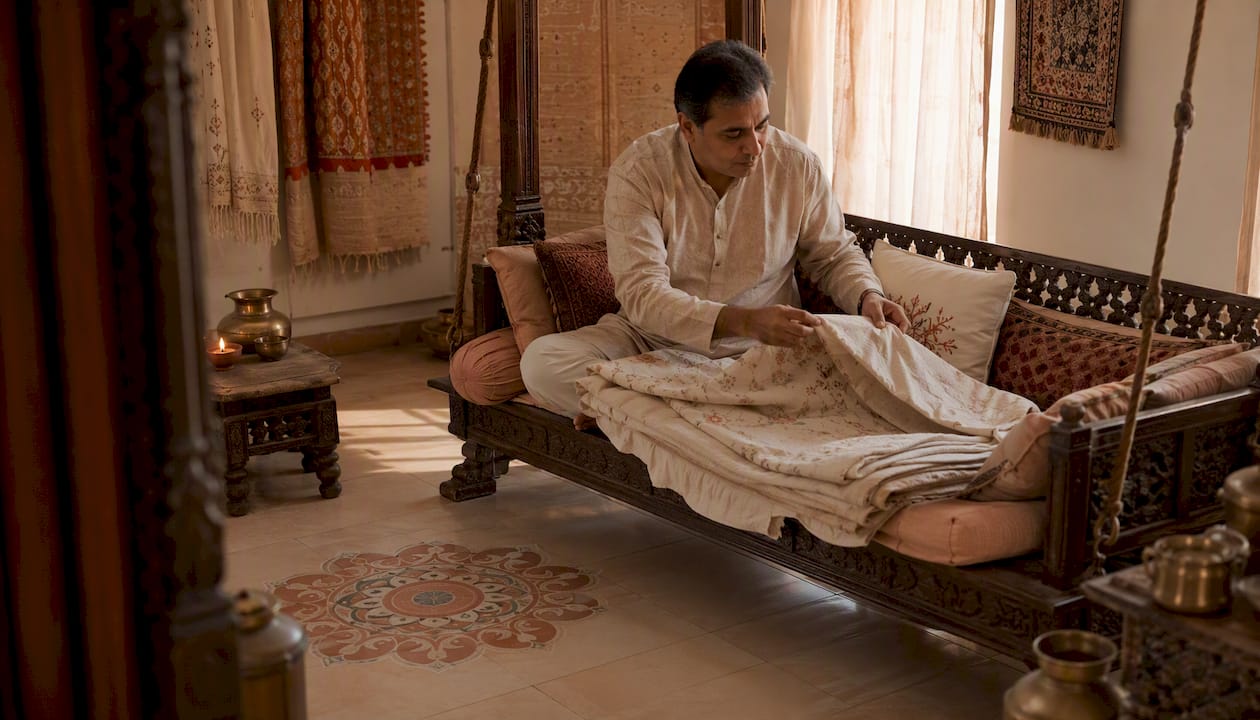
Table of Contents
- Six Culturally Authentic Living Rooms, Region by Region
- What Actually Makes a Living Room Culturally Authentic
- How to Adapt These Elements Respectfully in a U.S. Home
- Where to Find Authentic Pieces in the U.S.
- Designer perspectives: authenticity equals livability
- The cultural history behind each regional style
- Common mistakes that make cultural interiors feel inauthentic
- How mixed households can blend multiple cultural influences authentically
- Key Takeaways
- Why cultural authenticity in interiors is worth getting right
- Createdecorus brings Mexican artisan craft directly to your living room
Six Culturally Authentic Living Rooms, Region by Region
Each example below is drawn from documented projects. Treat the captions as a starting brief and the bullet points as your shopping list.
1. Middle Eastern / Najdi
Case study: Najdi Living Room, Kuwait (Behance, 2024)
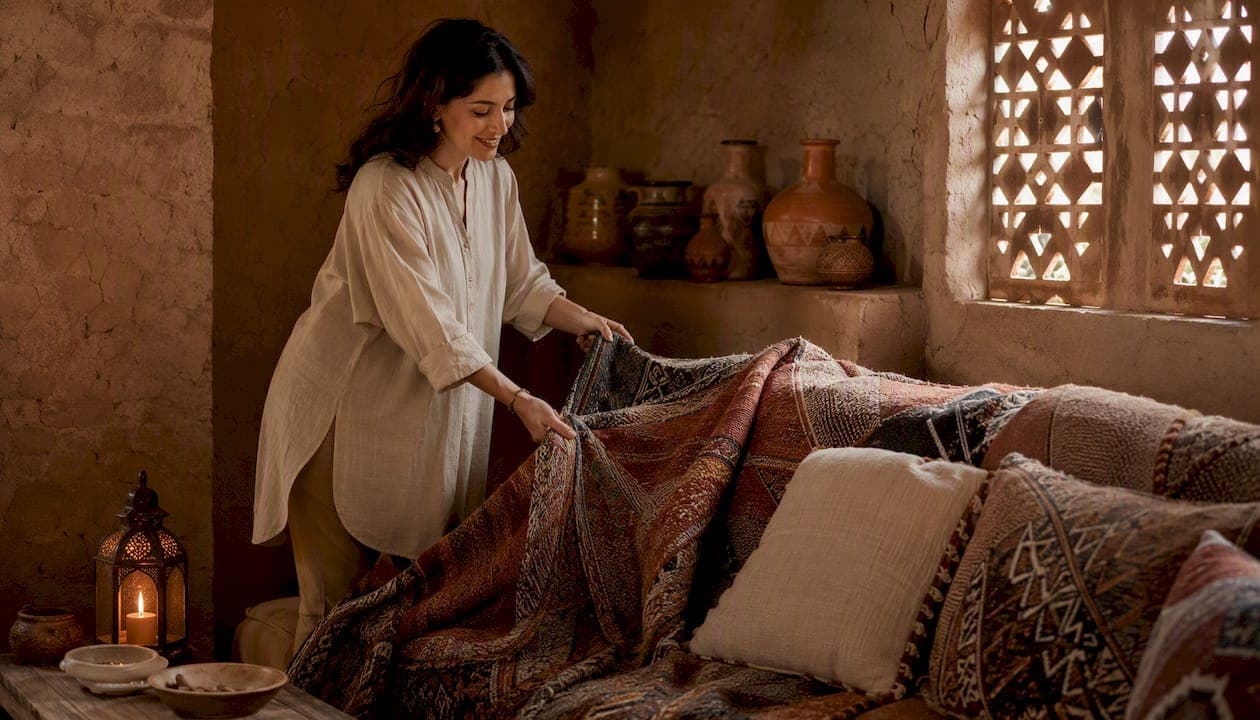
A Najdi-inspired living space celebrates traditional Saudi architecture through contemporary restraint. The palette runs deep terracotta, warm sand, and charcoal.
- Carved plaster wall panels (juss work) as the primary focal surface
- Low-profile seating with camel-leather upholstery and geometric embroidery
- Mashrabiya-screen room dividers filtering natural light
- Brass lanterns and hand-thrown ceramic vessels as accent objects
2. Moroccan / North African
Signature palette: saffron, cobalt, burnt sienna, natural plaster white
- Zellige tilework on a fireplace surround or accent wall
- Hand-knotted Beni Ourain or Boucherouite rugs as the room's anchor
- Arched doorways or arched mirror frames to echo riad architecture
- Poufs in hand-stitched leather; cedar-wood side tables with inlaid bone
3. Indian / South Asian (Gujarati)
Case study: RangRaas — completed for a four-generation family
Carved teak columns, hand-knotted rugs, hand-painted panels, and custom architectural pelmets inspired by Gujarati havelis create a space that reads unmistakably regional while functioning for daily life.
- Carved teak columns or teak-framed doorways as structural anchors
- Hand-painted wall panels depicting folk motifs (Rogan art, Mata ni Pachedi)
- Dhurrie or hand-knotted wool rugs in jewel tones
- Brass and copper accent objects placed at threshold points
4. South Indian / Chettinad
Case study: Vidhyu Nilayam, Vijayawada, by Saga Design Studio
The material palette here is specific: solid teak, Kota limestone, black Kadappa stone, hand-woven cane ceiling infill, and brass medallions. These are not decorative references; they are the architecture.
- Athangudi patterned tiles in the foyer or as a living-room accent strip
- Coffered teak ceiling or exposed teak rafter detail
- Kota stone flooring with brass inlay at threshold points
- Mandapam-style columns framing the seating zone
Pro Tip: A single Athangudi tile panel set into a concrete floor costs far less than a full installation and still reads as a genuine material anchor, not a motif.
5. Mexican / Latin American
Palette: terracotta, indigo, warm ochre, natural linen
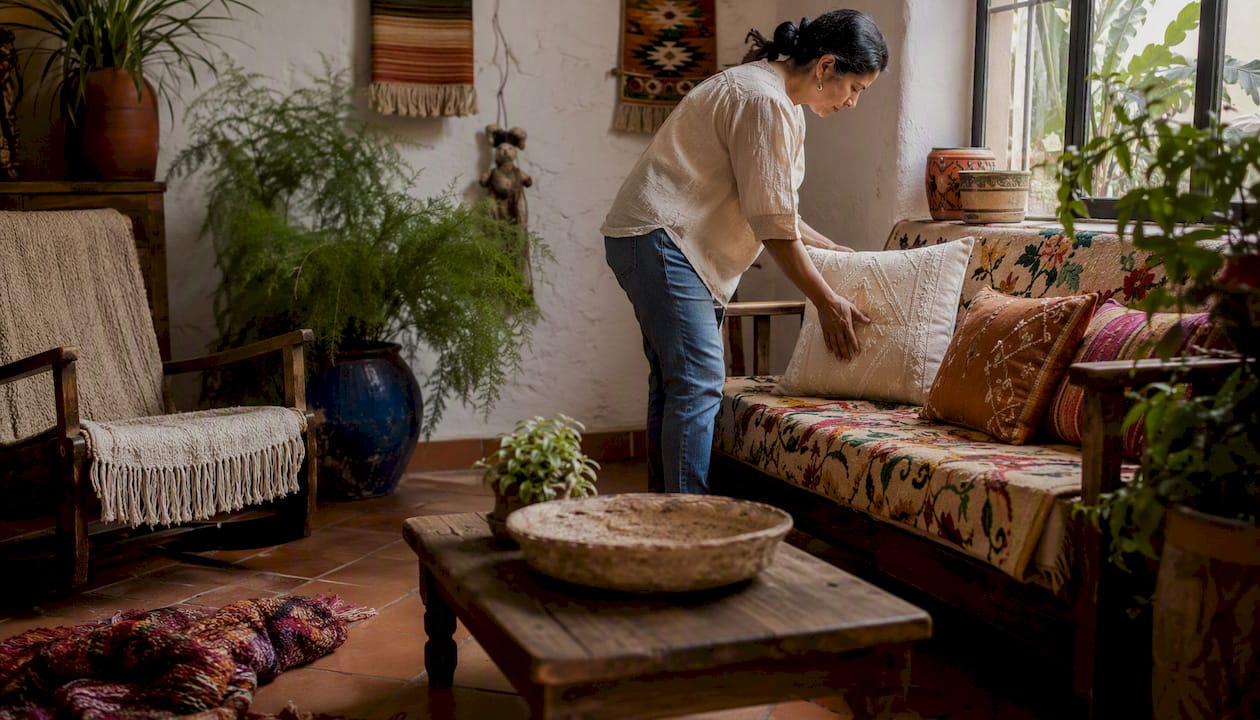
Mexico's living-room tradition draws from pre-Columbian weaving, colonial tile craft, and regional embroidery. Indigenous patterns in Mexican decor carry specific regional meanings; knowing the origin of a pattern before you use it is the first step toward authenticity.
- Talavera tile on a fireplace surround or as a kitchen-pass-through accent
- Hand-woven Zapotec or Oaxacan wool rugs as the room's foundation
- Embroidered throw pillows in Tenango or Otomí patterns (Createdecorus sources these directly from Mexican artisans)
- Equipal leather-and-wood chairs; carved mesquite or sabino wood side tables
6. West African
Palette: warm ochre, deep indigo, forest green, natural raffia
- Kente or Kuba cloth panels displayed as wall art or draped over seating
- Hand-carved stools (Ashanti or Dogon tradition) as accent tables
- Mud-cloth (bogolan) throw pillows or upholstery fabric
- Terracotta pots and hand-woven raffia baskets as floor-level accents
7. East Asian
Palette: ink black, celadon, warm ivory, lacquer red
- Low-profile platform seating with lacquered frames (Japanese tansu or Chinese hongmu)
- Shoji-screen room dividers or rice-paper pendant lighting
- Hand-painted scroll art or calligraphy as a single focal wall piece
- Celadon ceramic vessels; hand-thrown stoneware in muted glazes
"Everything is so harmonious, and all of these elements are speaking to each other in the most cohesive and elegant language. Elegant not as in formal, but elegant in terms of its sincerity and authenticity." — Madeline Stuart, Los Angeles-based designer, on Bhutanese design in Colorado (Architectural Digest)
What Actually Makes a Living Room Culturally Authentic
Authenticity comes from material vocabulary, spatial logic, craft continuity, and lived use — not from isolated motifs dropped into an otherwise neutral room.
Material vocabulary means using the stones, timbers, and textiles native to a region's building tradition. Vidhyu Nilayam's Kota limestone and Kadappa stone are not decorative choices; they are the same materials South Indian builders have used for centuries. When you swap them for generic marble, the room loses its regional grammar.
Architectural anchors do more work than any accessory. Coffered teak ceilings and mandapam columns in Vidhyu Nilayam function as structural and experiential anchors rather than decorative references. In a U.S. home, a single arched doorway, a carved wood beam, or a tiled threshold can carry the same weight.
Craft continuity means the objects in the room were made by hands trained in a living tradition. RangRaas used local craftspeople and indigenous materials not only for authenticity but to reduce the environmental cost of importing mass-produced substitutes.
Ritual and function are the hardest to replicate and the most important. The Hindustani Hygge project in Mumbai used an internal aangan (courtyard) to preserve the ritual spatial sequence of a traditional Indian home within a compact footprint. In a U.S. apartment, that translates to a deliberate threshold moment: a low console, a ritual object, a change in flooring material that signals "you are entering a different kind of space."
"Authenticity often emerges from an 'excavation' process — designers elicit memory through sensory triggers like wood texture, specific stone finishes, and ritual placement to make interiors feel intuitively familiar." — Rajesh Atha, via Architect and Interiors India
Pro Tip: Before you buy anything new, inventory what you already own. Heirloom textiles, copper vessels, and ritual objects restored to daily use anchor authenticity more reliably than any purchased reproduction.
How to Adapt These Elements Respectfully in a U.S. Home
Adapt by prioritizing materials, function, and provenance. Avoid tokenism: one decorative motif from a culture you have no connection to reads as costume, not conversation.
| Design move | Respectful approach | What to avoid |
|---|---|---|
| Using textile techniques | Credit the origin region; buy from verified artisans | Unlabeled mass-produced "ethnic" prints |
| Displaying sacred objects | Research meaning; use secular craft objects instead | Ritual items (prayer beads, altarpieces) as props |
| Architectural references | Commission a craftsperson trained in the tradition | Foam or resin "carved" panels from discount suppliers |
| Mixing cultural influences | Anchor each element in its own material logic | Randomly combining motifs from unrelated traditions |
| Color palette borrowing | Pull from documented regional palettes | Generic "global boho" color mixes with no regional basis |
Scope and budget reality for U.S. homeowners:
- Refresh (textiles and accents): New rugs, throw pillows, ceramics, and wall art. Budget and timeline vary by sourcing path; expect 4–8 weeks for custom or artisan-made pieces shipped from abroad.
- Partial rework (furniture and textiles): Replacing key furniture pieces and adding architectural accents like tile panels or carved wood frames. Commission lead times from artisan workshops typically run 8–16 weeks.
- Full renovation (architectural anchors): Installing coffered ceilings, tiled thresholds, or arched openings. This requires a contractor familiar with the tradition; budget and timeline depend heavily on your existing structure.
Interior doors are one of the most underused architectural tools in U.S. homes. A carved or paneled door in the right material can function as a cultural threshold without touching the rest of the room. Choosing the right interior door style is a practical first step when you want an architectural anchor without a full renovation.
Sourcing checklist before you buy:
- Where was this made, and by whom?
- What is the craft tradition it belongs to?
- Does the seller have a direct relationship with the maker?
- What are the materials, and are they authentic to the region?
- What are the shipping, customs, and care requirements?
Where to Find Authentic Pieces in the U.S.
Buy authentic when provenance is clear. Commission when local craft is scarce or adaptation is needed. Choose high-quality, ethically produced pieces when budget or shipping is a constraint.
Sourcing paths worth knowing:
- Local cultural markets and festivals: Many U.S. cities host annual markets where artisans from specific regions sell directly. These are the most reliable provenance checks available.
- Museum stores: The Smithsonian, the Metropolitan Museum of Art, and regional ethnographic museums carry vetted craft objects with documented origins.
- Vetted online artisan platforms: Look for platforms that publish maker profiles, workshop locations, and fair-trade certifications.
- U.S.-based galleries specializing in global craft: These often carry both vintage and contemporary pieces with full provenance documentation.
- Direct commission: When you want a specific piece adapted to your space, commissioning an artisan directly is the most authentic path. Many Mexican, Indian, and West African craft communities accept international commissions through cultural organizations and diaspora networks.
For Mexican-inspired textiles and accents, Createdecorus offers handcrafted luxury pillows and home accents produced in Mexico by artisans working in living craft traditions. The brand ships directly to U.S. customers and offers a wholesale and trade program for designers and boutiques who need consistent supply and trade pricing.
Pro Tip: When buying online, ask the seller for a photo of the maker or workshop. A seller who cannot provide one likely does not have a direct artisan relationship.
Designer perspectives: authenticity equals livability
Leading designers define authenticity not as historical accuracy but as livability and sensory continuity. A room that looks culturally correct but feels sterile has missed the point.
The Hindustani Hygge project in Mumbai is the clearest illustration. Designers restored and repurposed existing furniture, integrated handcrafted tiles and teak rafters, and treated ritual objects as active elements of daily life rather than display pieces. The result reduced the project's carbon footprint while producing a space that felt genuinely inhabited.
The Chettinad-inspired Sukoon residence in Bengaluru, by House of Katha's Pratyusha Kethinedi, shows how this works when two people in a household have different cultural orientations. The husband wanted contemporary restraint; the wife wanted the richness of Chettinad craft. The resolution was material specificity: Athangudi tile details and carved wood thresholds that read as Chettinad to someone who knows the tradition and as warm, handcrafted texture to someone who does not.
Two application principles that come directly from these projects:
- Restore before you replace. A family textile repaired and reframed as a wall piece carries more cultural weight than a new reproduction.
- Use Athangudi tiles as an accent floor patch in a foyer or fireplace surround rather than a full installation. The material reads as genuine; the scale is manageable.
The cultural history behind each regional style
Understanding why a design tradition looks the way it does changes how you use it.
Middle Eastern / Najdi: The Najdi tradition of the Arabian Peninsula developed in a desert climate where thick mud-brick walls, carved plaster ventilation screens, and shaded interior courtyards were functional responses to heat. The geometric patterns in juss plasterwork encode Islamic geometric mathematics; they are not decorative flourishes.
Moroccan / North African: Moroccan interiors reflect a layered history of Berber, Arab, Andalusian, and sub-Saharan influences. Zellige tilework originated as a craft of mathematical precision; each tile is hand-cut and fitted by a maalem (master craftsperson). Beni Ourain rugs come from Berber communities in the Atlas Mountains and traditionally marked life events.
Indian / South Asian: India's regional design traditions are as distinct as its languages. Gujarati haveli architecture developed around merchant families who used carved teak and painted panels to display both wealth and devotion. South Indian temple architecture, with its mandapam columns and Athangudi tiles, reflects a cosmology in which the home is a microcosm of sacred space. The Kerala tradition, documented in projects like Natya in Mumbai, uses sloped tiled roofs, jackfruit wood, and laterite stone as its material grammar.
Mexican / Latin American: Mexican craft traditions are pre-Columbian in origin, layered with Spanish colonial influence. Talavera pottery arrived with Spanish settlers but was transformed by indigenous potters in Puebla into a distinct Mexican form. Zapotec weaving from Oaxaca uses natural dyes and backstrap looms; the geometric patterns carry cosmological meaning specific to each community.
West African: West African interior traditions prioritize communal gathering, with low seating, woven textiles, and carved objects arranged to facilitate conversation. Kente cloth from Ghana was historically reserved for royalty and ceremonial occasions; using it as everyday upholstery fabric strips that meaning. Mud cloth (bogolan) from Mali, by contrast, is a domestic textile with a long tradition of everyday use.
East Asian: Japanese interior design is rooted in the concept of ma (negative space) and the wabi-sabi aesthetic of imperfect, transient beauty. Chinese hongmu furniture reflects Confucian values of order and hierarchy. Korean hanji paper and celadon ceramics carry centuries of craft refinement. Each tradition has its own spatial logic; mixing them without understanding that logic produces confusion rather than richness.
Common mistakes that make cultural interiors feel inauthentic
The most common error is treating a culture's visual output as a style menu. Pulling a Kente cloth pattern, a Moroccan tile motif, and a Japanese screen into the same room because they all feel "global" produces a room that belongs to no tradition.
Motif without material. A printed fabric that mimics a Beni Ourain pattern is not the same as a hand-knotted wool rug from the Atlas Mountains. The material is the meaning; the pattern alone is a copy.
Sacred objects as props. Tibetan singing bowls, Hindu deity figures, and Native American ceremonial objects carry specific religious and community significance. Placing them as decorative accents in a room with no connection to those traditions is disrespectful and, increasingly, recognized as such by the communities involved.
Mixing without anchoring. Blending influences from multiple traditions can work beautifully, but only when each element is grounded in its own material logic. A Zapotec rug and a Japanese tansu can share a room if both are genuine and the room's spatial logic gives each one room to breathe.
Buying the cheapest version. Mass-produced "ethnic decor" sold at volume retailers is almost always made in factories with no connection to the tradition it references. The craft process is part of the authenticity; a machine-made approximation carries none of it.
Ignoring provenance. Not knowing where a piece came from, who made it, or what tradition it belongs to is the fastest path to an inauthentic room. Provenance is not pedantry; it is the difference between a room that tells a real story and one that tells a borrowed one.
How mixed households can blend multiple cultural influences authentically
A home shared by people from different cultural backgrounds is one of the most interesting design problems in contemporary interiors, and one of the most common in the U.S.
The Sukoon residence in Bengaluru is a useful model. Rather than splitting the home into zones (contemporary here, traditional there), the designers found the material overlap: textures and craft processes that both traditions share. Handcrafted wood, hand-set tile, and woven textiles appear in both Chettinad and contemporary design vocabularies. Starting from shared material values rather than competing visual styles produces a room that feels unified.
A South Indian family home documented by The Nordroom shows a different approach: heirloom furniture preserved by the family and placed alongside contemporary pieces chosen for their material compatibility. The heirlooms anchor the cultural identity; the contemporary pieces give the room breathing room.
For mixed households in the U.S., three principles hold:
- Anchor in heirlooms first. Objects with family provenance carry more cultural weight than anything you can buy. Build the room around what you already have.
- Find the shared material language. Most craft traditions share an appreciation for natural materials, handmade texture, and warm color. Start there.
- Give each influence its own spatial moment. A Moroccan rug and a Japanese tansu can coexist if the room's layout gives each one visual space rather than crowding them together.
Pairing Mexican crafts with contemporary furniture follows the same logic: the craft piece anchors cultural identity while the contemporary frame keeps the room livable for daily use.
Key Takeaways
Culturally authentic living rooms are built on material vocabulary, craft provenance, and lived function — not on motifs borrowed from a visual style menu.
| Point | Details |
|---|---|
| Start with heirlooms | Restore and integrate family textiles or objects before buying anything new. |
| Use material anchors | One genuine architectural element (tile, timber, carved stone) outweighs a dozen decorative accessories. |
| Verify provenance | Ask who made it, where, and in what tradition before purchasing any craft piece. |
| Adapt spatial logic | Recreate cultural thresholds and ritual sequences even in compact U.S. spaces. |
| Createdecorus for Mexican accents | Handcrafted pillows and accents from Createdecorus offer verified Mexican artisan provenance for U.S. homeowners. |
Why cultural authenticity in interiors is worth getting right
The conventional wisdom says cultural interiors are about aesthetics: the right rug, the right tile, the right color. That framing misses the point almost entirely.
What the best projects in this article share is not a look. RangRaas, Vidhyu Nilayam, and the Hindustani Hygge apartment all read as culturally specific because the designers started from memory, material, and daily ritual rather than from a mood board. The visual result followed from those decisions; it was not the starting point.
For U.S. homeowners, this matters practically. A room built around a genuine heirloom textile, a commissioned piece from a living craft tradition, and a spatial sequence that reflects how your family actually moves through a home will age well. A room assembled from visual references will feel dated the moment the trend shifts.
There is also a quieter argument here. Authentic design supports living craft traditions and the artisans who carry them. Every time a U.S. homeowner commissions a Zapotec weaver, buys a Createdecorus pillow made by Mexican artisans, or restores a family textile instead of replacing it, they are participating in something larger than interior decoration. That is worth doing carefully.
Createdecorus brings Mexican artisan craft directly to your living room
If the Mexican / Latin American examples in this gallery resonated with you, Createdecorus is the most direct path to authentic pieces made by living artisans. Every pillow and accent in the collection is handcrafted in Mexico, using artisan textiles and craft techniques passed down through generations. The brand ships directly to U.S. customers with vacuum-compressed packaging, and every piece comes with the provenance that mass-produced "ethnic decor" cannot offer.
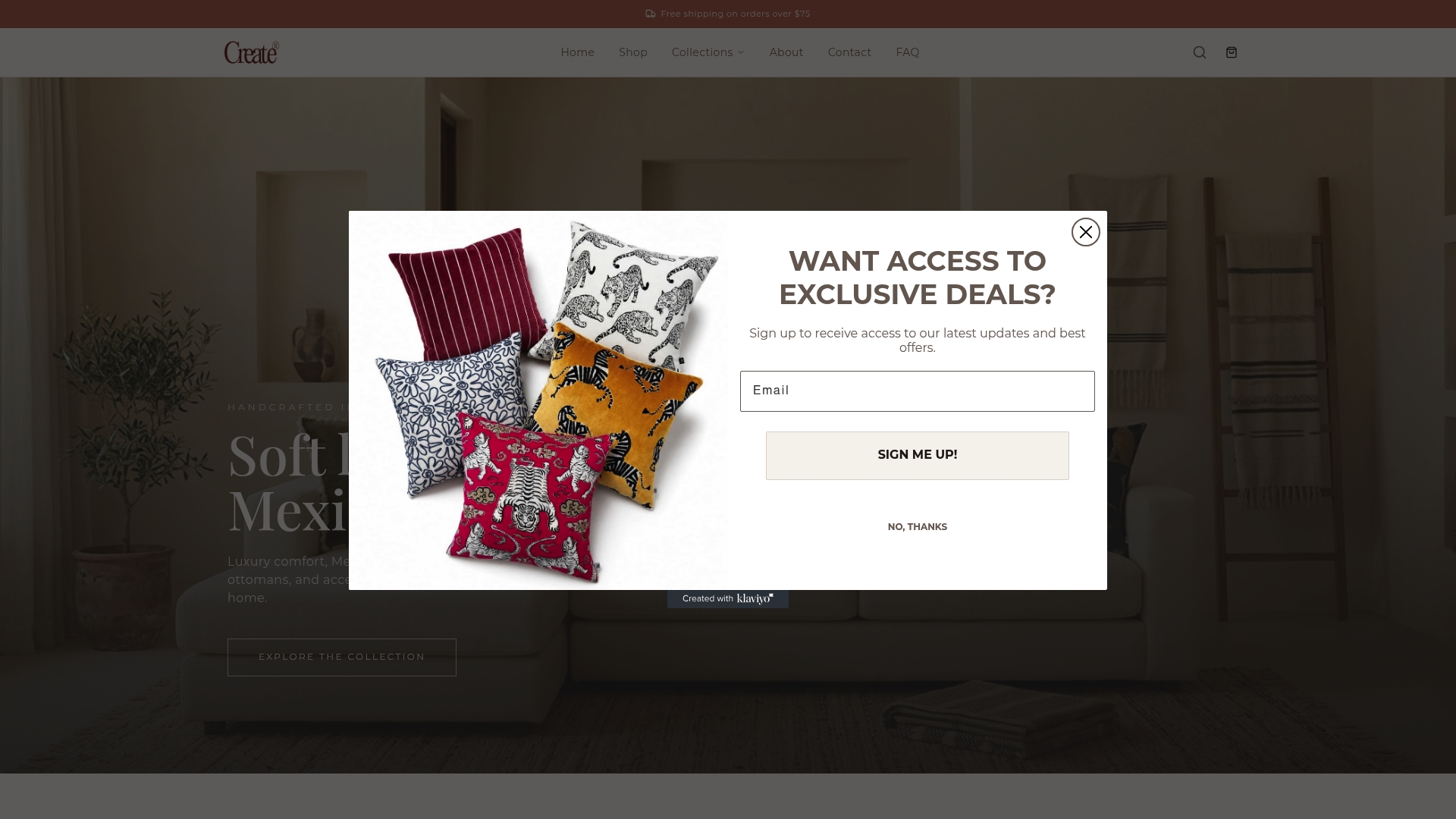
For homeowners, the shop carries a full range of handcrafted pillows and accents ready to ship. Interior designers and boutiques can apply for the wholesale and trade program for trade pricing and custom order options. If you want one piece that carries a genuine piece of Mexican craft into your living room, that is where to start.