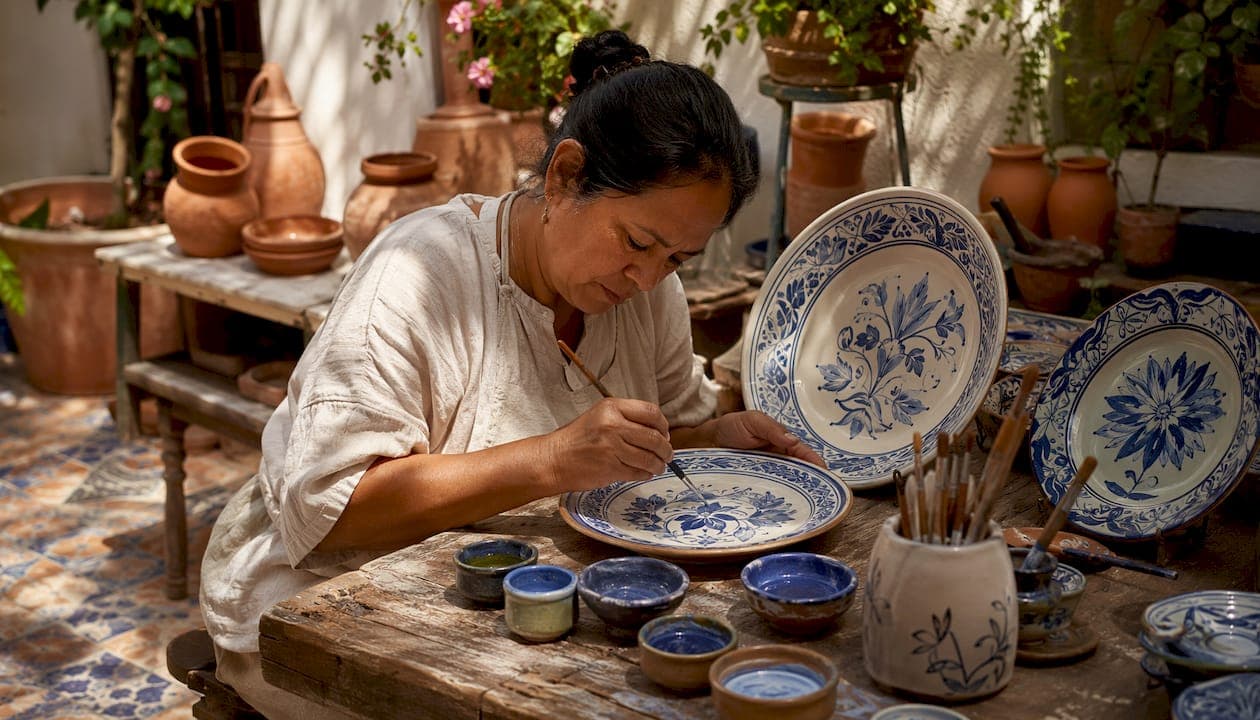
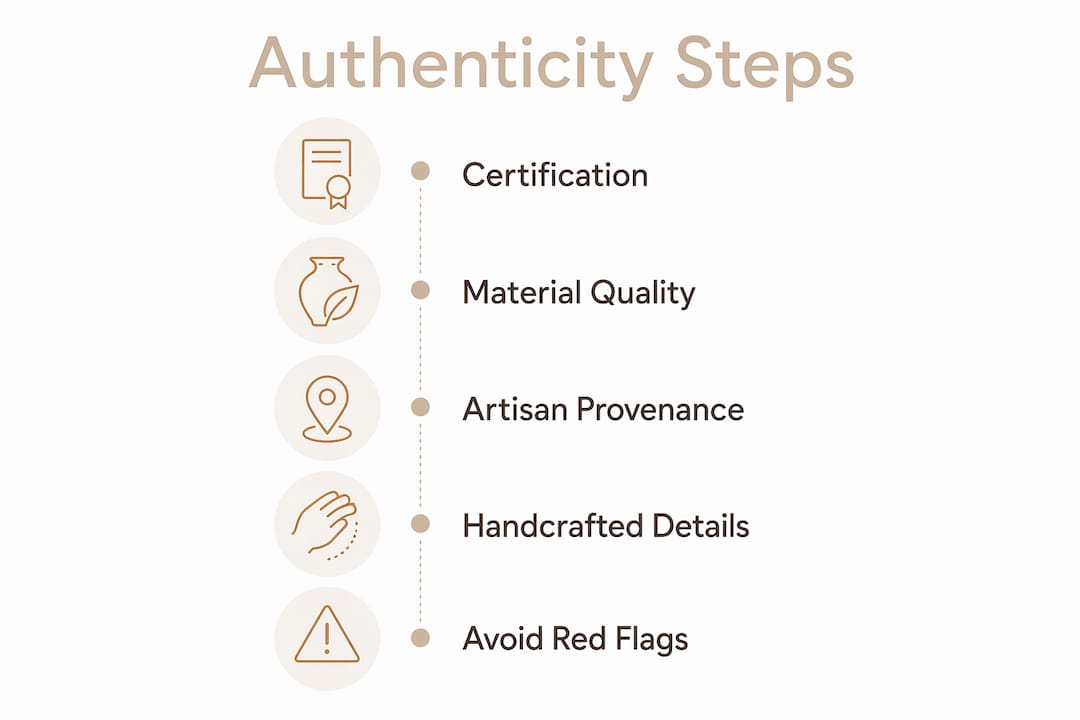
Authentic Mexican handwork carries unmistakable signs that separate it from mass-produced imitations. A genuine piece will show a potter's signature, workshop logo, and government-sanctioned hologram on ceramics; deep relief carving with sharp vertical edges in leather rather than soft, uniform embossing; and visible hand-painted brushstrokes with intentional imperfections on pottery surfaces. Subtle variations between individual units are a feature, not a flaw. When two pieces look absolutely identical, that uniformity is the red flag. Suspiciously low prices and same-day availability on large quantities point toward factory production, not the hands of a skilled artisan working in Puebla or Oaxaca.
- Certification marks on ceramics: Talavera must carry three marks: potter's signature, workshop logo, and hologram seal.
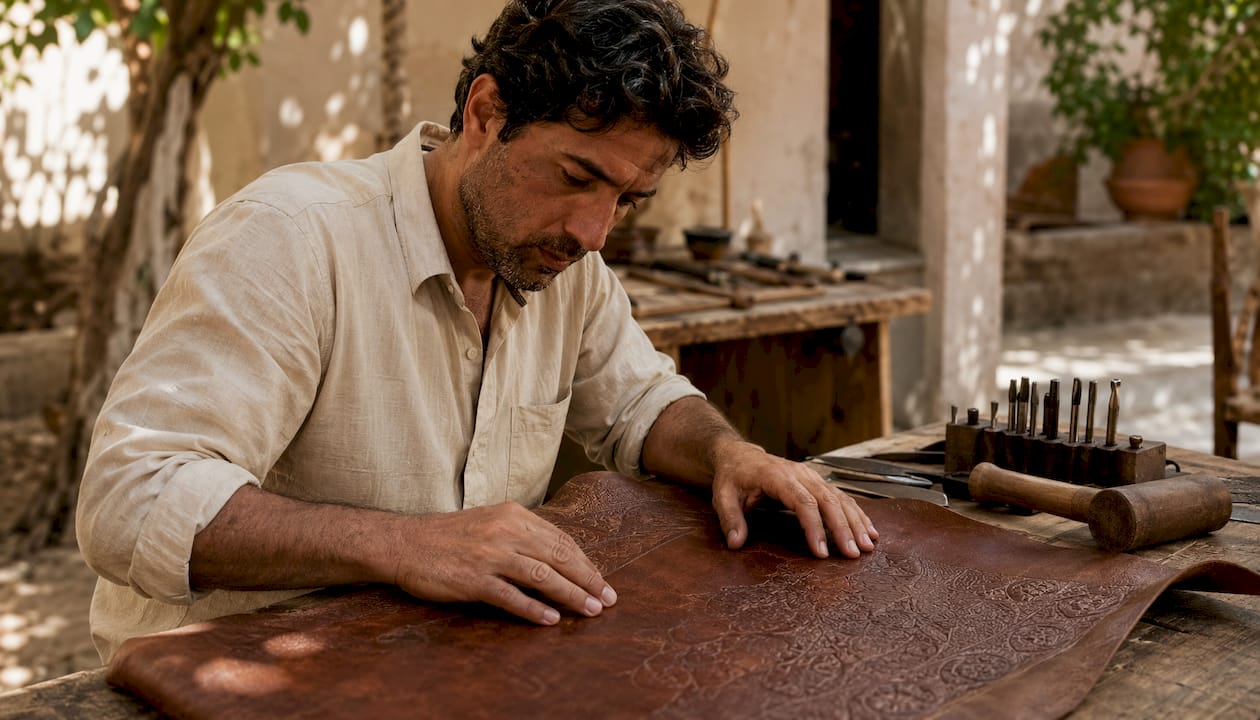
- Deep relief in leather: Hand-tooled carving sits 2–3mm proud with crisp edges; machine embossing is shallow and soft.
- Brushstroke evidence: Authentic painted pottery shows slight color variation and visible strokes, not printed flatness.
- Intentional irregularity: No two handmade pieces are exactly alike in color, texture, or dimension.
- Traditional materials: Natural mineral pigments, full-grain vegetable-tanned leather, copal wood, and handspun fibers each carry a distinct weight, texture, and aroma.
- Realistic pricing and lead times: Genuine artisan goods take days or weeks to produce and are rarely available for immediate bulk shipping.
Table of Contents
- 1. How to verify authentic Talavera ceramics
- 2. How to distinguish genuine hand-tooled leather
- 3. Why artisan provenance and seller transparency matter
- 4. Red flags that point to factory production
- Key Takeaways
- The case for slowing down before you buy
- Createdecorus brings certified Mexican artisan craftsmanship to your home
1. How to verify authentic Talavera ceramics
Talavera is one of Mexico's most protected craft traditions, and its authentication process is among the most formalized in the country. Authentic Talavera must bear three certification marks: the potter's personal signature, the workshop's registered logo, and a government-sanctioned hologram seal. These marks are governed by the NOM-132-SCFI-1998 standard, which restricts certified production to specific regions in Puebla and Tlaxcala. A piece without all three marks is not certified Talavera, regardless of how it is labeled.
The color palette is equally telling. Traditional Talavera pigments are limited to six mineral-based colors, with cobalt blue being the most prized and the most expensive to produce. The glaze should appear milky white with a slightly matte to soft sheen, not the bright, almost plastic finish common on factory reproductions. Flip the piece over: the unglazed base should reveal a warm, off-white clay body, not a stark white or gray industrial clay.
Hand-painted designs show slight variations in line weight and color saturation. If the pattern looks printed, perfectly symmetrical, or transfer-applied, it is not authentic Talavera.
2. How to distinguish genuine hand-tooled leather
The difference between hand-tooled and machine-embossed leather is something you can see and feel within seconds. Authentic hand-tooled leather, known in Mexico as cincelado, features deep 2–3mm relief carving with sharp, vertical edges created by hand-held swivel knives and stamping tools. Machine embossing produces shallow, uniform impressions with soft, rounded edges that look almost identical across every inch of the surface.
Run your fingernail lightly across the background areas. Hand-hammered backgrounding tools leave a subtly uneven texture, while machine-pressed leather feels uniformly flat. The edges of a quality piece tell their own story: burnished edges sealed with natural gums produce a smooth, permanent finish that resists fraying, while painted or coated edges chip and peel over time.
A few additional sensory checks are worth making:
- Scratch test: Scratch a hidden area lightly. Full-grain vegetable-tanned leather shows a slight whitish mark that buffs away; synthetic coatings flake.
- Water drop: A small drop of water on genuine leather is absorbed gradually; synthetic materials bead or repel it.
- Aroma: Authentic vegetable-tanned leather carries a rich, earthy tannin scent. Chemical or plastic odors indicate synthetic materials.
Premium hand-tooled leather is typically full-grain hide of substantial weight. If the piece feels thin, uniform, or light, the material is likely not what it claims to be.
3. Why artisan provenance and seller transparency matter
Authentic artisan pieces are, as collectors understand them, embodied knowledge rooted in community traditions rather than products designed for volume sales. The story behind a piece is as much a part of its value as the object itself. A seller who cannot tell you which region a piece comes from, which artisan made it, or which technique was used is a seller worth approaching with caution.
Transparency from sellers is one of the clearest authenticity signals available. Reputable sources share workshop photos, artisan process videos, and raw material details because they have nothing to hide and everything to be proud of. Expert artisans openly share behind-the-scenes production content as proof of their craft integrity. When you are buying authentic artisan home decor online, request photos of the actual piece being made, not just stock imagery.
Genuine handcrafted items require long production times and are rarely available for immediate large-quantity shipping. A listing offering dozens of identical units with next-day delivery is a practical impossibility for true handwork. Honest sellers also acknowledge material limitations openly: they will tell you that natural dyes may shift slightly over time, or that hand-formed clay pieces may show minor surface variation. That candor is itself a mark of integrity.
Pro Tip: Flip or examine the back of any carved piece. Authentic hand-tool marks, natural material aging, and subtle wear on the reverse side are nearly impossible for factory processes to replicate convincingly.
Collectors who value Mexican artisan craft tradition know that provenance details, regional style markers, and artisan signatures are not decorative flourishes. They are the evidence. A piece from a named workshop in San Bartolo Coyotepec or a certified Talavera studio in Puebla carries a verifiable lineage that a mass-produced imitation simply cannot offer.
4. Red flags that point to factory production
Knowing what to avoid is as useful as knowing what to seek. Several patterns consistently indicate that a piece is not what it claims to be.
Handmade items show subtle variations between individual pieces; identical units suggest factory production. If you see a shelf of ten "handmade" pots that look cast from the same mold with the same printed pattern, trust that instinct. Similarly, a price that seems too good for the described labor is almost always telling you something accurate about how the piece was made.
Watch for synthetic materials masquerading as natural ones: plastic-bright glazes, chemical odors, textiles with perfectly uniform thread thickness, and leather that feels like vinyl. Authentic Mexican handwork uses materials that carry weight, texture, and scent. Natural pigments, handspun fibers, and vegetable-tanned hides each behave and age in ways that synthetics cannot replicate. A reputable artisanal seller will also acknowledge realistic material limitations rather than claiming perfection, because honest sellers expose material constraints rather than hiding them.
Vague or absent provenance is the final red flag. If a seller cannot name the artisan, the workshop, the region, or the technique, the piece's claimed heritage is unverifiable. Authentic Mexican craftsmanship is deeply regional: Oaxacan barro negro, Guerrero ceremonial masks, Michoacán lacquerware, and Puebla Talavera each carry distinct material and stylistic signatures. A seller who knows their craft will speak to those specifics with ease. For guidance on honoring Mexican artistry through your purchases, the regional knowledge matters as much as the visual inspection.
Key Takeaways
Authentic Mexican handwork quality is confirmed through a combination of certified marks, observable craftsmanship details, traditional materials, and transparent seller provenance.
| Point | Details |
|---|---|
| Talavera certification | Authentic Talavera bears three marks: potter's signature, workshop logo, and government hologram, per NOM-132-SCFI-1998. |
| Leather relief depth | Genuine hand-tooled leather shows 2–3mm deep carving with sharp edges; machine embossing is shallow and uniform. |
| Seller transparency | Reputable sellers share workshop photos, artisan videos, and material details; honest ones also name material limitations openly. |
| Variation as proof | Subtle differences between individual pieces confirm hand production; identical units across a batch indicate factory origin. |
| Createdecorus | Createdecorus sources certified, handcrafted Mexican pieces with verified artisan provenance, offering luxury home accents made with traditional materials and transparent craft storytelling. |
The case for slowing down before you buy
There is a quiet pressure in the U.S. market to treat authenticity as a checkbox rather than a conversation. You find a piece you love, you scan for a hologram or a signature, and you move on. That approach catches the obvious fakes, but it misses the subtler ones.
The most convincing imitations get the visual details right while skipping the material integrity. A transfer-printed pattern can mimic brushwork at a glance. A machine-embossed belt can fool a quick touch. What they cannot replicate is the full sensory and contextual picture: the weight of vegetable-tanned leather, the slight color drift of mineral pigments, the artisan's name attached to a specific workshop in a specific town with a documented history.
We believe the real standard for identifying authentic Mexican handwork is not a single test but a convergence of evidence. Certification marks, material behavior, production timelines, seller knowledge, and regional specificity all need to align. When they do, you are not just buying a beautiful object. You are participating in a living tradition that connects your home to generations of craft knowledge. That connection is worth the extra time it takes to verify.
Createdecorus brings certified Mexican artisan craftsmanship to your home
Finding authentic Mexican handcrafted luxury decor in the U.S. market takes exactly the kind of scrutiny this guide describes: verified provenance, traditional materials, and a seller willing to show their work. Createdecorus was built around that standard.

Every piece in the Createdecorus collection is sourced from certified Mexican artisans whose workshops, techniques, and materials are documented and shared openly. From hand-tooled leather accents to richly textured decorative pillows, each item reflects the dialogue between artisan heritage and contemporary design that defines the brand. Production runs are intentionally limited, made-to-order where the craft demands it, and never rushed to meet artificial inventory targets. That is what genuine handwork requires, and it is what your home deserves.
Explore the full collection of handcrafted luxury home accents at Createdecorus, or browse the complete artisan home decor catalog to find pieces that carry both beauty and a verifiable story.