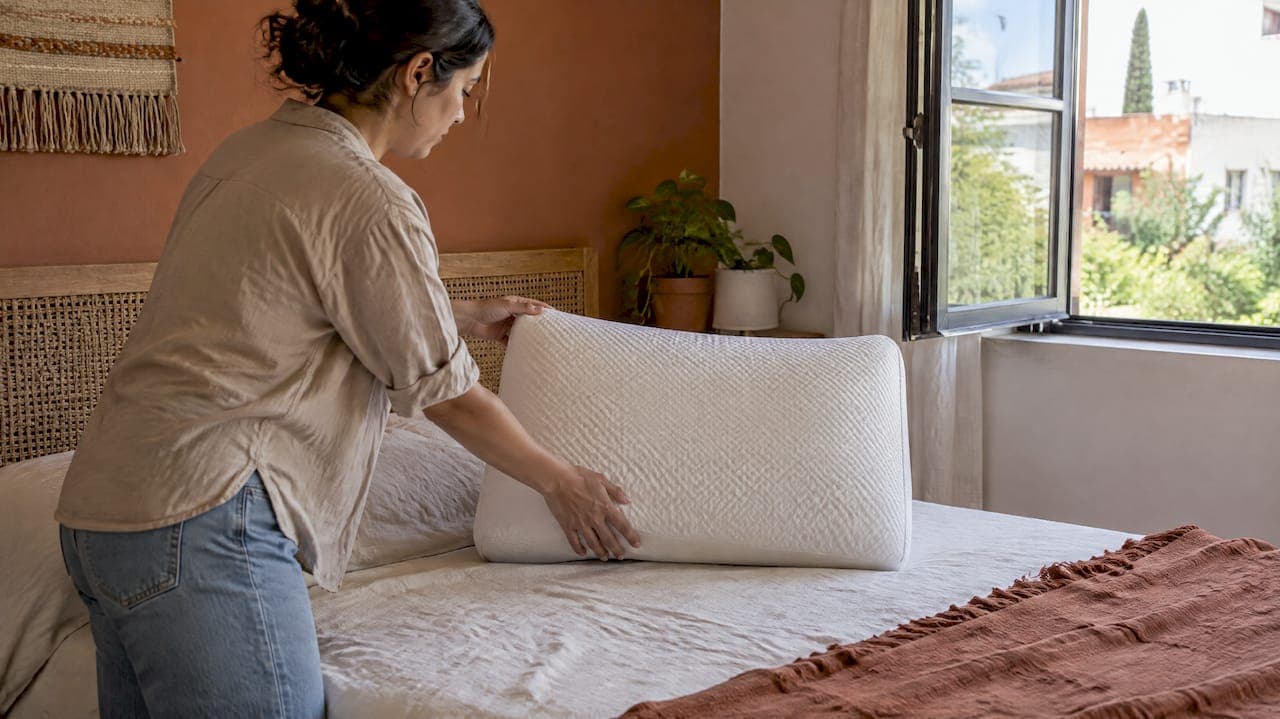
Off-gassing is the release of volatile organic compounds, or VOCs, from synthetic foam as it settles into room air, and for most people the smell is a passing nuisance rather than a hazard. The safest first step is simple: unpack a new pillow, remove any plastic wrapping, and let it air out in a separate, well-ventilated room before you sleep on it.
TL;DR:
- Most VOC emissions from memory foam peak within the first 24 hours and decline significantly over the following days, sometimes lingering for weeks.
- Proper airing in a well-ventilated room, combined with gentle baking soda treatment, can reduce odor within one to two weeks.
- Certifications like CertiPUR‑US indicate low VOC levels during testing but do not guarantee the absence of initial odor.
- Natural fillings such as latex or buckwheat generally emit fewer VOCs and have less odor than polyurethane foam.
- Physical symptoms or persistent odor beyond a few weeks may signal the need to replace the pillow or consult a healthcare professional.
Table of Contents
- Why memory foam pillows smell: chemistry, manufacturing, and packaging factors
- How long off-gassing lasts: evidence-based timelines and influencing factors
- How to remove or reduce odor safely: step-by-step, what works and what to avoid
- Choosing lower-odor pillows: certifications, materials, and questions to ask sellers
- Create Decorus craftsmanship and caring for handcrafted memory-foam pillows
- What actually matters when you unpack a new pillow
- Bring handcrafted comfort home with Create Decorus
- FAQ
- Sources
Why memory foam pillows smell: chemistry, manufacturing, and packaging factors
Memory foam is made from polyurethane, a material formed by combining petroleum-based chemicals. That reaction leaves behind residual compounds that continue to evaporate slowly after the foam cools and cures, which is what you smell when you open a new pillow. Additives used to shape texture, firmness, or fire resistance can add their own scent to the mix, and the specific formulation varies by manufacturer.
Packaging intensifies the effect. Vacuum-sealing compresses a pillow for shipping, but it also traps the VOCs that would normally disperse during manufacturing, so the odor feels stronger the moment you cut the seal.
- Polyurethane foam forms through a chemical reaction that produces lingering byproducts as it cures.
- Flame retardants and processing aids can contribute additional compounds to the final scent.
- Vacuum-sealed packaging holds VOCs close to the foam until you open it.
- Natural fills, like latex or buckwheat hulls, generally involve fewer synthetic additives.
Different materials emit very different amounts of VOCs. A sampling-bag study of 20 pillows found that polyurethane and polyethylene products released multiple volatile compounds, while buckwheat hull pillows produced fewer emissions on average. The takeaway: the filling material is one of the biggest variables in how much odor you notice.
How long off-gassing lasts: evidence-based timelines and influencing factors
Most memory foam odor follows a predictable arc. A room-scale study of memory foam mattresses found that airborne VOC concentrations peaked during the first day after unpacking, then decayed steadily over the following 31 days, with some compounds dropping off within hours and others lingering at low levels for weeks.
- Expect the strongest smell in the first 24 hours after unwrapping.
- A sharp decline typically follows over the next one to three days.
- Trace odor can linger at low levels for days or even a few weeks, depending on the foam and the room.
Warmer rooms speed up evaporation, while poor airflow slows it down, so a pillow left in a sealed closet will smell longer than one aired out near an open window. Foam density, how long it sat vacuum-sealed in transit, and room size all shift the timeline in either direction. If an odor persists well beyond a few weeks, or if you notice eye, nose, or throat irritation that does not improve, that is a signal to stop using the pillow and consider replacing it or speaking with a doctor, a point Sleep Foundation raises directly in its consumer guidance.
How to remove or reduce odor safely: step-by-step, what works and what to avoid
A little patience in the first few days makes a real difference. Here is a practical sequence that lines up with Sleep Foundation's recommendations for reducing VOC exposure from new foam products.
- Unpack the pillow in a separate, well-ventilated room, ideally not the bedroom you sleep in that night, and consider using a specialized piercing pillow with ear cutouts to enhance comfort during recovery.
- Remove any removable cover and wash it separately if the care label allows machine washing.
- Stand the foam upright or lay it flat with open space on all sides so air can move around it, not just over it.
- Open a window and use a box fan to push fresh air across the room for several hours a day during the first week.
- Sprinkle baking soda lightly over the foam, let it sit for a few hours to absorb odor, then vacuum it off with a soft brush attachment.
- Repeat ventilation daily until the smell fades to a level you no longer notice.
Pro Tip: Point a fan so air flows past the foam and out an open window rather than just stirring air around a closed room; directional airflow clears VOCs faster than ambient circulation.
A few things to avoid matter just as much as the steps themselves. Do not apply heat, direct strong sunlight, solvents, perfume sprays, or essential oils straight onto the foam. Heat and sunlight can degrade the material, while oils and solvents can stain it or react with the foam's surface, and neither actually removes VOCs faster. If the smell has not faded noticeably after a couple of weeks of consistent airing, or if it comes with physical symptoms, contact the seller about a return rather than continuing to use a product that bothers you.
Choosing lower-odor pillows: certifications, materials, and questions to ask sellers
Certifications give you a shortcut past guesswork, though they come with limits worth understanding. CertiPUR-US certification requires foam to meet low VOC emission limits under defined chamber conditions, specifically less than 0.5 parts per million after a 72-hour conditioning period. That is a meaningful bar, but chamber testing does not perfectly mirror the airflow and temperature of your actual bedroom, so certified foam can still carry a noticeable smell when it first arrives.
- CertiPUR-US screens for low VOC emissions, flame retardants, and certain heavy metals in foam.
- GREENGUARD Gold and OEKO-TEX extend similar chemical-emission screening to a wider range of home products.
- Natural latex and buckwheat hull fillings tend to emit less and suit buyers who are especially sensitive to smell.
- Certification reduces the odds of severe off-gassing but is not a promise of zero odor for every user.
Before buying, ask sellers what the filling is actually made of, whether they can show proof of certification, and whether the product underwent any conditioning or curing period before shipping. A clear return policy matters too. A 72-hour chamber conditioning period is standard practice under CertiPUR-US technical guidelines, which gives you a concrete benchmark to ask sellers about directly.
Create Decorus craftsmanship and caring for handcrafted memory-foam pillows
We build each decorative pillow by hand, pairing artisan textile traditions with shredded memory foam chosen for its plush, supportive feel. Because we work with shredded foam rather than a single molded block, the material breathes more readily than solid foam, which tends to shorten the time any new-product scent lingers once a pillow is unpacked.
- We recommend airing a new pillow in a well-ventilated room before placing it on a sofa or bed.
- Our guide to shredded memory foam fillings walks through how the material behaves and how much fill typically goes into a given pillow size.
- We suggest keeping artisan cushions in a space held around 18 to 21 degrees Celsius with 40 to 50 percent humidity to protect both the fabric and the filling over time.
- The fabric covers are removable, which makes it easy to freshen a pillow without disturbing the foam inside.
Every piece ships vacuum-compressed, so a short airing period after unboxing is a normal and expected part of bringing one of our pillows home.
What actually matters when you unpack a new pillow
Most of the anxiety around memory foam odor outpaces the evidence. Chasing a "zero odor" guarantee is chasing something no certification actually promises, since every chamber test still happens under controlled conditions that differ from your living room.

Where the conventional advice falls short is in treating certification labels as a finish line. A CertiPUR-US stamp tells you the foam met a specific chemical threshold during a 72-hour test, not that you will never notice a smell on day one. The better mindset is practical, not anxious: expect a short adjustment period, give the pillow real airflow, and judge it by how it smells and feels after a week, not after an hour.
If you take one thing from this, prioritize airflow over products. A fan and an open window do more in the first 48 hours than any spray or treatment you could buy.
— Ernesto
Bring handcrafted comfort home with Create Decorus
We make it simple to add a pillow that feels as good as it looks, without wondering whether the materials inside were chosen carelessly. Every Create Decorus piece pairs shredded memory foam with artisan textiles made by hand, and we are upfront that a brief airing period after unboxing is a normal part of enjoying one.

If you are furnishing one room or outfitting a whole collection, our shop carries decorative pillows in a range of textures and colors, and our wholesale trade program offers a path for designers and retailers buying in bulk. Browse the animal print collection if bold pattern is what you are after, or explore our wallpaper, wall art, and rugs to round out a room. Start with a piece that fits your space today.
FAQ
How long does off-gassing take?
Odor typically peaks within the first 24 hours of unpacking a memory foam product, then declines sharply over the next one to three days. A room-scale study of memory foam mattresses found concentrations continued to taper off over 31 days, with low-level traces sometimes lingering for a few weeks depending on ventilation and room temperature.
How do I get rid of odor from a memory foam pillow?
Unpack the pillow in a separate, well-ventilated room and let it air out before use, ideally with a fan pushing air toward an open window. Sprinkling baking soda on the foam for a few hours before vacuuming it off can help absorb residual smell, while heat, sunlight, and solvents should be avoided since they can damage the foam without speeding odor removal, according to Sleep Foundation guidance.
How is memory foam made?
Memory foam forms when petroleum-based chemicals react together to create polyurethane, a process that leaves behind residual compounds that slowly evaporate as the foam cures and ages. Manufacturers add other ingredients for firmness, texture, or fire resistance, and those additives can influence both the feel and the smell of the finished product.
Are memory foam pillows okay to use?
Modern memory foam is generally considered safe once it reaches your home, though new foam often releases a temporary odor as it off-gasses. Sleep Foundation notes that smell alone does not indicate toxicity, but some people may notice eye, nose, or throat irritation and should ventilate the room or discontinue use if symptoms persist.
Does a certification like CertiPUR-US mean a pillow will have no smell?
Not entirely. CertiPUR-US certification confirms foam met specific low-VOC thresholds during a 72-hour chamber conditioning test, which reduces the likelihood of strong or lasting odor, but chamber conditions differ from a typical bedroom, so a brief smell after unboxing is still common even with certified foam.
Sources
- Is memory foam toxic? — Sleep Foundation
- Evaluation of volatile organic compound (VOC) emissions from memory foam mattresses and potential implications for consumer health risk
- About the CertiPUR‑US certification
- Analysis of Volatile Organic Compounds Emitted from Bedding Products