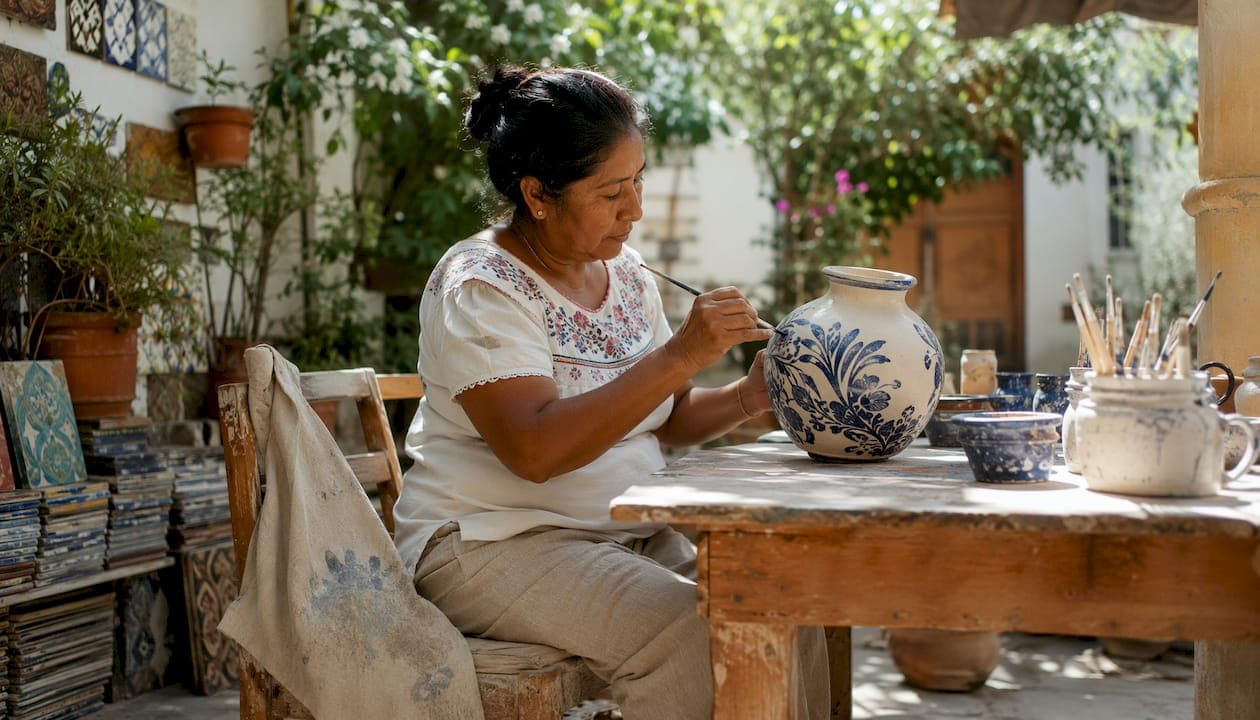
Mexican artisan techniques resist wholesale modernization because they encode cultural identity, material-specific knowledge, and livelihood strategies that automation simply cannot reproduce. Talavera pottery, inscribed by UNESCO for its unbroken 16th-century process, stands as the clearest proof: every stage from clay preparation to kiln management carries community meaning that a machine cannot hold. Anthropologist Néstor García Canclini warned that framing these crafts as "dying" invites top-down fixes that serve institutions, not makers. Createdecorus works from the opposite premise, sourcing directly from artisan partners whose hands remain at the center of every decision.
For buyers, three things follow immediately:
- Authentic pieces carry longer lead times — often weeks, not days — because no stage is rushed.
- Pricing reflects real labor, not factory overhead; expect a premium that signals genuine craft.
- Provenance matters: ask for maker information before you purchase, not after.
Table of Contents
- Why do Mexican artisan techniques resist modernization so persistently?
- What makes these materials and processes so hard to mechanize?
- Why do artisans and communities push back against outside modernization?
- How can technology support artisans without erasing what makes their work distinctive?
- What does this mean for your sourcing, pricing, and timelines?
- How Createdecorus works with Mexican artisans
- Key Takeaways
- The tension between authenticity and market pressure
- Handcrafted Mexican pillows and accents, sourced with integrity
- Selected sources for designers and retailers
Why do Mexican artisan techniques resist modernization so persistently?
Talavera pottery from Puebla and Tlaxcala has followed the same sequence of steps since the 16th century: clay selection and tempering, hand-painting with mineral pigments, tin enamel application, and a two-stage kiln firing. UNESCO's recognition of this process confirms what communities already knew — each step is inseparable from the identity it carries. Skipping or mechanizing one stage doesn't simplify the craft; it breaks the chain of meaning.
García Canclini's scholarship cuts through romantic narratives on both sides. He argued that preservation debates too often ask the wrong question.
That framing matters for anyone sourcing handcrafted goods. Intergenerational transmission — a grandmother teaching a granddaughter to read clay moisture by touch — is not inefficiency. It is the knowledge system itself. Institutional recognition, from UNESCO to regional craft councils, has reinforced that continuity rather than disrupted it, giving artisan communities a formal argument against outside pressure to industrialize. For designers seeking authentic Mexican heritage in their interiors, understanding this history changes how you specify and source.
What makes these materials and processes so hard to mechanize?
The physical properties of traditional materials create genuine friction for automation. Clay bodies vary by region and season; a machine calibrated for one batch fails on the next. Natural pigments derived from cochineal, indigo, or local minerals behave differently under humidity, temperature, and the pressure of a human hand. Hand-tensioned looms respond to the weaver's body weight and rhythm in ways no servo motor replicates. These are not romantic details — they are engineering realities.
| Material / Process | Why mechanization is difficult |
|---|---|
| Regional clay body | Composition varies by source; requires tactile tempering judgment |
| Natural mineral pigments | Color intensity shifts with humidity, heat, and application pressure |
| Hand-tensioned backstrap loom | Tension controlled by weaver's posture; no fixed mechanical equivalent |
| Hand-knotted embroidery | Motif placement requires cultural knowledge, not just pattern data |
| Kiln management (wood-fired) | Temperature read by flame color and sound, not digital sensors |
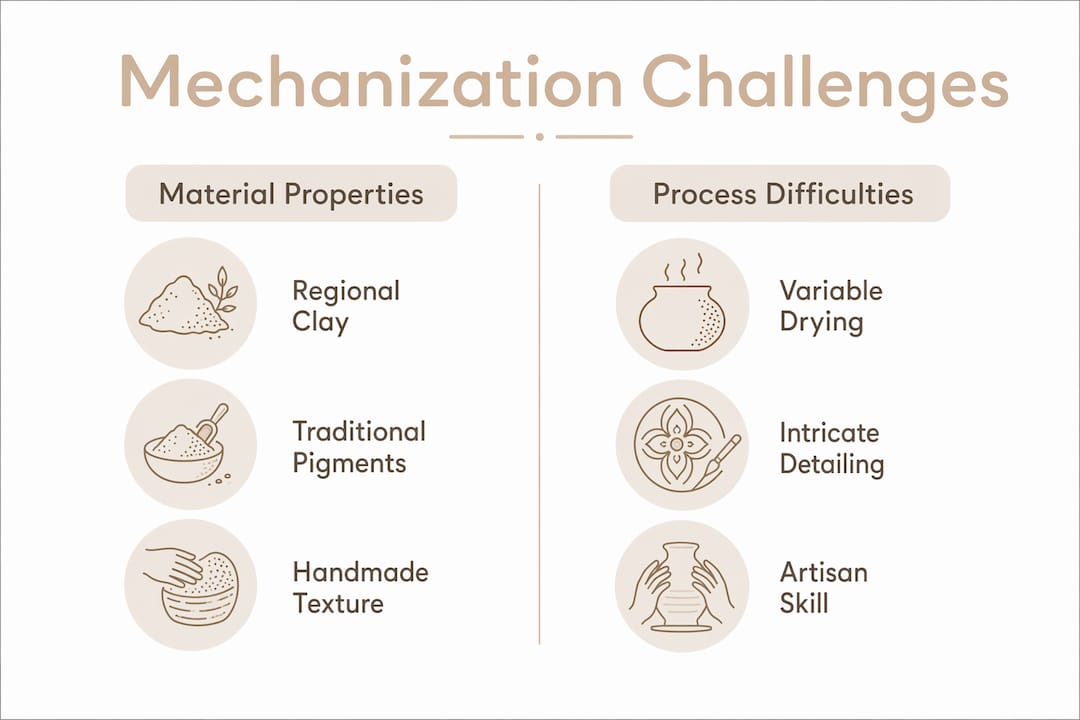
Production is also shaped by resource access. Local reporting documents how agricultural monocultures and shifting regional economies threaten access to firewood for kilns and clay deposits — pressures that make modernization less a choice than a survival calculation.
The craft stages where human judgment is irreplaceable follow a clear sequence:
- Clay tempering — reading moisture and plasticity by hand before any shaping begins.
- Pigment mixing — adjusting ratios based on the day's humidity and the specific clay body.
- Loom tension setting — calibrating resistance through the weaver's own body position.
- Motif stitching — placing symbolic elements according to community visual grammar.
- Kiln reading — interpreting flame color and sound to judge firing temperature.
Why do artisans and communities push back against outside modernization?
The economic logic is sharper than it first appears. When cheap imports flood a market, artisans face a choice: compete on price and lose, or shift toward luxury-authentic positioning where handwork commands a premium. Research on ceramics shows that preserving high-quality traditional production can be a deliberate market strategy, not mere conservatism.
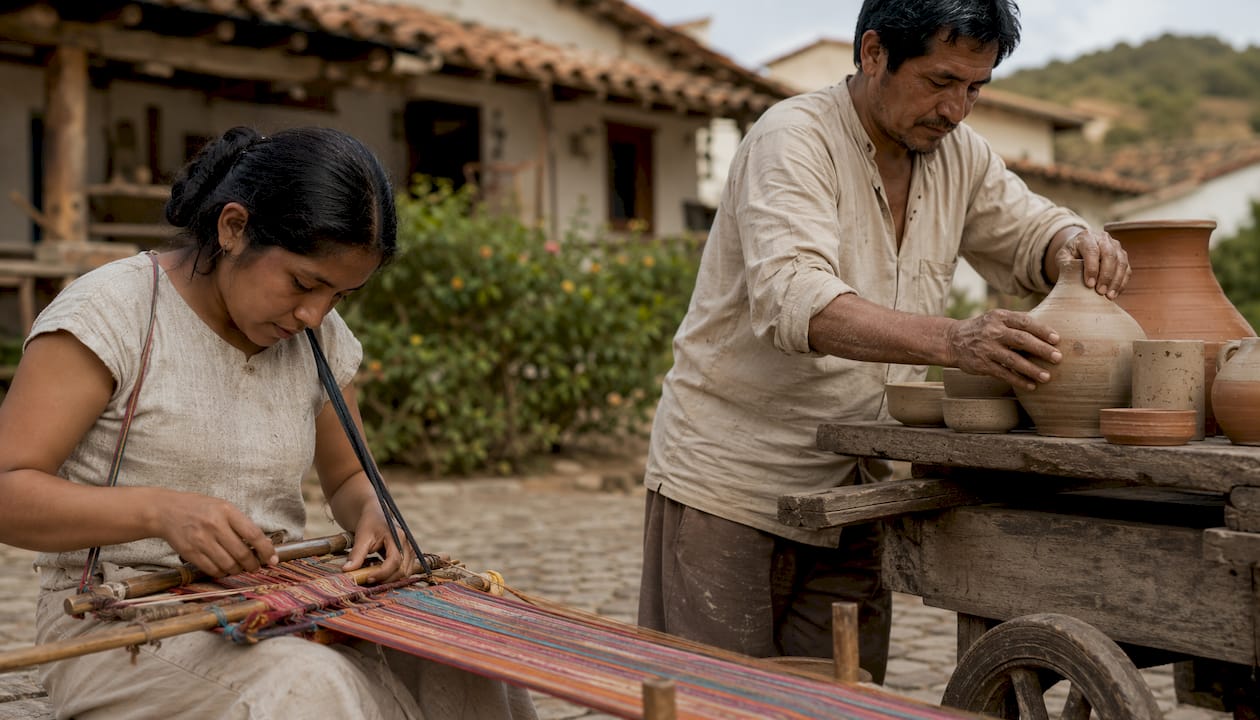
Authorship is the other pressure point. Addison Nace's research documents how labeling indigenous textiles as "innovated" by outside designers shifts credit away from the original maker, reducing both recognition and income for the artisan. When an external collaborator's name appears on a piece, the weaver's contribution becomes invisible — and so does their leverage to set prices or refuse terms.
Pro Tip: When evaluating a vendor's "handmade" claim, ask specifically who designed the motifs and who holds the copyright. If the answer points to an outside studio rather than the artisan community, the piece may be artisan-executed but not artisan-authored — a meaningful distinction for ethical sourcing.
For retailers and designers, this means that spotting authentic Mexican handwork requires looking past the label and into the production relationship.
How can technology support artisans without erasing what makes their work distinctive?
The answer, according to research by Ioana Pop Cohuţ and colleagues, is augmentation rather than automation. In the hybrid artisan model, digital tools handle exploration and repetitive tasks while the artisan retains final authority over form, color, and symbolic meaning. The system must be co-designed with the community, not imposed from outside.
Concrete tools artisans use today without compromising their craft:
- Digital photography for catalogs and social media, expanding market reach without changing production.
- CAD-assisted pattern mockups for client presentations, letting artisans show options before committing hand-hours.
- Simple e-commerce platforms that connect makers directly to buyers, cutting out intermediaries who often capture most of the margin.
- Social media storytelling that documents process and builds the provenance narrative buyers increasingly want.
For designers and retailers proposing technology partnerships, the governing principle is cultural governance: artisans decide which tools enter their process, and human judgment stays on every step that carries cultural meaning.
What does this mean for your sourcing, pricing, and timelines?
Field research in Hidalgo found that while 95% of studied artisans maintain traditional techniques, only about 20% use basic digital tools — and the gap is explained by training access and infrastructure, not skill or willingness.
Statistic: Field research in Hidalgo found that while 95% of studied artisans maintain traditional techniques, only about 20% use basic digital tools. The bottleneck is training and infrastructure, not talent.
That gap has direct implications for buyers. Authentic handcrafted pieces do not move on mass-production timelines. A sourcing checklist worth keeping:
- Ask the vendor which specific steps are hand-executed and which are not.
- Request maker profiles or community names, not just country-of-origin labels.
- Confirm lead times in writing — four to eight weeks is realistic for genuine artisan work.
- Ask how the artisan is compensated and whether pricing reflects living-wage standards.
On pricing: handcrafted authenticity commands a premium because it should. For retail buyers, that premium translates into a defensible markup story — one that resonates with customers who want to know where their objects come from. For interior designers, it means building lead time into project schedules and communicating that timeline to clients as a feature, not a flaw. Care for handcrafted textiles follows from their materials: spot-clean natural-dye pieces, keep them from prolonged direct sunlight, and avoid machine washing embroidered work. A suspiciously low price on a "handmade" piece is the clearest red flag — authentic labor cannot be compressed to match factory costs.
How Createdecorus works with Mexican artisans
Createdecorus operates as a provenance-first partner, meaning maker relationships and production transparency are built into the sourcing model, not added as marketing. Every piece in the collection — from handcrafted decorative pillows to ottomans and accents — is produced in Mexico with artisan-controlled design decisions. The steps that define the piece's character remain fully hand-executed.
A typical product journey at Createdecorus:
- Artisan design input: motif selection and color palette decisions rest with the maker, not an outside studio.
- Hand-executed production: weaving, embroidery, and finishing are completed without mechanized substitution.
- Lead time: custom and wholesale orders are negotiated directly with artisan partners, with realistic timelines communicated upfront.
- Wholesale and trade program: interior designers and boutique retailers can access trade pricing and bulk options through the wholesale program.
- Custom orders: available through direct inquiry, with artisan input on feasibility and timeline.
For designers building a Mexican craftsmanship-informed interior, Createdecorus offers a path that respects both the maker and the client's timeline expectations, including guidance on how to choose closet doors that fit a Spanish Colonial or Ranch-style San Antonio home to complement authentic design elements like handcrafted Mexican pieces (How Do You Choose Closet Doors That Fit a Spanish Colonial or Ranch-Style San Antonio Home? | One Day Doors & Closets).
Key Takeaways
Mexican artisan techniques persist because they carry cultural identity, material knowledge, and economic strategy that no machine replicates — and sourcing authentically means respecting all three.
| Point | Details |
|---|---|
| Resistance is deliberate | Artisans protect technique to preserve authorship, identity, and market positioning. |
| Material constraints are real | Clay, natural dyes, and hand-tensioned looms resist mechanization for physical, not sentimental, reasons. |
| Digital adoption is low | 95% of studied artisans maintain traditional techniques, but only about 20% use basic digital tools; infrastructure gaps, not skill, explain the difference. |
| Buyers must adjust timelines | Authentic handcrafted work takes four to eight weeks; build that into design schedules and retail planning. |
| Createdecorus as a sourcing partner | Createdecorus sources provenance-first, with maker profiles, hand-executed production, and a trade program for designers and retailers. |
The tension between authenticity and market pressure
The conversation around artisan modernization tends to flatten into two camps: those who want to preserve everything unchanged and those who see tradition as an obstacle to scale. Both miss the point. What I've come to understand, working closely with Mexican artisan communities, is that the most resilient makers are neither frozen in time nor chasing industrial efficiency. They are making strategic choices about which parts of their practice carry irreplaceable value and which administrative tasks — photography, order tracking, client communication — can be handled with simple tools without touching the craft itself.
The ethical failure in most "modernization" projects isn't the technology. It's the assumption that an outside party knows better than the artisan what should change. When a designer proposes a new motif without understanding its community meaning, or a retailer pushes for faster turnaround without adjusting the price, the artisan absorbs the cost. Respecting craft means respecting the maker's authority over their own process — and paying accordingly.
Handcrafted Mexican pillows and accents, sourced with integrity
Createdecorus brings the same provenance-first thinking that this article describes directly into its product line. Every decorative pillow, ottoman, and home accent is produced in Mexico by artisan partners who retain creative authority over their work. The collection is built for homeowners who want their spaces to carry genuine cultural warmth, and for designers and retailers who need a sourcing partner they can stand behind.

Browse the full collection at Createdecorus, explore the shop for retail purchases, or apply for the trade program if you're a designer or boutique buyer. Custom orders are available — reach out directly to discuss timelines and artisan availability.
Selected sources for designers and retailers
- UNESCO Intangible Cultural Heritage — Talavera of Puebla and Tlaxcala. The primary institutional record of Talavera's 16th-century process and its role as a community identity symbol. Essential reading for anyone specifying or sourcing Talavera-adjacent work.
- Addison Nace — Commodification and authorship in indigenous textiles (University of Nebraska Press). Documents how "innovation" labeling shifts credit from weaver to external designer. Foundational for ethical sourcing decisions.
- The Hybrid Artisan: Integrating AI-Powered Design Tools with Traditional Craftsmanship (Ioana Pop Cohuţ et al., preprint). The clearest framework available for technology augmentation that preserves cultural fidelity — recommended for any designer proposing digital tools to artisan partners.
- MIIPA Model: Innovation and preservation in Huejutla de Reyes, Hidalgo. Field research documenting the 95%/20% gap between technique preservation and digital adoption. Useful for understanding why artisan communities adopt technology slowly and what support actually helps.
- DNYUZ — "Ceramics, Once the Lifeblood of Mexican Artisans, Are Under Pressure." Ground-level reporting on resource constraints, agricultural competition, and the economic pressures shaping artisan choices today.
- AaltoDoc collection — Designer-artisan relations and cultural dynamics (citing Néstor García Canclini). The source for García Canclini's critique of technocratic preservation frameworks and his argument that artisan agency must lead any intervention.