
Trade programs typically cut supplier costs by a significant percentage and pair those discounts with better payment terms, giving designers real room to protect margin. On the service side, Mexican designers commonly charge hourly rates for consultation, flat fees per room that vary widely, or a percentage of total project cost. The sections ahead walk through supplier realities, how to build those numbers into a proposal, and where handcrafted sourcing fits into the math.
TL;DR:
- Trade discounts typically range from 25 to 35 percent below retail prices, with higher discounts available for consistent bulk orders.
- Minimum order requirements can be as low as no minimum or as high as $5,000, and lead times vary from days for in-stock items to several months for made-to-order products.
- Most designers blend billing models, often quoting hourly during discovery and switching to flat rates or percentages once scope is defined, with Mexican rates averaging MXN 700 to 1,400 per hour.
- Confirm minimum order quantities, lead times, and payment terms with suppliers before quoting clients to prevent delays or misunderstandings.
- Present sourcing benefits clearly in proposals, using fee structures aligned with project complexity, and communicate supply delays immediately to maintain client trust.
Table of Contents
- What Precios Trade Interiorismo Really Means for Your Studio
- How Much Do Trade Discounts and Supplier Terms Actually Run?
- What Should You Charge? Pricing Models and Mexico Rate Ranges
- How Do You Qualify for a Trade Account?
- How Do You Present Trade Pricing in a Client Proposal?
- Sourcing Handcrafted Accents Through Createdecorus
- What I've Learned Reviewing Studio Pricing Practices
- Explore trade pricing options for handcrafted pillows and accents, with wholesale accounts and custom orders built for designers who need reliable trade terms rather than a one-off retail purchase. Unlike sourcing from mass retailers, you're working with artisan-made pieces that carry genuine craftsmanship into a client's home.
- Sources
What Precios Trade Interiorismo Really Means for Your Studio
Precios trade interiorismo refers to the wholesale pricing structure suppliers extend to verified design professionals, distinct from what a retail customer pays at checkout. A trade account typically bundles four things: discounted pricing, access to fabric and finish samples not sold to the public, a dedicated trade representative who can expedite issues, and payment terms that let you order before the client's deposit clears.
Those benefits translate directly into studio economics. A discount on a sofa or a set of custom pillows either lowers your client's total invoice or widens your markup, depending on how you structure billing. Either way, the supplier relationship becomes a profit lever, not just a purchasing convenience.
Trade access comes in three flavors, and mixing them intelligently is part of running a healthy studio:
- Retailer trade programs — furniture and home goods chains that offer a flat discount tier to registered professionals.
- Manufacturer trade accounts — direct relationships with makers, often with better pricing but higher minimums and longer lead times.
- Specialist trade suppliers — artisan or boutique producers, including handcrafted decor makers, who offer trade pricing alongside custom sizing and materials.
Most working designers hold accounts across all three, matching the supplier type to the scope of each project.
How Much Do Trade Discounts and Supplier Terms Actually Run?
Trade discounts commonly fall within a range below retail prices, and suppliers usually tier that rate to your purchase volume. A designer who orders occasionally might land at the lower end, while a studio placing consistent bulk orders can negotiate into the higher bracket. Trade vs. retail comparisons show this spread holding fairly consistently across furniture categories.
On a full furniture package for a living room and dining area, trade-sourced totals tend to run 25 to 35 percent below comparable retail pricing, a gap large enough to change whether a client says yes to a proposal.
Minimum order requirements vary widely. Some suppliers set no minimum at all, while others require $500 to $5,000 or more before extending trade pricing, and that threshold often softens for repeat customers. Budget for these realities on every quote:
- Lead times split into two buckets: in-stock goods ship in days; made-to-order pieces can take 6 to 16 weeks.
- Payment terms commonly run net-30 or net-60 for established accounts, though new accounts often pay upfront.
- Shipping, customs on imported goods, installation labor, and rush fees for compressed timelines rarely appear in the sticker price, so line them into your proposal separately.
What Should You Charge? Pricing Models and Mexico Rate Ranges
Five billing models dominate interior design practice, and most designers end up blending two or three depending on the client:
- Hourly — best for consultations or advisory-only scopes; typically MXN 700 to 1,400 per hour, sometimes offered free as a first session.
- Flat fee per room — predictable for both sides; common ranges run MXN 8,000 to 60,000 or more per space depending on complexity.
- Flat project fee — a single number covering the whole scope, favored for smaller full-home projects where the client wants cost certainty.
- Percent of project cost — commonly 10 to 50 percent added to furnishings, aligning your fee with procurement volume.
- Per square meter — used mostly for commercial or larger residential work where scope scales with footprint.
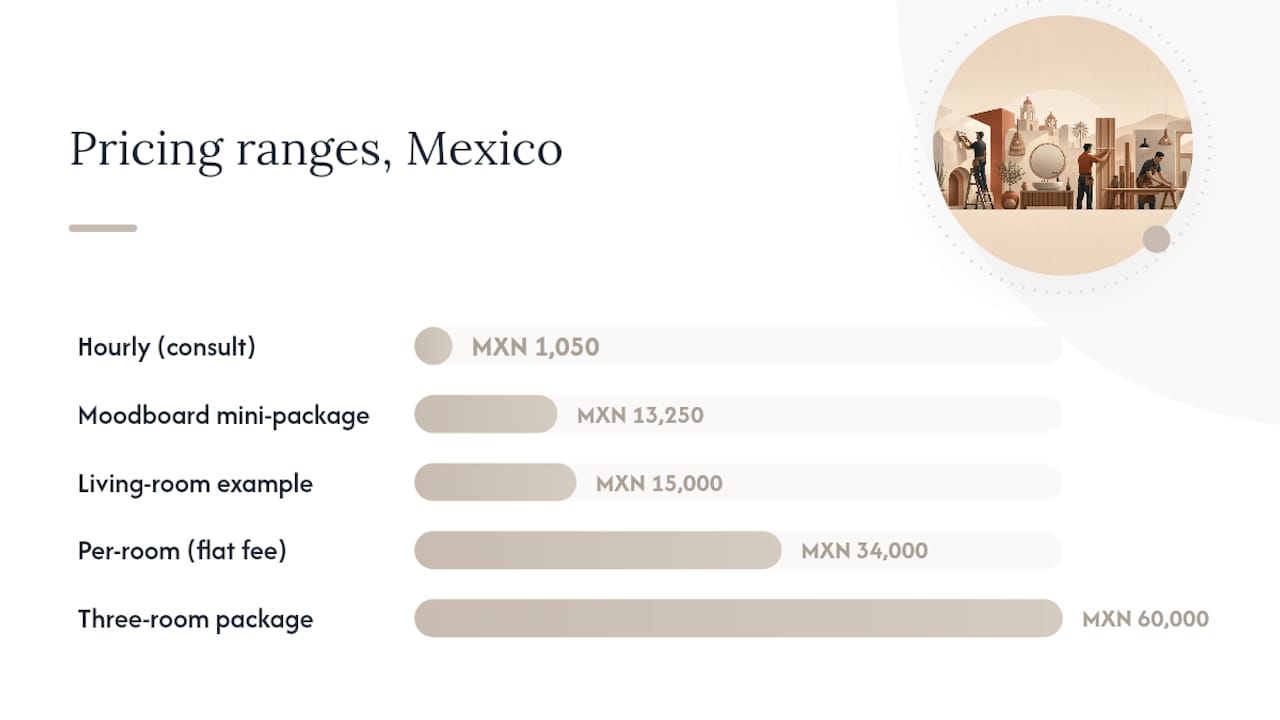
Market data for Mexico puts moodboard or single-space mini-packages at MXN 1,500 to 25,000, depending on how many deliverables the client wants. A living room refresh with a moodboard, floor plan, and sourcing list might land near MXN 15,000 flat. A three-room package covering living room, dining, and primary bedroom, billed at MXN 20,000 per room, comes to roughly MXN 60,000 before procurement markup.
Pro Tip: Quote hourly for the discovery phase and switch to flat or percent-based billing once scope is locked. Clients tolerate hourly uncertainty far better before they've committed to a full project.
Choose the model based on procurement complexity: hourly suits advisory work, flat fees suit contained scopes, and percent-of-project makes sense when you're managing significant furniture sourcing, since it lets your fee track the trade savings you're generating.
How Do You Qualify for a Trade Account?
Suppliers want proof you're a working professional before they extend trade pricing, not proof you're a designer in title only. The paperwork is straightforward once you have it assembled:
- Your RFC (tax ID) showing registered business activity.
- Proof of professional practice: a portfolio, active website, or business letterhead.
- A completed application, often submitted online, followed by a short verification window.
Verification usually takes a few business days once your documentation clears review. Once approved, request a sample kit before your first order, confirm the actual minimum in writing, and get payment terms documented rather than assumed. Verbal promises about net-30 terms have a way of becoming net-upfront once an invoice actually arrives.
How Do You Present Trade Pricing in a Client Proposal?
A proposal that hides how sourcing works invites distrust the moment a client sees an invoice. Structure yours around six elements: scope of work, specific deliverables, clear exclusions, a timeline, a payment schedule, and a note on how items are sourced.
- Describe the sourcing benefit in outcome terms: "furnishings sourced at professional trade rates, savings reflected in your total" rather than naming suppliers or discount percentages.
- Pick your fee structure deliberately. A flat fee protects your time on advisory-heavy projects; percent-of-project rewards you for procurement effort; cost-plus (trade cost plus a set markup) works well when clients want full visibility into what they're paying for goods.
- Build a payment schedule around milestones: typically a deposit at signing, a progress payment at design approval, and final payment at delivery or install.
Pro Tip: When a lead time shifts, whether a fabric run gets delayed or a supplier changes a delivery window, update the client in writing immediately. Surprises kill trust faster than delays do.
Small design touches, like the layering tricks in making a living room look more expensive, also help justify fees to clients who are comparing your proposal against a cheaper, less considered alternative.
Sourcing Handcrafted Accents Through Createdecorus
Createdecorus offers handcrafted pillows, ottomans, and home accents, providing wholesale accounts alongside custom orders and trade pricing for designers. That structure lets you specify pieces with real cultural weight rather than mass-produced substitutes, while still working inside a professional pricing framework.
When specifying handcrafted accents on a client project, plan for a few practical steps:
- Request swatch photos and material specs before presenting options to a client.
- Ask about custom sizing or fill options if the piece needs to match specific furniture dimensions.
- Factor vacuum-compressed shipping and production lead time into your project schedule, especially for made-to-order pieces.
- Confirm minimum order quantities directly with suppliers when quoting a trade order.
Browsing handcrafted pieces built for professional projects before your client meeting gives you concrete options to reference instead of vague promises about "artisan quality."
What I've Learned Reviewing Studio Pricing Practices
Three mistakes show up again and again: designers quote lead times optimistically instead of confirming them with the supplier, they skip verifying minimums until an order is already placed, and they bill clients without explaining how sourcing costs work, which breeds suspicion at invoice time. A workflow that avoids all three is simple: confirm minimums and lead times at inquiry, lock your pricing model before drafting the proposal, document payment terms in writing, and communicate any supply delays the moment you know about them. Trade accounts reward designers who treat the paperwork with the same care they bring to a moodboard.
— Ernesto
Explore trade pricing options for handcrafted pillows and accents, with wholesale accounts and custom orders built for designers who need reliable trade terms rather than a one-off retail purchase. Unlike sourcing from mass retailers, you're working with artisan-made pieces that carry genuine craftsmanship into a client's home.
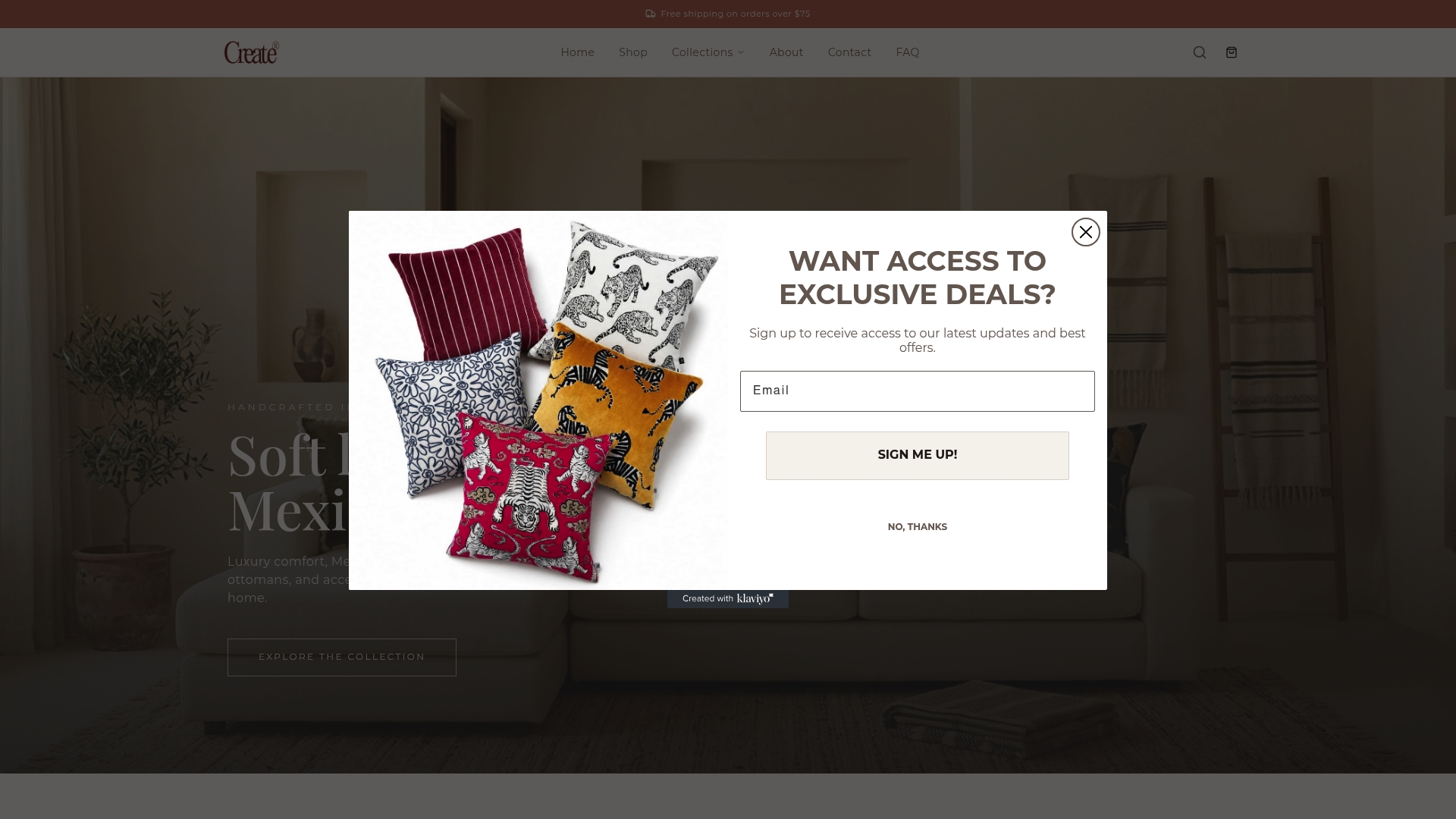
If a project calls for something with real texture and story, start by reviewing the full pillow catalog to shortlist options for your next proposal. When you're ready to move forward, visit Createdecorus to request trade pricing, swatches, and a lead-time estimate before you finalize your client quote.
Sources
- ¿Cuánto cuesta el diseño de interiores en México? Guía 2026
- Trade vs. Retail Furniture Pricing: Hidden Cost Guide
- Interior Design Pricing: How Much Does It Really Cost in 2026? - Lesssea
Always confirm current minimums, discounts, and payment terms directly with each supplier before quoting a client.