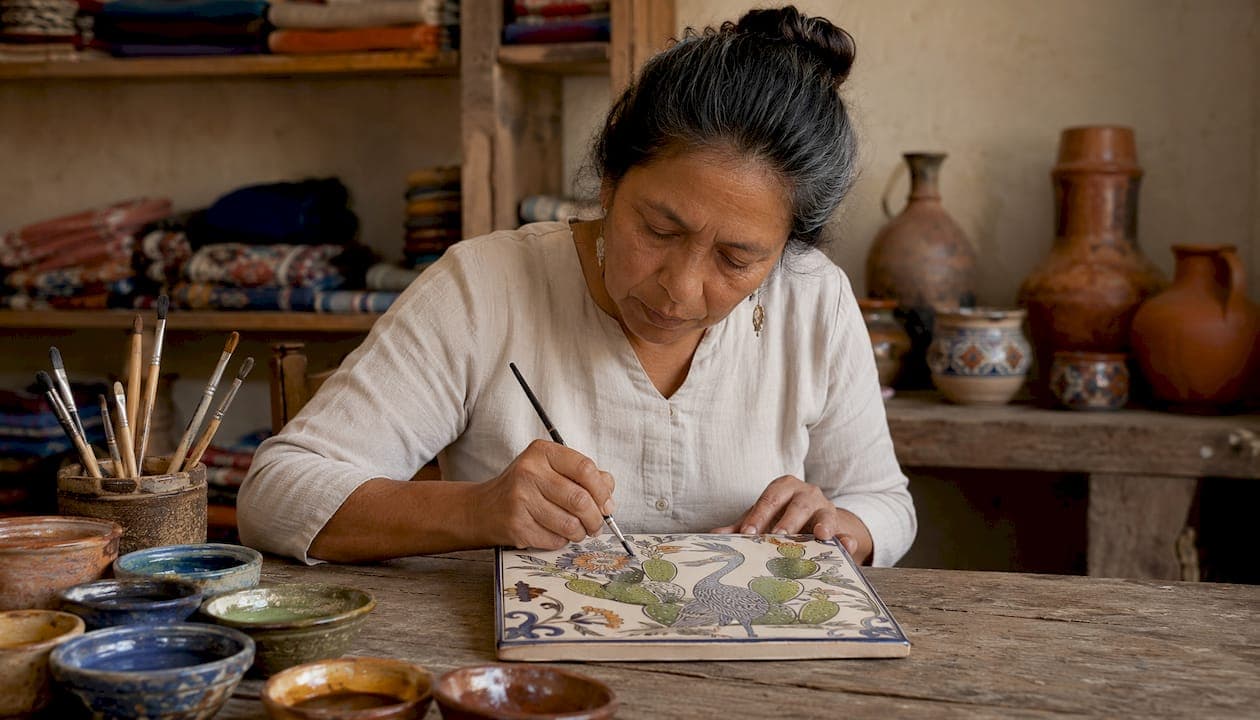
Storytelling is the organizing principle of Mexican decorative arts: motifs, palettes, and techniques encode community memory, making every handcrafted pillow or accent a living narrative you bring into your home. When you understand this, you stop shopping for surface beauty and start choosing pieces with genuine cultural weight. UNESCO's safeguarding programs for Yucatecan Mayan embroidery, Createdecorus's artisan partnerships, and scholarly research on materialized narratives all confirm the same truth: the story encoded in a textile or ceramic is inseparable from its value.
- A decorative pillow carrying Teenek embroidery or Mayan motifs holds a specific community's history in every stitch, not just a pattern.
- Cultural and emotional depth raises the collectible and monetary value of handcrafted accents beyond comparable machine-made goods.
- Before buying, ask for the artisan's name, their region of origin, and a provenance statement or collective affiliation.
Table of Contents
- How storytelling shapes Mexican decorative arts
- How artisans encode memory into motifs, palettes, and technique
- How to choose luxury Mexican pillows and accents that carry real stories
- Styling and preserving the story in your home
- How Createdecorus partners with Mexican artisans to preserve storytelling
- Key Takeaways
- Why the story behind the object matters more than most buyers realize
- Createdecorus: handcrafted Mexican accents with documented stories
How storytelling shapes Mexican decorative arts
Scholars describe ceramics and textiles as materialized narratives: objects that carry collective identity and lived experience into domestic space. This framing matters for buyers because it reframes what you are actually purchasing. A hand-embroidered pillow from Chiapas is not decoration in the passive sense. It is a record.
The historical roots run deep. Pre-Hispanic polychrome vessels were commissioned to encode political alliances and social status through visual narrative. That elevated function did not disappear with colonization. It adapted. Indigenous potters and weavers absorbed European forms while preserving ancestral meanings beneath them, a practice that defines Mexican artisan traditions to this day.
The evolution follows a clear arc:
- Pre-Hispanic period: Mnemonic motifs and ceremonial objects encoded cosmology, lineage, and political power.
- Colonial encounter: Artisans hybridized indigenous and European imagery, often as a form of quiet resistance.
- Post-Revolution continuity: Folk art became a vehicle for national and indigenous identity, championed by artists like Frida Kahlo and Diego Rivera.
- Contemporary craft: Artisan collectives in Yucatán and Chiapas sustain living traditions, supported by programs like UNESCO's 350-woman embroidery initiative coordinating with the Banorte Foundation and state government.
The crane-and-nopal motif in Talavera ceramics is one of the most studied examples of this continuity. Art historians read it as an act of cultural memory: Indigenous potters replaced the colonial eagle with a crane, preserving Aztec meaning within an available visual vocabulary. That single substitution is a lesson in how much a motif can hold.
How artisans encode memory into motifs, palettes, and technique
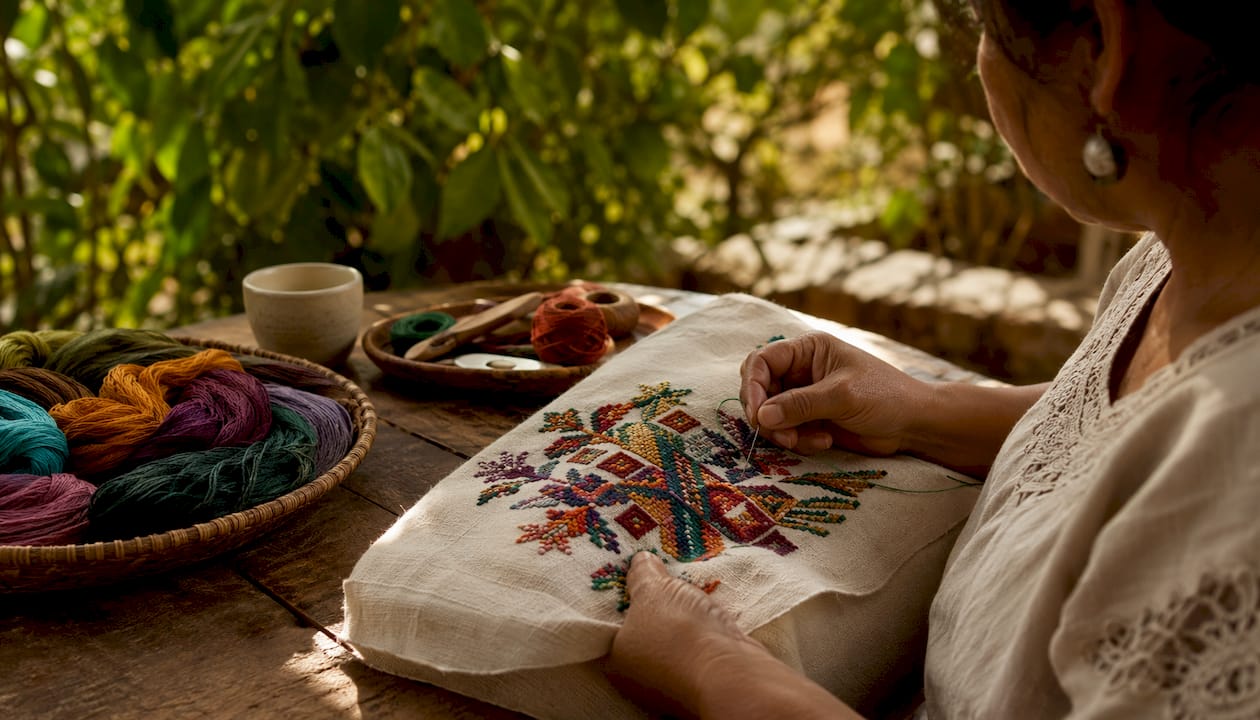
Makers encode memory intentionally. The choice of a color, a stitch type, or a specific symbol is rarely arbitrary — it signals region, community, and often a particular oral history.
| Design Element | Meaning / Story | Region | Craft Technique |
|---|---|---|---|
| Crane-and-nopal | Resilience, cultural memory, resistance to colonial erasure | Puebla / Tlaxcala | Talavera ceramics |
| Mayan geometric patterns | Cosmological order, lineage identity | Yucatán | Backstrap loom weaving, hand embroidery |
| Teenek embroidery palettes | Community belonging, ceremonial life in Huasteca | Veracruz / San Luis Potosí | Needle embroidery on manta cloth |
| Cochineal red | Pre-Hispanic continuity, sacred and celebratory use | Oaxaca, Chiapas | Natural dye from crushed cochineal insect |
| Chiapas floral embroidery | Seasonal cycles, feminine identity, village affiliation | Chiapas highlands | Chain stitch and satin stitch on wool or cotton |
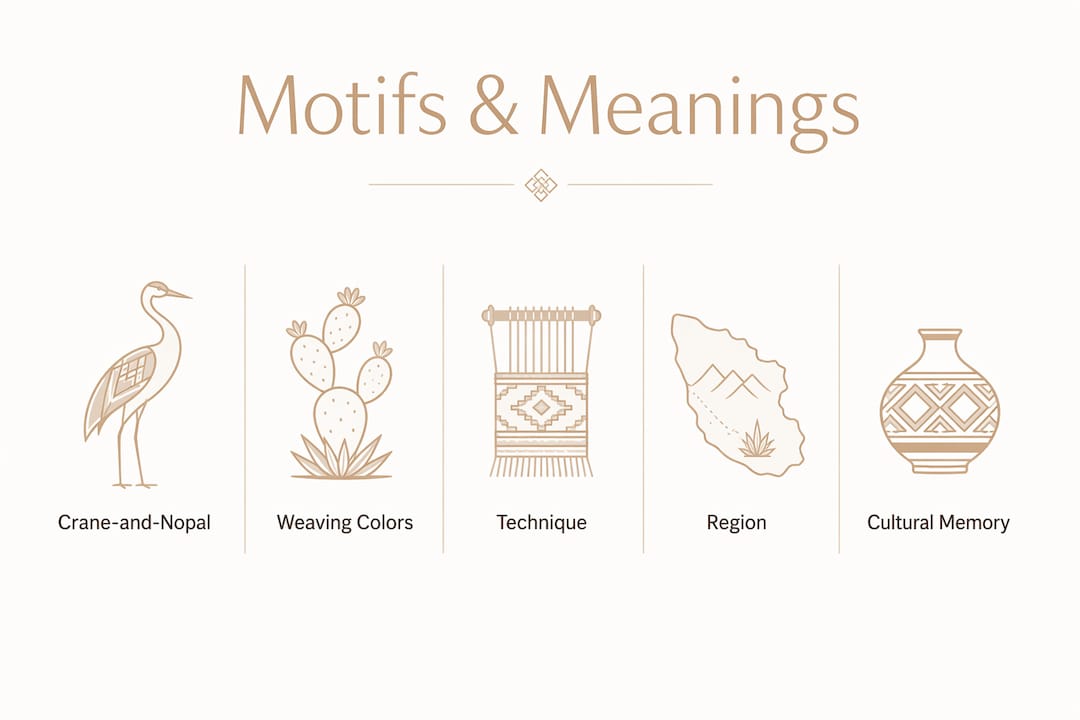
Technique itself is a form of transmission. Female artisans teaching stitch patterns and palette systems to younger generations are passing down oral history in a physical form. The indigenous patterns visible on a finished pillow are the surface expression of that deeper process.
Hand-embroidery signals to look for include irregular stitch spacing (a mark of hand production), slight color variation within a single thread color (natural dye behavior), and visible loom marks on woven ground cloth. Machine production cannot replicate these qualities.
Pro Tip: Flip a pillow or textile over and examine the reverse side. Hand embroidery shows a consistent but imperfect mirror of the front. Machine embroidery produces a flat, uniform backing with no variation. That 10-second check tells you more than any label.
- Request close-up photographs of the motif and the reverse of the textile before purchasing online.
- Ask whether the artisan works within a collective or cooperative, which signals both technique continuity and ethical sourcing.
- Look for region-of-origin labels that name a specific state or community, not just "Made in Mexico."
How to choose luxury Mexican pillows and accents that carry real stories
Prioritize provenance, artisan bios, and technique disclosure over surface aesthetics alone. A beautiful pillow with no documented origin is a decorative object. A beautiful pillow with a named artisan, a region label, and a description of its dye and stitch method is a piece of living culture.
Buying checklist:
- Natural or documented fiber content (cotton, wool, manta cloth)
- Hand-embroidery evidence (see the pro tip above)
- Named region of origin (state and ideally community)
- Artisan name or collective affiliation
- Production method disclosure (backstrap loom, hand-dyed, hand-stitched)
- Dye and fiber sourcing details
- Filling quality for pillows (memory foam or high-grade polyester for longevity)
Questions to ask any seller:
- Where specifically was this made, and by whom?
- Is the artisan part of a collective or cooperative?
- Which dyes and fibers were used, and are they natural or synthetic?
- Does the brand maintain ongoing relationships with the artisan community?
- Is there documentation of fair pricing or community economic support?
UNESCO's community-led model for Yucatecan Mayan embroidery shows what ethical sourcing looks like at scale: public-private partnerships that sustain technique while creating economic independence for artisan communities. That standard is worth holding any luxury retailer to. For collectors building a considered collection, starting with a clear framework makes each purchase more intentional.
Styling and preserving the story in your home
Place story-rich pieces where their motifs can actually be read. A Mayan-patterned pillow centered on a sofa, or a Teenek-embroidered accent on an ottoman focal point, invites the kind of close attention that rewards the artisan's work. Burying a narrative piece in a crowded arrangement diminishes both its visual and cultural presence.
Pairing guidance: neutral luxury palettes (warm linen, soft terracotta, natural wood) let bold embroidery speak without competition. One statement pillow as a narrative anchor tends to carry more weight than several competing pieces. For room-level context, interior doors and architectural features can frame a vignette and give artisan accents a proper stage.
Care instructions tied to materials:
- Hand-wash embroidered textiles in cold water with gentle soap; avoid machine agitation, which loosens hand-stitching.
- Keep natural-dyed pieces out of direct sunlight to prevent fading of cochineal and indigo pigments.
- Store flat or loosely rolled, never compressed long-term, to preserve stitch integrity.
- Memory-foam and polyester-filled pillows shipped vacuum-compressed will regain their shape within a few hours of unpacking.
Keep the artisan card, region tag, and care instructions together with each piece. Future owners, or your own memory years from now, will value that documentation as much as the object itself.
How Createdecorus partners with Mexican artisans to preserve storytelling
Createdecorus sources from artisan collectives and documents provenance with artisan bios and region-of-origin labels on every product. That practice is not incidental. It is the foundation of what makes each piece worth its price.
Partnership practices at Createdecorus include:
- Direct relationships with artisan communities in Mexico, supporting fair pricing and collective economic models
- Product pages that disclose materials, construction methods, and artisan or regional origin
- Premium filling options (memory foam and high-grade polyester) that meet luxury standards without compromising the handcrafted textile surface
- Vacuum-compressed shipping that protects pillow integrity during transit
- A wholesale and trade program for interior designers and boutiques, with trade pricing and custom order options
For designers and boutique buyers, the trade program offers a structured path to sourcing story-rich accents at scale, with the provenance documentation that discerning clients expect. Integrating Mexican craftsmanship into luxury interiors is most convincing when the sourcing story is as strong as the piece itself.
Key Takeaways
Storytelling in Mexican decorative arts is not metaphor: it is a documented, scholarly-confirmed function of motifs, palettes, and techniques that directly raises the cultural and monetary value of handcrafted luxury accents.
| Point | Details |
|---|---|
| Storytelling equals provenance | Every motif and palette encodes a specific community's history; provenance documentation is the proof. |
| Motifs decode region and meaning | The crane-and-nopal signals resilience in Talavera; Teenek palettes signal community identity in Huasteca. |
| Inspect stitch, dye, and label | Hand embroidery shows irregular spacing and natural dye variation; machine production does not. |
| Request artisan bio and collective proof | Ask for the artisan's name, region, and collective affiliation before purchasing any luxury accent. |
| Createdecorus as a provenance-led source | Createdecorus documents artisan bios, region labels, and materials on every handcrafted pillow and accent. |
Why the story behind the object matters more than most buyers realize
There is a tendency, even among serious collectors, to treat provenance as a nice-to-have rather than a core criterion. That instinct is worth examining. When I encounter a motif like the crane-and-nopal, what strikes me is not its beauty alone but the deliberateness behind it: an artisan centuries ago made a specific choice to preserve meaning under pressure. That act of cultural continuity is still alive in the objects we bring home today, if we know how to look for it.
Buyers who ask for artisan bios and collective affiliations are not being precious. They are participating in the same chain of transmission that kept these traditions alive through colonization, industrialization, and globalization. Purchasing responsibly, from sources that document and honor that chain, is one of the most direct ways a U.S. buyer can support cultural continuity in Mexican artisan traditions. My piece on honoring Mexican artistry explores nine specific ways to do that with intention.
Createdecorus: handcrafted Mexican accents with documented stories
Createdecorus offers something specific that generic home decor retailers cannot: handcrafted luxury pillows and accents sourced directly from Mexican artisan communities, with provenance documentation built into every product. Each piece carries artisan bios, region-of-origin labels, and materials disclosures, so you know exactly whose hands made it and where.
For designers and boutique buyers, the trade program provides wholesale pricing, custom order options, and the sourcing transparency your clients deserve. Every pillow and accent ships vacuum-compressed and is backed by Createdecorus's commitment to exceptional materials and ethical artisan partnerships. Shop the full collection of handcrafted luxury pillows and bring a genuine story home.