
Sustainable home decor is defined as the practice of selecting furnishings, textiles, and decorative objects that minimize environmental harm and support human health across their full lifespan. This means looking beyond surface aesthetics to consider where materials come from, how they are made, and what happens to them at the end of their use. The US EPA ranks indoor air pollution among the top five threats to human health, which makes the materials inside your home far more consequential than most people realize. Certifications like FSC, GOTS, and GREENGUARD exist precisely to help you cut through vague claims and make choices grounded in real standards. Sustainable interior design, as the industry formally calls it, is not a trend. It is a framework for living with intention.
What materials and practices define sustainable home decor?
Sustainable home decor starts with the materials themselves. Renewable, recycled, and responsibly sourced inputs form the foundation of any credible eco-friendly decor claim. The most widely recognized options include FSC-certified wood, organic cotton, bamboo, cork, and reclaimed materials. Each of these reduces pressure on virgin resources and, when processed correctly, keeps harmful chemicals out of your living space.

Non-toxic finishes and low-VOC paints matter just as much as the base material. Volatile organic compounds off-gas from conventional paints, adhesives, and synthetic finishes for months or even years after installation. Choosing products that carry GREENGUARD certification means an independent body has verified that the item meets strict chemical emission limits.
Third-party certifications are the clearest signal of credibility:
- FSC (Forest Stewardship Council): verifies responsible forest management for wood and paper products
- GOTS (Global Organic Textile Standard): covers organic fiber from harvest through manufacturing
- GREENGUARD: confirms low chemical emissions for indoor air quality
- Cradle to Cradle: evaluates a product's full material health, recyclability, and social responsibility
Manufacturing practices carry equal weight. A textile made from organic cotton but sewn in a facility with unsafe labor conditions or heavy water use does not qualify as truly sustainable. Social responsibility and environmental impact are two sides of the same coin.
Pro Tip: When you see a product labeled "natural," ask which certification backs that claim. "Natural" has no legal definition in home decor marketing, but FSC, GOTS, and GREENGUARD do.
How do you spot greenwashing when buying sustainable decor?
Greenwashing is the practice of making vague or misleading environmental claims to attract eco-conscious buyers. It is widespread in home decor, and the tactics are often subtle. Phrases like "eco-friendly," "green," or "earth-conscious" on product labels carry no regulatory weight unless paired with a verifiable third-party certification.
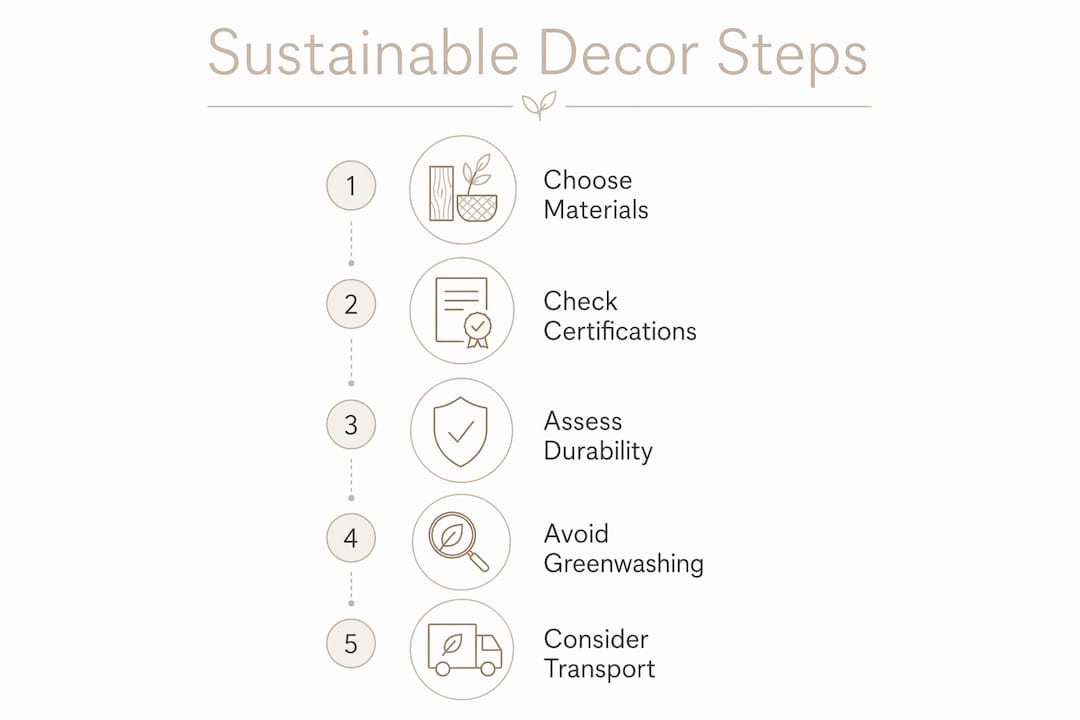
True sustainability requires a life-cycle assessment that covers raw material extraction, manufacturing, transportation, product use, and end-of-life disposal. Most brands only address one or two of these phases, which makes their sustainability claims incomplete at best and misleading at worst.
When evaluating a product, work through these questions in order:
- Does the product carry a recognized third-party certification? Look for FSC, GOTS, GREENGUARD, or Cradle to Cradle. A brand's own "eco" badge is not a substitute.
- Where are the materials sourced, and where is the product made? Transparent brands name their suppliers and regions. Vague answers signal a gap.
- What happens to the product at the end of its life? Recyclable, compostable, or take-back programs indicate genuine lifecycle thinking.
- How durable is the construction? Check seam quality, finishing, and backing materials. A well-made piece lasting 20 years often outperforms a certified but poorly constructed item on every sustainability metric.
- Is the brand transparent about trade-offs? Honest brands acknowledge limitations. Brands that claim perfection across every category deserve skepticism.
Pro Tip: Search the brand name alongside "certifications" and "supply chain" before purchasing. Credible brands publish this information openly. If you cannot find it, that absence is itself an answer.
What are the trade-offs in choosing sustainable decor materials?
No material is perfect, and understanding the trade-offs helps you make genuinely informed choices. Durability is the most underrated sustainability factor. FSC-certified or reclaimed wood can last 15 to over 100 years, while organic cotton textiles typically have a lifespan of 3 to 10 years. A longer-lived piece consumes fewer resources over time, even if its upfront environmental cost is higher.
Reclaimed wood presents its own complexity. The environmental benefit is real, but safe, non-toxic finishes are non-negotiable. Older wood may carry lead paint, chemical treatments, or structural damage that creates indoor air quality risks and shortens its usable life. Always verify the finish history before bringing reclaimed pieces indoors.
Transport emissions are another overlooked variable. The 500-km rule holds that sourcing materials within 500 kilometers of the point of use significantly reduces embodied carbon from shipping. A bamboo product manufactured responsibly but shipped across three continents may carry a larger carbon footprint than a locally made piece using conventional materials.
| Material | Lifespan | Key trade-off |
|---|---|---|
| FSC-certified wood | 15–100+ years | Higher upfront cost; verify finish safety |
| Organic cotton textiles | 3–10 years | Shorter life; prioritize quality construction |
| Reclaimed wood | Varies | Check for toxic finishes and structural integrity |
| Mud or lime plaster | Decades | Up to 70% lower carbon footprint; often cost-neutral or 15% cheaper than conventional finishes |
| Bamboo | 10–25 years | Sustainable crop, but verify processing chemicals |
The table above shows that affordability and sustainability are not opposites. Mud or lime plaster, for example, can cost the same or less than conventional wall finishes while delivering a dramatically lower carbon impact. The myth that green decor always costs more does not hold up under scrutiny.
How to practically incorporate sustainable decor into your home
Sustainable decorating does not require a full renovation or a large budget. Low-impact choices like low-VOC paint and LED lighting deliver a significant share of the available environmental benefit with minimal investment. Start there, then build.
Practical steps for every budget and living situation:
- Prioritize durability over novelty. Buy fewer pieces and choose ones built to last. A well-constructed handcrafted decor piece from a local artisan often outlasts mass-produced alternatives by years.
- Repair and reuse before replacing. Reupholstering a sofa or refinishing a table with low-VOC products extends its life and keeps it out of the landfill.
- Choose local artisans and makers. Local sourcing reduces transport emissions and supports regional economies. Handcrafted pieces also tend to use traditional techniques that rely on natural materials rather than synthetic shortcuts.
- Introduce natural fiber textiles. Organic cotton, linen, and wool rugs and cushions replace synthetic alternatives that shed microplastics with every wash.
- Add air-purifying plants. Peace lilies, snake plants, and spider plants improve indoor air quality at no ongoing cost. They complement, rather than replace, the choice of low-emission materials.
- Use low-VOC or zero-VOC paint. This single change has an outsized effect on indoor air quality, particularly in bedrooms and children's rooms.
Renters have more options than they often realize. Removable wallpaper made from natural materials, natural fiber area rugs, and textile wall hangings all create a soulful, intentional space without permanent modifications. The WELL Building Standard, which incorporates human health alongside environmental metrics, recognizes these choices as meaningful contributions to a healthier indoor environment.
Key Takeaways
Sustainable home decor is defined by material safety, durability, certified sourcing, and honest life-cycle thinking, not by marketing language alone.
| Point | Details |
|---|---|
| Certifications matter most | FSC, GOTS, and GREENGUARD verify claims that vague labels like "natural" or "eco-friendly" cannot. |
| Durability is sustainability | A well-made piece lasting 20+ years outperforms a certified but fragile item on every environmental metric. |
| Life-cycle thinking is required | Assess raw materials, manufacturing, transport, use, and disposal before trusting any sustainability claim. |
| Local sourcing cuts carbon | The 500-km rule reduces embodied carbon from transport, which often negates the benefit of distant sustainable materials. |
| Affordable options exist | Mud plaster, low-VOC paint, and natural fiber textiles deliver real environmental gains without premium pricing. |
What I have learned about sustainable decor after years of paying attention
The most common mistake I see is treating certification as a finish line. A GOTS label on a textile tells you the fiber was grown organically. It tells you nothing about how long the piece will hold up, whether the dyes are colorfast, or whether the construction will survive three years of daily use. Certification is a starting point, not a verdict.
My honest priority order, after thinking through this carefully, is: indoor air quality first, durability second, certifications third. The WELL Building Standard frames health as inseparable from environmental responsibility, and I think that framing is correct. A beautiful piece that off-gasses chemicals into your bedroom for two years is not a sustainable choice, regardless of what the label says.
I am also skeptical of the idea that sustainable decor requires sacrifice. The most enduring rooms I have seen combine natural materials, handcrafted objects, and a clear sense of cultural identity. That combination is not a compromise. It is the point. Artisan-made pieces, particularly those rooted in living craft traditions, tend to be built with the kind of care that mass production cannot replicate. That care shows up in longevity, and longevity is the most honest measure of sustainability we have.
The future of green home decor will belong to brands that publish their supply chains, name their materials, and stand behind the lifespan of what they sell. Reward those brands now, and the market will follow.
— Ernesto
Createdecorus and the craft behind conscious decorating
Choosing sustainable decor means choosing pieces built to last, made with care, and connected to a real place and tradition. Createdecorus handcrafts luxury home accents in Mexico, drawing on artisan techniques passed down through generations. Every pillow, ottoman, and accent piece uses rich natural textures and bold, authentic colors that reflect the cultural heritage of the makers.

These are not decorative objects assembled for a season. They are made to become part of your home for years. That durability, combined with the use of quality natural materials and the absence of mass-production shortcuts, aligns directly with what sustainable interior design asks of us. If you are ready to bring that kind of intention into your space, the handcrafted luxury collection at Createdecorus is a place worth starting.
FAQ
What is sustainable home decor, exactly?
Sustainable home decor is the practice of choosing furnishings and decorative objects that minimize environmental harm and support indoor health across their full lifespan. It covers material sourcing, manufacturing ethics, durability, and end-of-life disposal.
Which certifications should I look for when buying eco-friendly decor?
Look for FSC for wood products, GOTS for organic textiles, and GREENGUARD for low chemical emissions. These third-party certifications verify claims that brand-created labels cannot.
Is sustainable home decor more expensive?
Not always. Mud or lime plaster costs the same or up to 15% less than conventional wall finishes while delivering a significantly lower carbon footprint. Low-VOC paint and natural fiber textiles are widely available at standard price points.
How do I avoid greenwashing when shopping for green home decor?
Ask for the specific certification, the country of manufacture, and the supplier name. Brands with genuine sustainability practices publish this information. Vague answers or proprietary "eco" badges without third-party backing are warning signs.
Does durability really matter more than certification for sustainable decor?
A well-made, uncertified piece lasting 20 years often has a lower lifetime environmental impact than a certified piece that wears out in three. Durability reduces the total resources consumed over time, making construction quality a core sustainability factor.