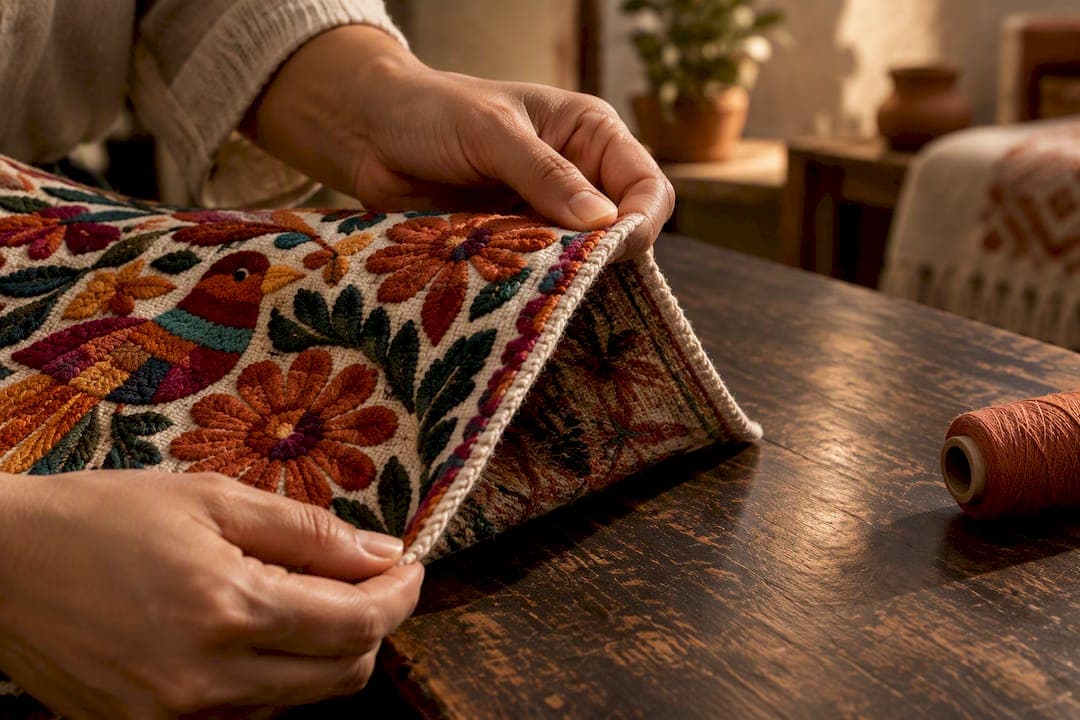
Otomí embroidery, especially the vibrant Tenango-style panels, brings hand-stitched color and cultural storytelling to a home in a way few textiles can match. It works beautifully as a pillow, a wall hanging or a table runner. The pieces worth buying are the ones that credit the artisan who made them. If you want that warmth without guesswork, Create Decorus curates handcrafted, luxury-finished accents that make the search simple.
TL;DR:
- Authentic Tenango embroidery is made on durable cotton manta with tight, dense stitches that significantly increase labor time and value.
- Provenance verification involves asking for artisan or cooperative details, reverse side photos, and documentation linked to a collective mark.
- The most impactful pieces are those made by recognized Otomí artisans, with looser stitching and clear origin attribution justifying higher prices.
- Proper care includes gentle hand washing, drying away from sunlight, and storing in breathable fabric to preserve color and stitch integrity.
- Create Decorus offers curated, luxury-finished Otomí textiles with documented artisan roots, simplifying the sourcing process for buyers and designers.
Table of Contents
- Visual inspiration: motifs, color palettes and formats for Otomí decor
- Room-by-room applications for living rooms, bedrooms and more
- What the fabric is made of and what the motifs mean
- Understanding Tenango's origin, collective mark and ethical sourcing
- Caring for embroidered textiles so they last for years
- Where to buy and how to vet a piece before purchase
- Create Decorus builds its collection around handcrafted luxury home accents made with respect for artisan technique that defines authentic Tenango work. Every piece draws on traditional stitching and pattern-making, adapted thoughtfully rather than copied, and finished with premium materials suited to daily use in a modern home.
- Where to read more about Tenango and Otomí embroidery
- What matters more than trend when you buy Otomí decor
- Bring an authentic piece into your own home
- Sources
- FAQ
Visual inspiration: motifs, color palettes and formats for Otomí decor
Every Tenango panel tells a story before you know its name. Artisans stitch animals, birds, flowers and everyday village scenes across the fabric, often arranged so the eye travels from one figure to the next like a page of illustrated folklore. This layout style, built on symmetry and repetition, is part of what makes Otomí pieces read as art rather than pattern.
The color work is where these textiles earn their reputation. Traditional palettes lean into saturated pinks, oranges, turquoise and deep greens, all stitched on unbleached cotton so the thread colors pop against a neutral ground. That contrast is exactly why a single Otomí piece can carry a whole room.
You can bring this into a home in several formats:
- Pillows: the easiest entry point, mixing well with solid linen or velvet cushions.
- Framed panels or tapestries: treated as wall art, ideal above a console or headboard.
- Table runners: add color to a dining table without overwhelming place settings.
- Curtain panels or valances: used sparingly, since the density of embroidery can be visually heavy at large scale.
Scale matters more than people expect. A small Otomí pillow in a neutral living room reads as an accent, while a large framed panel becomes the room's focal point, so choose the format based on how much visual attention you want the piece to command. For pairing ideas with other folk art traditions, this guide to iconic Mexican folk art styles is a useful next stop.
Room-by-room applications for living rooms, bedrooms and more
Otomí textiles adapt to nearly every room, but the right approach changes depending on what else is in the space.
- Living room: use one Otomí pillow as an anchor on a neutral sofa, then repeat one of its colors in a solid pillow nearby so the eye has somewhere to rest.
- Bedroom: layer an embroidered lumbar pillow or throw over plain linens and wool blankets, letting the pattern stand out against texture rather than competing with other prints.
- Dining room: a Tenango runner down the center of the table works well for everyday use, though hand embroidery benefits from a protective glass topper or careful placement away from spills.
- Entryway or small spaces: a framed panel above a console table gives a strong first impression without requiring floor space, which makes it a smart choice for apartments or narrow hallways.
The through-line across all four rooms is restraint. Otomí embroidery is detailed enough that it does not need a busy backdrop, and it tends to look best against solid walls, plain upholstery or natural wood. This design guide on pairing a bold artisan piece with contemporary furniture walks through that balance in more depth, and the styling principles at Blistr offer additional ways to blend statement textiles into a room without letting them overwhelm it.
What the fabric is made of and what the motifs mean
Authentic Tenango pieces are almost always stitched on cotton manta, a plain-weave cotton fabric chosen for its durability and its ability to hold tight stitches without puckering. The thread is typically cotton floss in saturated, colorfast dyes, since the whole appeal of the piece depends on color that does not fade quickly.

Stitch density is the clearest signal of labor and value. A piece stitched with small, tight stitches close together represents far more time and skill than one with loose, sparse stitching, and that difference shows up directly in price.
A single large, high-quality Tenango tapestry can take a long time to complete, depending on its size and the complexity of the scene. That timeline is one reason authentic pieces cost more than mass-produced imitations, and it is worth asking a seller directly how long a piece took.
Common motifs include:
- Animals: deer, birds, rabbits and other local fauna, often stitched mid-motion.
- Plants: flowering branches and leaves that frame or separate figures.
- Scenes: village life, celebrations or symmetrical arrangements that suggest a narrative.
Tenango is one of several regional Otomí embroidery techniques, alongside punto de cruz and pepenado, and it is distinguished by its flat textile format and dense, scene-based compositions rather than the garment-focused stitching used elsewhere in the region.
Understanding Tenango's origin, collective mark and ethical sourcing
Tenango embroidery takes its name from Tenango de Doria, the municipality where the style developed and where a large share of practicing artisans still work today. Understanding that origin matters because it is the foundation of what makes a piece authentic rather than a commercial copy.
An institutional study on Tenangos and their patrimonialization documents how the craft was named, formally registered as a collective mark, and promoted by local institutions as part of the region's cultural identity. That collective mark exists specifically to protect the term "Tenango" and the communities behind it, which makes it a useful reference point when you are trying to confirm a piece's origin.
Before buying, ask sellers for a few things:
- Artisan or cooperative name, ideally traceable to Tenango de Doria or the wider Otomí region.
- Photos of the piece's reverse side, which reveal stitch consistency and knotting technique.
- Any documentation or labeling tied to a collective mark or known cooperative.
Buying direct from artisans or cooperatives, rather than through unlabeled resellers, increases the chance that payment reaches the people who made the piece, according to advocacy work on Otomí-region embroidery techniques. That same source recommends looking beyond Tenango alone toward other Otomí-Tepehua-Nahua techniques as a way to widen support across the region's artisan economy.
Red flags include sellers who cannot name a cooperative, listings with only front-facing photos, and prices far below what hand stitching of that density would reasonably require.
Pro Tip: Ask a seller how long a piece took to stitch. A vague answer usually means the piece was not made by hand at all.
Caring for embroidered textiles so they last for years
Embroidered decor holds up well with a little attention, but harsh washing or direct sun will shorten its life fast.
- Wash by hand in cool water with a mild detergent, gently working suds through the embroidered areas rather than scrubbing.
- Dry flat away from direct sunlight, since UV exposure fades the saturated dyes that give Tenango pieces their character.
- Iron on the reverse side on a low setting if needed, never directly over the stitching.
- Store folded in breathable fabric, not plastic, to prevent trapped moisture and mildew.
For small repairs, a loose thread can often be secured with a simple hand stitch in matching floss, but larger damage is worth sending back to the artisan or cooperative that made the piece, since they know the original stitch pattern best.
Pro Tip: Keep embroidered pillow covers off wherever direct afternoon sun hits, even indoors. Fading happens gradually, and it is not reversible.
Where to buy and how to vet a piece before purchase
Authentic Otomí embroidery is sold through a few reliable channels: artisan cooperatives in the source region, boutique home decor brands that document their sourcing, vetted online marketplaces, and direct commissions with a known maker. Each offers a different balance of convenience and traceability.
Price mainly reflects size, stitch density and documented provenance. A small pillow cover with looser stitching costs far less than a large tapestry with tight, dense stitching and a verified artisan name attached, and that gap is normal rather than a red flag on its own.
Before checking out online, look for:
- Clear artisan or cooperative attribution in the product listing.
- Photos of the embroidery's reverse side, not just the styled front view.
- A stated return or shipping policy, since embroidered textiles can vary piece to piece.
- Any reference to a collective mark or known Otomí community.
If you are buying direct from a maker or cooperative, ask provenance questions plainly and respectfully: where the piece was made, how long it took, and whether the maker's name can appear alongside the item description. For more on weaving these motifs into a broader design plan, see this guide on indigenous patterns in Mexican decor.
Create Decorus builds its collection around handcrafted luxury home accents made with respect for artisan technique that defines authentic Tenango work. Every piece draws on traditional stitching and pattern-making, adapted thoughtfully rather than copied, and finished with premium materials suited to daily use in a modern home.
What that means for a reader working through this guide:
- Custom requests may be available for buyers seeking specific palettes or motifs.
- Wholesale and trade pricing may be offered to support designers and boutiques sourcing multiple pieces.
- Sustainable production methods and vacuum-compressed shipping help keep the process efficient without cutting corners on craftsmanship.
A Create Decorus pillow or wall panel slots directly into the living room and entryway ideas covered earlier. It gives you a handcrafted anchor piece without the guesswork of vetting an unfamiliar seller.
Where to read more about Tenango and Otomí embroidery
For deeper background, the INAH study on Tenangos and their collective mark offers the clearest institutional account of the craft's naming and protection. The discussion of alternative Otomí-region techniques from Psydeh is worth reading if you want to support artisans beyond Tenango specifically. Wikipedia's overview of Tenango embroidery is a reasonable starting point for quick background before you dive into sourcing.
What matters more than trend when you buy Otomí decor
Most decor advice treats Otomí embroidery as a pattern choice, something to match against a color scheme. That misses the point. The real decision is not which motif looks best on your sofa, it is whether the piece in front of you was actually made by the community whose name it borrows.
Conventional buying guides spend far more time on styling than on provenance, which is backwards given how much of this craft's value comes from the hours a specific person put into it. A piece with looser stitching and a documented cooperative behind it is worth more, culturally and practically, than a tighter, cheaper import with no name attached.
If you take one thing from this guide, let it be this: ask who made it before you ask how it looks in your living room. The pattern will always be beautiful. The provenance is what makes it honest.
— Ernesto
Bring an authentic piece into your own home
Sourcing genuine Otomí embroidery takes patience: tracking down a cooperative, verifying stitch quality, waiting on shipping from a small workshop. Create Decorus removes that friction by handling the sourcing and craftsmanship on your behalf, so you get a handcrafted piece with documented artisan roots without doing the legwork yourself.

Our decor pillows bring that same hand-stitched warmth into ready-made form, and our wall art collection offers framed and tapestry-style pieces sized for the statement placements covered earlier in this guide. Designers and boutiques can also explore our wholesale trade program for stocking multiple pieces at once. Browse the current collection and find the piece that fits your space.
Sources
FAQ
What does Otomí embroidery represent?
Otomí embroidery, particularly the Tenango style, represents local flora, fauna and everyday scenes stitched into symmetrical, story-like compositions. The motifs reflect the natural surroundings and cultural life of the communities that developed the technique, especially around Tenango de Doria.
What do indigenous embroidery patterns generally symbolize?
Indigenous embroidery patterns across many Mexican regions typically reflect the natural world, community life and inherited techniques passed down through generations of artisans. Meanings vary by community and region, so a specific symbol's significance is best confirmed with the artisans or cooperative who made the piece.
What are typical Otomí handcrafts beyond embroidery?
The Otomí craft tradition includes embroidered textiles, weaving and other handmade goods rooted in techniques passed down within families and cooperatives. Tenango-style embroidery is the best known internationally, but regional variations like punto de cruz and pepenado are also part of the broader Otomí-Tepehua-Nahua craft tradition.
What are the main types of embroidery found in Mexico?
Mexico is home to several distinct embroidery traditions, including Tenango from the Otomí region, punto de cruz, pepenado and telar de cintura weaving-based work, each tied to a specific community and technique. These styles differ in stitch method, base fabric and the type of object they traditionally decorate, from garments to flat textiles like tablecloths and panels.
How can I tell if an Otomí piece is worth its price?
Look at stitch density, the reverse side of the embroidery and whether the seller can name the artisan or cooperative behind the piece. A well-made, large Tenango tapestry with tight stitching can take months to years to complete, which is reflected in a higher, but justified, price.