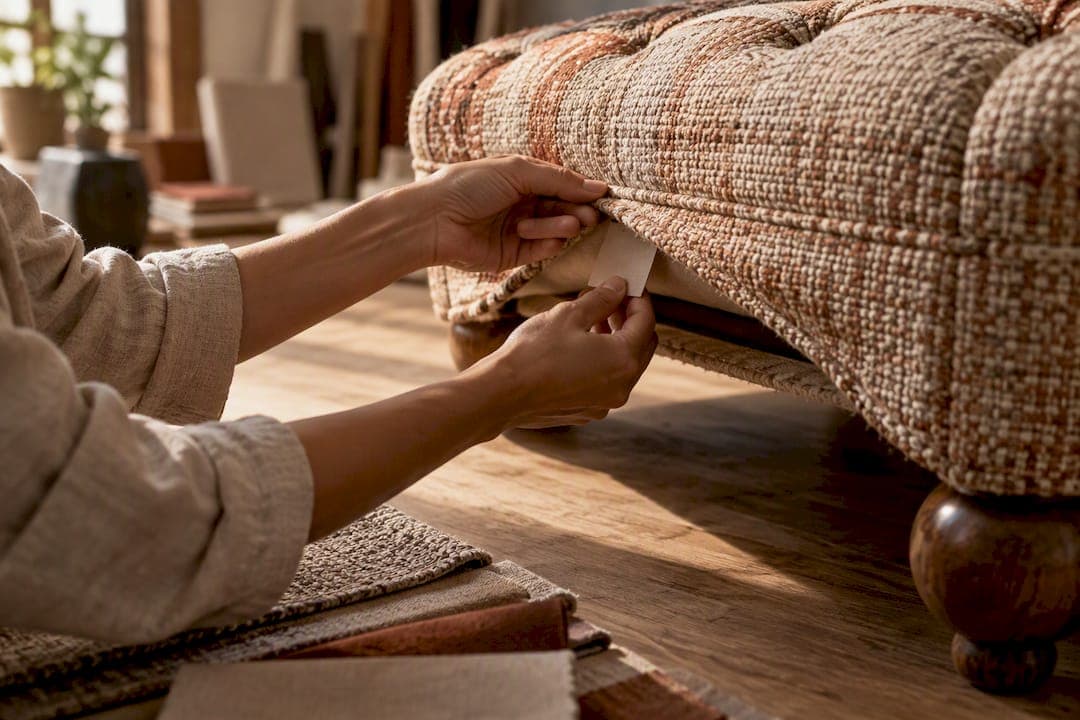
Find the fabric care code sewn under the cushion or on the frame, then follow what it allows: W for water-based cleaners, S for solvents only, W-S for either, and X for vacuum only. For a fresh spill, lift off any solids first, blot gently with a clean white cloth without rubbing, and test any product on a hidden spot before it touches the visible fabric. If the stain lingers or the fabric feels delicate, stop and call a professional rather than risk the piece.
TL;DR:
- Regular vacuuming with an upholstery attachment and gentle brushing prevent dust buildup that wears down fibers over time.
- Always identify the fabric care code—W, S, W-S, or X—before attempting any cleaning to avoid damaging delicate textiles or natural fibers.
- Spot cleaning should start immediately with blotting rather than rubbing, using the appropriate method based on the care code, to prevent stain spreading.
- Deep cleaning methods vary: foam-based solutions for W-coded fabrics, solvent spotters for S-coded, and only vacuuming for X-coded fibers, with moisture control crucial.
- Professional cleaning is recommended for set-in stains, natural fibers, or artisanal textiles, with costs ranging depending on fabric and stain complexity.
Table of Contents
- What to gather before you start cleaning
- How to find and read the upholstery care code
- Vacuuming and everyday maintenance for a longer-lasting ottoman
- Removing fresh spills and everyday stains step by step
- Deep-cleaning your ottoman based on its fabric code
- Drying and deodorizing your ottoman without inviting mildew
- Which tools and products actually belong in your cleaning kit
- When it's smarter to call a professional cleaner
- How Create Decorus thinks about caring for handcrafted ottomans
- Balancing regular care against knowing when to leave well enough alone
- Choosing durable, well-documented ottomans from Create Decorus
- Where to learn more about upholstery care
- Sources
- FAQ
What to gather before you start cleaning
A little preparation saves an ottoman from a well-meaning mistake. Before touching any stain, assemble a short kit and run through a simple sequence: vacuum first, test second, spot clean third, dry last.
- Soft-bristled upholstery brush: loosens surface dust without scuffing delicate weaves.
- Vacuum with an upholstery attachment: pulls embedded grit out of seams and tufting.
- White cotton cloths or unprinted paper towels: colored fabric can transfer dye onto damp upholstery.
- A mild, pH-neutral cleaner appropriate to the care code: harsh formulas can strip dye or stiffen fibers.
- A small bowl for diluting cleaner: concentrated product almost always does more harm than good.
Work in a ventilated room, especially with solvent-based cleaners, since fumes can build up quickly in a small space. Keep windows open or a fan running, and never mix cleaning products. That sequence, vacuum, test, spot clean, dry, applies to almost every ottoman regardless of fabric, and skipping the test step is the most common reason a quick fix turns into a bigger problem.
How to find and read the upholstery care code
Every upholstered piece, handcrafted or mass-produced, is built around a fabric that has specific tolerances, and the manufacturer's care code is the fastest way to know what those tolerances are. According to the University of Illinois Extension, the first step in cleaning any upholstered item is identifying the code: W, S, W-S (sometimes written S-W), or X.
- W means the fabric tolerates water-based cleaners or foam.
- S means only a solvent-based cleaner is safe, since water can cause shrinkage or permanent marks.
- W-S means either method works, which gives you more flexibility.
- X means vacuum only. No liquid of any kind should touch the fabric.
The code is usually stitched onto a tag under a cushion, along the frame's underside, or included in paperwork that came with the piece. When no tag exists, the University of Illinois Extension recommends a conservative approach: test a hidden patch, let it dry completely, and check for color loss, shrinkage, or texture change before treating any visible area.
A code is not a suggestion, it's a prediction. It reflects how the dye, backing, and fiber blend will react to a specific type of moisture or chemical, which is why a cleaning method that worked beautifully on a cotton sofa can ruin a silk-blend ottoman. This matters even more for handwoven or hand-dyed textiles, where the dye may not be as colorfast as a machine-printed fabric.
This is also where common kitchen remedies fall short. Vinegar and baking soda circulate constantly as "natural" upholstery fixes, but on wool, silk, or fabrics with decorative embroidery, the acidity in vinegar can fade dye and the abrasiveness of baking soda can wear down delicate fibers if scrubbed in. Neither ingredient is calibrated to a care code, so neither belongs on a fabric you haven't already tested.
If you're shopping for a new piece and want the label question settled before it ever becomes a problem, it helps to understand how care symbols on handcrafted textiles are structured in the first place.
Vacuuming and everyday maintenance for a longer-lasting ottoman
Most fabric damage doesn't come from a dramatic spill. It comes from ordinary dust grinding into the weave every time someone sits down, and the fix is almost embarrassingly simple: vacuum regularly. Guidance from University of Nebraska custodial services points out that routine vacuuming with an upholstery attachment removes the abrasive dust that wears down fibers and padding over time, functioning less like tidying and more like conservation.
A thorough weekly pass covers more than the cushion top:
- Seams and tufted buttons: dust collects where fabric folds, and it's easy to miss on a quick pass.
- The underside and any storage cavity: ottomans with lift-tops trap crumbs and pet hair that never touch the visible surface.
- Along piping and welt cord: these edges take the most contact and wear fastest.
Use low suction and a soft-bristled brush attachment, moving with the direction of the nap rather than against it. Going against the grain can flatten pile fabrics or loosen delicate stitching, particularly on velvet or chenille.
Pro Tip: Rotate a footstool-style ottoman a quarter turn every few weeks so the same edge doesn't take all the wear, and keep it out of direct sunlight, which fades dye far faster than foot traffic ever will.
A few habits round out the routine: blot spills the moment they happen instead of letting them set, keep sharp objects and pet claws away from tufted seams, and avoid placing an ottoman where sun streams in for hours each day. None of this takes long, but it's the difference between a piece that still looks sharp in five years and one that looks tired in one.
Removing fresh spills and everyday stains step by step
Speed matters more than technique in the first sixty seconds after a spill. According to the University of Illinois Extension, the right response is to remove solids without rubbing, absorb liquid with a white cloth, and always patch-test any cleaner in a hidden spot first. Rubbing pushes a stain deeper into the fibers and can also fray delicate weaves.
- Scoop or blot away anything solid with a spoon or dull knife, working gently so you don't grind it into the fabric.
- Blot, don't rub, pressing a clean white cloth straight down onto the spill to absorb as much liquid as possible.
- Check the care code before reaching for any cleaner, since a W-coded ottoman and an S-coded ottoman call for entirely different products.
- Test the cleaner on a hidden patch, letting it dry fully to confirm there's no discoloration or texture change.
- Work from the edge of the stain toward the center, which keeps the stain from spreading outward as you clean.
- Blot dry with a fresh cloth, then let the area air out before deciding whether a second pass is needed.
That edge-to-center motion deserves its own mention, since it's the step people skip most often. Cleaning in circles or starting from the middle pushes the stain outward, turning a coin-sized mark into something much larger.
The right solution depends entirely on the code:
- W-coded fabric: a small amount of mild, water-based upholstery foam or diluted dish soap, worked in lightly, then dried under pressure with a dry towel.
- S-coded fabric: a solvent made specifically for upholstery, applied sparingly, in a ventilated room.
- W-S coded fabric: either method works, so start with the gentler water-based option first.
- X-coded fabric: skip liquids entirely and stick to vacuuming or a dry upholstery brush.
Grease-based stains, from food or hand cream, respond best to a small amount of cornstarch or talc left to sit for several minutes before vacuuming it away, which pulls oil out of the fibers without introducing moisture. Ink is trickier: dab, never rub, with a cloth dampened only slightly with the solvent or cleaner appropriate to the code, working from the outer edge inward. Pet accidents call for the fastest possible blotting, since urine that sets can leave both a stain and an odor that's much harder to reverse later. In every case, if a spot doesn't lift after two gentle attempts, stop. Continued scrubbing at that point usually spreads the stain or damages the fabric rather than solving anything.
Deep-cleaning your ottoman based on its fabric code
A once-a-year deep clean keeps an ottoman looking like new, but the method has to match the code exactly, since this is where the wrong choice does the most damage. The University of Illinois Extension is direct on this point: manufacturer instructions override home remedies, especially for velvet, chenille, silk, wool, and artisanal textiles.
For W-coded ottomans, a foam-based upholstery shampoo or a mild detergent solution is the safest deep-clean route. Whip the cleaner into a stiff foam rather than a liquid, since foam carries far less water into the fabric. Apply with a soft brush in small sections, working from the edge toward the center, then press a dry towel firmly against the area to pull out moisture rather than letting it sit and soak in.

For S-coded ottomans, skip water altogether. A solvent-based upholstery spotter, used sparingly and in a well-ventilated room, is the only appropriate option. Apply it to a cloth rather than directly onto the fabric, and work in small sections so no area stays wet longer than necessary. Because solvents evaporate rather than needing to be rinsed, less is genuinely more here.
For W-S coded ottomans, you have the flexibility to choose either method, and the more conservative choice is usually the smarter one. Test both a water-based foam and a solvent spotter on separate hidden patches, then use whichever leaves the fabric looking and feeling the most like it did before.
For X-coded ottomans, deep cleaning means vacuuming and brushing only. No water, no steam, no solvent. These fabrics, often delicate silks, certain wool blends, or specialty weaves, are simply not built to tolerate liquid cleaning, and even a small amount of moisture can leave a permanent ring or cause shrinkage.
- Skip steam cleaners and extraction machines on delicate natural fibers or hand-dyed textiles, since high heat and saturation can set a stain permanently or bleed dye between colors.
- Avoid over-wetting any fabric, even W-coded ones, since excess moisture can seep into cushion foam and take days to dry, inviting mildew.
- Never combine cleaning products, particularly anything containing bleach or ammonia, which can react with dyes or finishes in unpredictable ways.
- Work in small sections, finishing and drying one area before moving to the next, rather than saturating the whole surface at once.
Pro Tip: If you're unsure whether your ottoman's fabric is genuinely W or S, treat it as S until proven otherwise. Reversing water damage is far harder than reversing an overly cautious solvent test.
Steam and extraction machines deserve a specific warning here, since rental units are widely available and tempting for a large stain. These machines push a significant amount of water and heat into the fabric, which is fine for many synthetic blends but risky for anything hand-dyed, hand-stitched, or wool. On a handcrafted ottoman where the tufting or embroidery was done by hand, that kind of saturation can loosen stitching or bleed color between panels in a way that no amount of careful drying afterward can undo.
Drying and deodorizing your ottoman without inviting mildew
Getting the cleaning right and then rushing the drying is one of the most common ways an otherwise successful cleaning job goes wrong. Damp upholstery left without airflow is exactly the environment mildew needs, and once mildew sets into foam padding, it's nearly impossible to fully remove without replacing the cushion.
- Position a fan nearby or place the ottoman near an open window to keep air moving across the damp area.
- Avoid direct sun or a heater vent, since fast, high heat can shrink fibers or warp wooden frames even as it speeds drying.
- Expect a drying window of several hours to a full day, depending on how much moisture was used and how humid the room is.
- Press a dry towel against the area periodically during the first hour to pull out extra moisture before it has a chance to sink into the padding.
Once fully dry, a light pass with an upholstery brush restores the nap and evens out any flattening from the cleaning process. For a light musty smell, a very light dusting of baking soda left for a few hours before vacuuning it away can help, but a persistent odor that doesn't fade after full drying is usually a sign that moisture reached the padding, which is a job for a professional rather than another round of home treatment. Fabric protector sprays, applied only after the piece is completely dry and only when compatible with the care code, add a layer of resistance against the next spill. For wool or other natural-fiber cushions, air drying for 24 to 48 hours is worth the patience, since natural fibers hold onto moisture longer than most synthetics.
Which tools and products actually belong in your cleaning kit
Not every product marketed for "upholstery cleaning" is safe for every fabric, and a few smart purchases up front prevent most disasters. Beyond the basics already mentioned, a handful of attributes separate a safe product from a risky one.
- A pH-neutral upholstery shampoo for W and W-S coded fabrics, since neutral formulas are far less likely to strip dye or leave a residue.
- A solvent-based spotter clearly labeled for upholstery use for S-coded fabrics, rather than a general-purpose stain remover.
- A soft microfiber cloth for buffing and blotting, since rougher towels can snag delicate weaves.
- A garment steamer, used sparingly and only when the code allows moisture, can loosen light wrinkles without saturating the fabric.
Steer clear of bleach, ammonia, and anything labeled as a heavy-duty degreaser. These are formulated for surfaces like tile and hard plastic, not woven textiles, and they can strip dye, weaken fibers, or leave a stiff residue that never fully softens again. Undiluted dish soap and most all-purpose cleaners fall into the same category. If a label doesn't specify that it's safe for upholstery, assume it isn't until you've confirmed otherwise on a hidden patch.
When it's smarter to call a professional cleaner
Some stains and some fabrics are simply not worth the risk of a DIY attempt. Set-in stains that have already dried, delicate artisanal weaves, wool with visible shrinkage risk, or any hint of mildew reaching into the padding are all situations where a professional's equipment and experience matter more than saving a service fee.
Price guidance from the Mexican market, compiled by Cronoshare, shows that upholstery cleaning costs vary widely depending on the item and method, with example ranges for chairs and sofas varying depending on size and fabric type. The same guidance notes that a deep professional cleaning once a year is a common recommendation for pieces in regular use, while lighter-use furniture can often go longer between professional visits.
A few factors move the price up or down: the fabric's fragility, how set-in the stain is, whether the cleaner needs to travel to your home, and whether the job is priced per seat or as a flat rate for the piece. Before booking, it helps to ask a short list of questions:
- What cleaning method will you use on this specific fabric?
- Do you offer any guarantee if the stain doesn't lift?
- Are you insured in case of accidental damage?
- How long will the piece need to dry before it's usable again?
A cleaner who answers these clearly and specifically to your fabric, rather than with a generic answer, is usually the safer choice for a piece you don't want to gamble on.
How Create Decorus thinks about caring for handcrafted ottomans
Handcrafted pieces carry details that mass-produced furniture simply doesn't: hand-tufted buttons, embroidery worked stitch by stitch, dye lots mixed by hand rather than machine-calibrated. That's exactly why reading the care code matters even more here than on an ordinary sofa. A dye variation that looks intentional and beautiful on day one can shift unevenly if the wrong cleaner touches it.
Ernesto, who writes on textile care for Create Decorus, keeps a short list of rules close at hand for handcrafted upholstery specifically: vacuum gently and often rather than waiting for visible dust, resist the urge to over-wet any stain even when it looks stubborn, and give wool or natural-fiber cushions a full 24 to 48 hours to air dry before deciding a stain needs a second treatment. These aren't complicated rules, but they're the ones most often skipped when a stain feels urgent.
For fabrics with decorative stitching, tufting, or hand-applied dye, the safest instinct is almost always the most conservative one: less moisture, more patience, and a professional call when the code is unclear or the fabric feels delicate to the touch. A piece built by hand deserves cleaning that respects the same care that went into making it, and that starts with reading the label before reaching for a cloth.
Balancing regular care against knowing when to leave well enough alone
A reasonable rhythm for most ottomans looks like this: vacuum weekly, treat spills the moment they happen, and reserve a full deep clean for once a year unless the piece sees heavy daily use. That rhythm keeps dust from grinding into fibers without over-handling a fabric that doesn't need frequent deep intervention.
Where I'd push back on the instinct to clean aggressively is this: a stain that has already set, or a fabric that's showing its age gracefully, doesn't always need a fix. Sometimes the better call is restraint, letting a professional decide whether treatment helps or simply adds more stress to fibers that have already done their job well for years. Preservation isn't the same as neglect. It's recognizing that a hand-dyed or hand-stitched piece has a finite tolerance for intervention, and spending that tolerance wisely matters more than chasing a spotless look.
— Ernesto
Choosing durable, well-documented ottomans from Create Decorus
If keeping track of care codes and testing patches sounds like more upkeep than you want to sign up for, choosing a piece built with that maintenance in mind from the start makes the whole question simpler. Handcrafted ottomans and decor pieces often carry artisan tradition, from tufted details to textiles sourced with care, making fabric care easier to understand.

Before buying any upholstered piece, whether from Create Decorus or elsewhere, it's worth checking the fabric care code upfront so you know exactly what daily life with it will look like.
- Handcrafted construction means details like tufting and stitching are done by artisans, not machines, which is part of what gives each piece its character.
- Clear product information helps you understand what you're bringing home before it arrives.
- A design library beyond ottomans, including pillows, wallpaper, wall art, and rugs, for anyone furnishing a full room with the same sensibility.
Browse the current collection of decor pillows and ottomans to see the textures and craftsmanship up close, and if you're outfitting a whole space, the wallpaper and rug collections carry the same handcrafted approach into the rest of the room.
Where to learn more about upholstery care
- University of Illinois Extension explains how to read fabric care codes and handle a fresh spill safely.
- University of Nebraska custodial guidance covers vacuuming technique and why regular suction protects fibers long-term.
- Cronoshare's Mexican price guide offers realistic cost ranges for hiring a professional upholstery cleaner.
- Care symbols explained breaks down the standards behind fabric labeling in more detail.
- Air-drying wool cushions walks through drying times specific to natural fibers.
Sources
- University of Illinois Extension - Textile care guidance
- University of Nebraska custodial guidance
- Cronoshare — approximate upholstery cleaning prices (Mexico)
FAQ
What does the W, S, W-S, and X care code mean?
The code tells you which cleaning method is safe for that specific fabric: W for water-based cleaners, S for solvents only, W-S for either, and X for vacuuming with no liquids at all. According to the University of Illinois Extension, checking this code before cleaning anything is the essential first step.
How often should I clean my fabric ottoman?
A weekly vacuum keeps dust from wearing down the fibers, spills should be treated the moment they happen, and a full deep clean once a year is a reasonable target for most ottomans in regular use, according to Mexican market pricing guidance. Heavily used pieces may benefit from more frequent professional attention.
Can I use vinegar or baking soda to clean an ottoman?
These household staples can damage certain fabrics, particularly wool, silk, or anything with hand-applied dye, since vinegar's acidity can fade color and baking soda can abrade delicate weaves if scrubbed in. It's safer to check the fabric's care code first and use a cleaner formulated for that specific type of upholstery.
How much does professional ottoman cleaning cost?
Prices vary by fabric, stain severity, and whether the job is charged per seat or as a flat rate, with example ranges for chairs and sofas in the Mexican market running between MXN 200 and MXN 800 per item. Getting a quote based on your specific piece is the most reliable way to know the real cost.
Does Create Decorus sell ottomans with clear care instructions?
Handcrafted ottomans and other decor pieces are available to browse on the shop page. Checking any product's care code before purchase remains the best way to plan for its long-term upkeep.