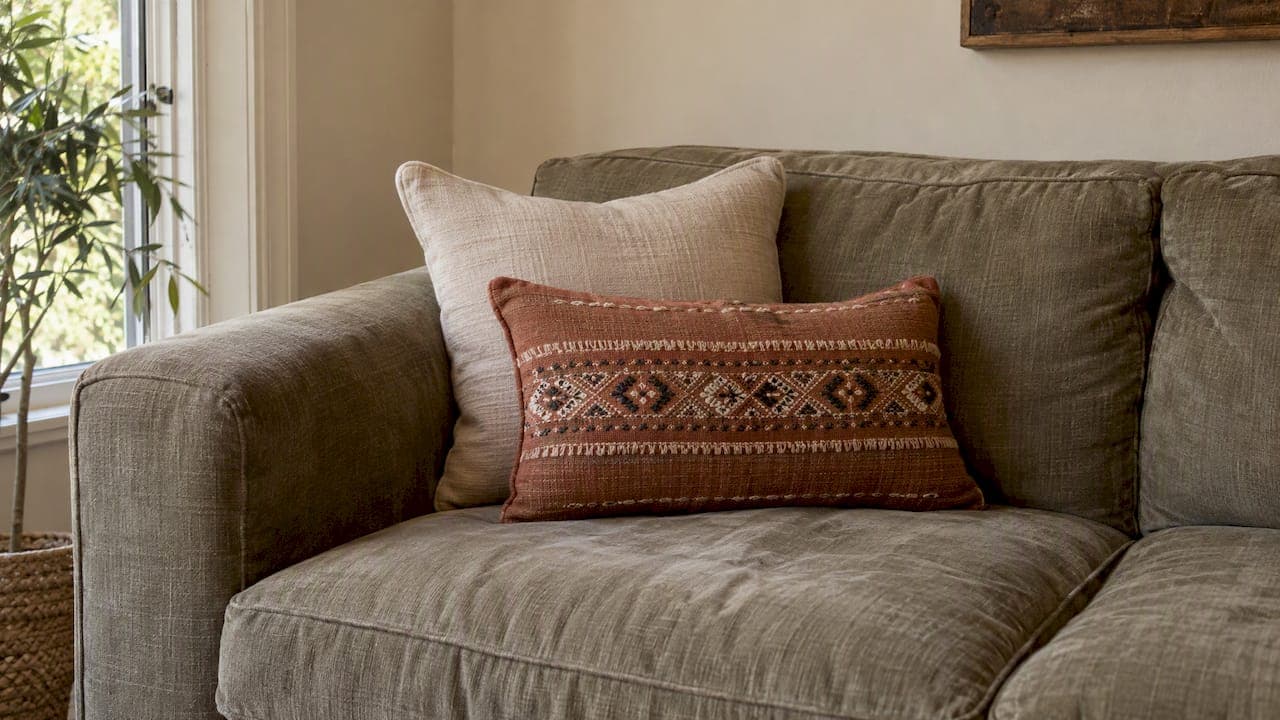
A decorative lumbar pillow belongs in the sofa corner, layered in front of a larger square, or centered across the width of a bed, where it anchors the arrangement and adds texture without crowding the space. Getting this placement right comes down to three things designers watch closely: proportion, texture contrast, and insert quality. Below, we walk through exactly how that plays out on a sofa, a sectional, a bed, and a chair.
TL;DR:
- On sectionals, space lumbar pillows evenly along the long run, but leave enough room between them to preserve usable seat depth.
- Sofa layering commonly suits a 14 by 20 inch lumbar, while beds and sectionals can take 14 by 36 or 16 by 36 inch styles.
- Choose an insert about two inches larger than its cover for a fuller shape; polyester or memory foam holds structure longer on busy sofas.
- Pair contrasting materials such as linen and velvet, and let either the lumbar or square pillows carry the bold pattern, not both.
- Fluff and rotate pillows weekly, and allow pillows shipped in compressed packaging a day or two to regain loft before judging their final shape.
Table of Contents
- Where to place a lumbar pillow on a sofa, chair, bench, or bed
- Styling formulas designers repeat
- Sizing and proportion: measurements that actually work
- Layering materials and texture around a lumbar pillow
- Practical tips from Create Decorus and Ernesto on inserts and care
- Ernesto's perspective: a small pillow with outsized impact
- Shop handcrafted lumbar pillows at Create Decorus
- FAQ
- Sources
Where to place a lumbar pillow on a sofa, chair, bench, or bed
Every piece of furniture asks for a slightly different approach, but the underlying logic stays the same: the lumbar pillow should feel intentional, not like an afterthought wedged into a gap.
On a sofa, the classic spot is the corner, tucked in front of a larger square pillow so it reads as a layer rather than a lone object. When a room calls for something quieter, a single lumbar centered against the back cushion gives a pared-down, tailored look. Architectural Digest notes that this shape works well specifically because it anchors an arrangement while layering in front of larger pillows without adding clutter.
Sectionals have more real estate, which means more room for rhythm. Pairs or repeated lumbar pillows spaced evenly along a long run keep the eye moving without overwhelming the seating. Just watch spacing closely: pillows placed too close together eat into usable seat depth.
Beds reward a bit of drama. An oversized lumbar stretched across a queen or king creates a single strong focal point, while a smaller lumbar tucked in front of the shams suits a more minimal bedscape.
- Chairs and benches: center the lumbar for a formal feel, or shift it slightly off-center for something more relaxed, adjusting for seat depth and arm height so the pillow does not fight for space.
Styling formulas designers repeat
Once you understand where a lumbar pillow goes, the next step is building a layout you can repeat across rooms. These four formulas cover most situations.
- Symmetrical sofa: place a larger square pillow at each end, then add a lumbar either centered between them or layered in front of one square for subtle asymmetry.
- Asymmetrical cluster: group pillows of varied sizes and textures at one end of the sofa, then finish with a contrasting lumbar to break up the visual weight.
- Bed anchor: use one oversized lumbar across a queen or king bed as the single statement piece, or scale down to a smaller lumbar for a twin or full.
- Adapted formula: adjust any of the above based on sofa depth, arm style, and how often the seat actually gets used, since a deep sofa with tall arms can carry more volume than a shallow one.
The common thread across all four is restraint. House Beautiful points out that designers typically start with the largest piece of furniture and build outward, letting the lumbar pillow do the work of adding contrast rather than piling on more squares. For a deeper breakdown of how shape choices affect a room's composition, our post on bolster versus lumbar pillows is worth a look.
Sizing and proportion: measurements that actually work
Size is where a lot of pillow arrangements quietly fall apart. A lumbar pillow that is too small for the furniture around it disappears, and one that is too large competes with everything else.
Common lumbar dimensions run from around 14x20 inches for layering on sofas to 14x36 or 16x36 inches for beds and sectionals, according to Homes & Gardens. A short lumbar pairs naturally with standard 20x20 or 22x22 sofa squares, while a long lumbar suits wider pieces like a king bed or a deep sectional run.
Designers often oversize inserts slightly relative to their covers to achieve a plumper, more structured look rather than a flat-fitting one. House Beautiful describes this oversizing habit as one of the most consistent recommendations among design editors and stylists.
- Deep seats can handle a longer lumbar without looking crowded.
- Low backs favor a shorter lumbar so the pillow does not disappear below the sightline.
- Arm style matters too: pillows on a sofa with low or no arms often need to be slightly larger to fill the visual gap.
For a closer look at measurements across different rooms, our guide to cushion sizes for every room breaks down the numbers in more detail.
Layering materials and texture around a lumbar pillow
Texture is what separates a styled room from a stack of pillows. The goal is a conversation between materials rather than a matched set.

Pairing linen with velvet, or bouclé with silk, gives a lumbar pillow a reason to stand apart from the squares around it. A touch of mohair on one accent piece adds warmth without turning the whole arrangement shaggy. Architectural Digest frames this texture-first approach as central to a high-end pillowscape, noting that contrasting surfaces create depth in a way flat color matching rarely does.
For color, pull one shade from something already in the room, a rug, a piece of art, a wall, rather than hunting for an exact match. A loose 60/30/10 split (dominant color, secondary color, accent pop) keeps a cushion arrangement cohesive but still lively.
- Swap to linen and cotton for warmer months, velvet and wool for cooler ones.
- Save bold pattern for the lumbar pillow when your squares are solid, and vice versa, so the eye has one clear focal point rather than two competing ones.
- Treat shape as part of the texture conversation too; our piece on cushion shapes for homes looks at when swapping a square for a lumbar changes the whole feel of a seating area.
Pro Tip: If you are unsure whether two fabrics work together, hold them against each other in the room's natural light before committing, sheen and weave read very differently under a lamp than they do by a window. For more on how lighting changes the way textures show up, Lights & Things has useful guidance on living room lighting and ambiance.
Practical tips from Create Decorus and Ernesto on inserts and care
A handcrafted lumbar pillow lives or dies by its insert. It is recommended to size the insert slightly larger than the cover, the same oversizing habit designers lean on, because it gives the pillow a fuller, more supportive shape that holds up over time rather than going flat within weeks.
- Down and feather blends offer a plush, moldable feel, while denser polyester or memory foam fills hold their structure longer on high-traffic sofas.
- Linen and cotton covers do well with gentle spot cleaning, while velvet and bouclé benefit from a soft brush and occasional professional cleaning.
- Rotate and fluff pillows weekly to keep the fill distributed evenly, and store seasonal pillows in a breathable bag rather than plastic.
- When ordering a handcrafted or custom lumbar pillow, ask about fabric swatches, fill options, and lead time before placing the order.
- Because pillows often ship vacuum compressed, give each one a day or two to fully recover its loft and fluff before judging the final shape.
Ernesto's perspective: a small pillow with outsized impact
A lumbar pillow is often the last thing added to a room and the first thing people notice. There is something satisfying about a piece that small carrying that much visual weight, especially when it is handmade and holds its shape because someone chose the right fill, not the cheapest one. In an earlier post comparing bolster and lumbar shapes, I made the case that shape decisions deserve as much thought as color or fabric. I still believe that. Choose placement with intention, and the smallest cushion in the room ends up doing the most work.
— Ernesto
Shop handcrafted lumbar pillows at Create Decorus
Every lumbar pillow is crafted in small batches, which means you get the oversized insert, the structured fill, and the fabric pairing described throughout this guide, built in from the start rather than fixed after the fact. Each piece carries the texture and craftsmanship of traditional techniques, so the pillow you place in that sofa corner or across your bed is never a mass-produced stand-in.

- Browse our full range of decor pillows, including lumbar shapes ready to layer into your existing arrangement.
- Looking for a bolder statement? Our animal print pillow collection pairs well with the texture-contrast approach covered above.
- Interior designers and retailers can explore custom sizing and bulk pricing through our wholesale trade program.
If you are ready to place a lumbar pillow that holds its shape and its story, start with our shop and find the piece that fits your space.
FAQ
Where should a lumbar pillow go on a sofa?
Place it in the corner, layered in front of a larger square, for a styled look, or centered against the back cushion for something quieter. Architectural Digest notes this positioning anchors the arrangement while keeping it from looking cluttered.
How many lumbar pillows should I use on a bed?
One oversized lumbar across a queen or king bed is often enough to serve as the room's signature accent, while a smaller lumbar suits a twin or full. Design editors commonly recommend scaling down to a shorter lumbar on smaller beds rather than using multiples.
What size insert should I use for a lumbar pillow?
A common designer trick is sizing the insert about two inches larger than the cover, so a 24-inch cover gets a 26-inch insert, for a fuller, more structured look. House Beautiful describes this oversizing habit as a consistent recommendation among stylists.
How many throw pillows is too many on a couch?
The right number depends on seat depth: shallow sofas look best with fewer, smaller pillows, while deeper sofas can carry a fuller grouping without losing usable seating space. The Spruce points to groupings built around one larger square, one medium square, and one smaller lumbar as a reliable starting formula.
Does Create Decorus offer custom lumbar pillow sizes?
Custom orders may be available alongside standard handcrafted pillow collections, with fabric and fill options discussed directly when an order is placed. Reach out through our shop or wholesale pages to start that conversation.
Sources
- The 11 Best Lumbar Pillows Bolster Your Back and Bedscape (2026) | Architectural Digest
- Designers Say THIS Is How to Style Throw Pillows for an Elevated Home
- This Is the Correct Number of Throw Pillows for a Couch, Designers Say
- Shea McGee ultimate pillow sizing guide | Homes & Gardens