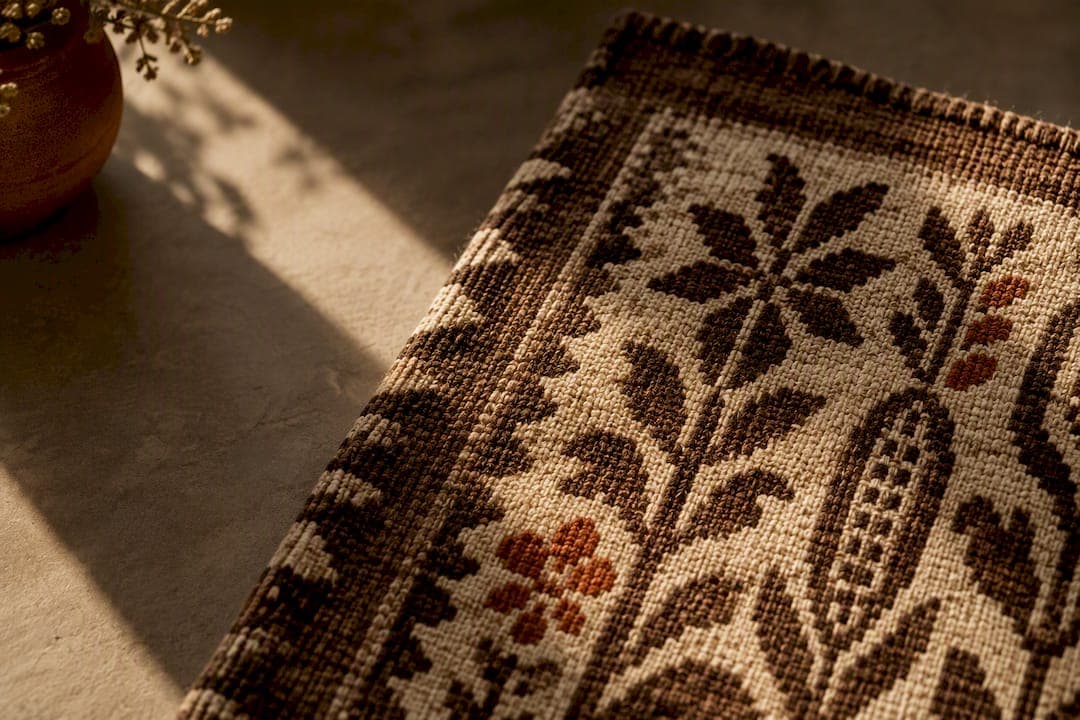
Mexican textile motifs are living documents: plants, animals and geometric signs that record a community's origin, beliefs and social roles. Each figure, whether a stitched maize plant or a woven rhomboid, carries meaning passed down through generations of weavers and embroiderers. The symbols shift by garment and region, appearing differently on a huipil from Oaxaca than on a tenango from Hidalgo, yet the underlying purpose stays constant: telling a group's story in thread.
TL;DR:
- Most traditional motifs are part of a complex visual language that combines symbols of nature, power, and cosmic relationships, often depending on technique and placement.
- Textile styles like huipils, rebozos, and tenangos encode regional identity, social status, and origin through motif arrangement and craftsmanship techniques.
- The tools, stitches, and natural dyes used in production reveal authenticity, with irregularities indicating handwork and specific dyes tied to cultural significance.
- Motifs act as a map of community history, geography, and social roles, with interpretations that evolve over time and allow multiple readings.
- Protecting indigenous motifs involves community branding and fair sourcing practices that support artisans and preserve cultural authenticity.
Table of Contents
- 1. Common motifs and their meanings
- 2. Signature textiles carry their own motif language
- 3. Looms, stitches and dyes shape what a motif can say
- 4. Motifs as maps of cosmovision and identity
- 5. Protecting motifs and the artisans who keep them alive
- 6. How Create Decorus honors motifs in handcrafted home accents
- Why these patterns deserve more than a passing glance
- Bringing these traditions into your own space
- Sources
- FAQ
1. Common motifs and their meanings
Floral and plant motifs speak to sustenance and renewal. Maize appears again and again as a symbol of life and fertility, reflecting its central place in Mesoamerican agriculture and diet, while flowers often mark seasonal cycles or ritual occasions tied to a community's calendar.
Animal figures carry their own vocabulary. Birds frequently stand in as messengers or lineage markers, connecting a wearer to ancestry or to the spiritual world, and felines such as jaguars point to power and a connection with the earth. Geometric forms round out the visual language: rhomboids, grecas and stepped frets function as maps of cosmic relationships, often marking where earth and sky are understood to meet.
According to research on pre-Hispanic dress, textile motifs act as ideographic documents, with maize, birds, trees and geometric rhomboids recurring as symbols of cosmic relationships across huipiles, fajas and quechquémitls.
- Flora: maize and flowering plants signal fertility, sustenance and seasonal ritual.
- Fauna: birds mark lineage or spiritual messengers; jaguars and other felines represent earth-bound power.
- Geometry: rhomboids and grecas trace cosmic order, often showing where sky and land intersect.
The greca and other geometric patterns appear across many world cultures, but their meaning in a Mexican textile depends on technique and placement rather than shape alone, a distinction museum curators draw when comparing global motifs. A single motif rarely stands alone. A bird paired with a flowering branch might reference a specific origin story, while the same bird set beside a rhomboid can shift toward a statement about rank or ritual role. Reading these combinations, rather than isolated symbols, is what turns a textile into a document.
2. Signature textiles carry their own motif language
Different garments organize motifs in different ways, and learning to read the placement is often more useful than memorizing individual symbols.
- Huipil: motifs cluster in identifiable zones, especially the neck and yoke bands, which often function as a readable signature of the wearer's home community.
- Rebozo: many rely on reservado jaspe, an ikat-style resist technique that produces large, blurred geometric fields rather than sharp figurative scenes.
- Tenango bordados: dense, all-over figurative scenes packed with animals and plants, associated with Tenango de Doria in Hidalgo and now carrying a collective mark tied to the region's economy.
- Quechquémitl: a shoulder garment whose motifs and construction vary sharply by region, with notable examples from Oaxaca, Yucatán and Tlaxcala.
Each of these textiles rewards close looking. A huipil's yoke band can identify a wearer's town almost like a return address, while a rebozo's jaspe pattern favors bold, repeatable geometry over fine detail. Tenangos, by contrast, pack dozens of figures into a single piece, turning the fabric into something closer to a narrative panel than a simple pattern.
3. Looms, stitches and dyes shape what a motif can say
The tool and technique behind a textile set real limits on what a motif can look like, which is part of why authenticity often shows in the details rather than the overall design.
The backstrap loom, tied to the weaver's body and waist, favors narrower cloth and motifs built from the structure of the weave itself, while the foot-pedal loom, introduced later, allows wider cloth and different patterning options. Embroidery techniques vary just as much: counted-stitch work known as xoc bi chui produces crisp, geometric figures on open-weave fabric, pepenado creates raised, sculptural surfaces, and brocading weaves supplementary threads directly into the cloth rather than adding them after the fact.
- Backstrap loom: narrower cloth, motifs built into the weave structure itself.
- Foot-pedal loom: wider cloth, introduced during the colonial period alongside wool and silk.
- Counted-stitch, pepenado, brocading: three distinct embroidery approaches that change how sharp or textured a motif appears.
Natural dyes add another layer of meaning and labor. Cochineal, harvested from insects that feed on prickly pear cactus, produces deep reds, while indigo yields the blues found across many traditions; both dyes carry cultural and economic weight tied to the communities that still process them by hand, as long-running textile traditions document.
Pro Tip: Look closely at stitch regularity and color variation. Slight irregularities and natural-dye shading are often signs of handwork, while perfectly uniform color and stitching usually point to machine production.

4. Motifs as maps of cosmovision and identity
A textile's symbols often work less like decoration and more like a resume of where someone comes from and what role they hold.
- Certain garments encode origin, rank or ritual function, letting a trained eye identify a wearer's home community or status within it.
- Geographic references appear directly in some designs, such as pleating patterns in Tlaxcala linked to the silhouette of the Matlalcueye volcano, tying cloth to a specific place on the landscape.
- Motifs are not frozen in time. Communities have long folded new imagery into traditional frameworks, keeping the practice alive rather than treating it as a museum piece.
- Interpretation is not always singular. Scholars and weavers sometimes read the same figure differently, and that plurality is part of how the tradition stays flexible across generations.
Weaving itself is often understood by artisans as more than a craft. Research on pre-Hispanic dress describes it as a cosmological act, with the loom treated as an extension of the weaver's body, which frames the finished cloth as something closer to a record of lived experience than a simple product.
5. Protecting motifs and the artisans who keep them alive
Traditional motifs face real pressure from mass production and unattributed copying, and communities have started fighting back with formal protections.
Tenango bordados offer a working example. The style has developed a collective brand and, in some cases, a registered mark meant to protect provenance and secure fairer returns for the artisans who produce it. Collective trademarking like this has proven an effective strategy for communities trying to keep both the iconography and the income tied to it.
Buying respectfully starts with a few habits any shopper can adopt.
- Ask who made the piece and where, and look for a name or a community rather than a vague "artisan-made" label.
- Expect a price that reflects hours of hand labor, not a discount that suggests mass production.
- Favor sellers who can describe the technique used, whether backstrap loom, counted-stitch embroidery or natural dye.
Pro Tip: A fair price for hand-embroidered or hand-woven work rarely competes with factory pricing. If a "traditional" piece seems unusually cheap, ask more questions before buying. For a deeper look at sourcing decisions, see this design guide on indigenous patterns.
6. How Create Decorus honors motifs in handcrafted home accents
We believe that carrying a motif into a home should never mean stripping it of context. Every piece is handcrafted using materials and traditional techniques, blending cultural heritage with quality-driven processes rather than mass replication. Our decorative pillows, rugs and wall art let these patterns live in everyday spaces, sourced with the same care described in our guide to authentically honoring artisan work. We source carefully and design around unique patterns you will not find in big box stores.

Why these patterns deserve more than a passing glance
Motifs like these survive because someone keeps choosing to stitch them, generation after generation, even when faster and cheaper options exist. That persistence says more about a community's values than any museum label could. My own reading of the record is that treating these patterns as pure decoration, detached from the hands and stories behind them, misses most of what makes them worth having. Visiting a textile museum or a local workshop, even briefly, changes how a piece looks on a shelf.
— Ernesto
Bringing these traditions into your own space
Choosing handcrafted pieces is one honest way to bring these motifs home without flattening their meaning. Our decor pillows, rugs and wall art draw on artisan patterns while keeping the materials and craftsmanship at the center of the piece, not as an afterthought.

- Browse decor pillows built around artisan-inspired textiles.
- Explore rugs that translate traditional patterns into larger formats for a room.
- Check our wholesale trade program if you design or sell for clients who value cultural authenticity.
Every piece offered reflects a partnership with artisan techniques and materials, so the pattern on your pillow carries real craftsmanship behind it. Start with our shop to find a piece that fits your space.
Sources
- Hilvanando la memoria. La indumentaria en el México prehispánico
- Textiles of Mexico — Wikipedia
- Mexican embroidery — Victoria and Albert Museum
- Tenangos como patrimonio cultural (INAH)
FAQ
¿Cuál es la historia de los textiles mexicanos?
Textile production spans over four thousand years, with pre-Hispanic weavers using backstrap looms and fibers like cotton and maguey long before the colonial period introduced wool, silk and foot-pedal looms, according to research on Mexican textile history. Oaxaca and the State of Mexico remain noted production hubs today.
¿Cuáles son algunos textiles mexicanos famosos?
The huipil, rebozo, tenango bordado and quechquémitl are among the most recognized traditional textiles, each tied to specific regions and motif styles. Tenangos from Hidalgo are especially known for their dense, all-over figurative embroidery.
¿Cuál es la producción de textiles en México?
Production ranges from backstrap-loom weaving done by individual artisans to larger foot-pedal loom operations, often centered in regions like Oaxaca. Natural dyes such as cochineal and indigo remain part of many traditional workshops, alongside techniques like ikat-style reservado jaspe.
¿Cuál es el origen del bordado mexicano?
Mexican embroidery has pre-Hispanic roots that were later transformed by Spanish needlework and Asian colonial influences arriving through trade routes. Modern safeguarding projects continue to support artisan communities who carry these techniques forward today.
How can I tell if a Mexican-inspired textile piece is handcrafted responsibly?
Look for maker or community credit, a price that reflects hand labor rather than mass production, and a seller who can name the technique used. Pieces built around traditional motifs and fair sourcing, like those found in this overview of Mexican artisan craft, tend to hold their value and story better than unattributed imports.