
You get trade pricing by applying directly to a brand's trade or wholesale program and supplying your business registration along with a resale or tax certificate. Most brands approve prepay accounts fastest, since credit terms require extra vetting. Some décor brands run trade programs for interior designers, boutiques, and retail professionals, with applications typically accessible through their wholesale program pages.
TL;DR:
- Most trade approval processes favor prepay accounts over credit terms, which require additional verification and can take longer.
- Having a ready, organized folder with tax ID, resale certificate, and sample project sheets streamlines multiple applications and reduces delays.
- Vendors scrutinize resale certificates most heavily, while social media proof often suffices for demonstrating active client work.
- A complete, well-documented application—especially with matching business and tax details—significantly speeds up approval, often within a few days.
- Post-approval, maintaining active ordering and current resale documents helps avoid account deactivation due to inactivity or expired certificates.
Table of Contents
- What Documents Do You Need for Trade Account Registration?
- How Does the Trade Application Process Actually Work?
- What Do Vendors Actually Check Before Approving You?
- What Happens After Your Trade Account Gets Approved?
- What I've Learned Approving Trade Accounts for a Mexican Artisan Brand
- Ready to Register for Createdecorus's Trade Program?
- Where to Learn More About Trade Registration and Resale Rules
- Sources
What Documents Do You Need for Trade Account Registration?
Every trade decoration registration starts with paperwork, and having it ready before you open the application form saves days of back and forth. Vendors want proof that you are a real business buying for resale or client work, not a homeowner hunting for a discount.
A typical trade account checklist includes:
- Business registration or official business name document, showing your company legally exists.
- Tax ID number, either Mexico's national taxpayer identifier or an EIN-equivalent for other jurisdictions.
- Resale or seller's permit tied to the tax exemption you are requesting.
- Professional portfolio, whether that is a website, an Instagram feed showing client projects, or a simple PDF sheet.
- Optional extras like design association memberships, accreditation proof, or banking details if you plan to request credit terms later.
Scan documents as PDFs rather than photos when possible. Vendors process clean, single-file uploads faster than a folder of blurry phone shots, and a business license split across three separate images is a common cause of application delays.
Pro Tip: Build one master folder now with your tax ID, resale certificate, and a one-page project sheet. Reuse it every time you apply to a new décor brand's trade program, since most ask for the same core documents in slightly different formats.
How Does the Trade Application Process Actually Work?
Most décor brands link their trade program from the site footer or a dedicated "Trade" or "Wholesale" tab in the main navigation. The form itself usually follows a predictable pattern, even if the exact fields shift from one vendor to the next.
Here's what to expect, step by step:
- Enter your business details. Legal business name, contact information, and business type (interior design firm, boutique, retailer).
- Add your tax and resale information. This is where your tax ID and resale certificate number get logged into the system.
- Submit your portfolio link. A website URL or Instagram handle usually satisfies this field; some vendors accept an uploaded PDF instead.
- Upload supporting documents. Expect to attach one to three files: business license, resale certificate, and occasionally an EIN letter, following document requirements similar to those major trade programs use.
- Choose your payment terms. Selecting prepay or pro forma billing tends to clear review faster than requesting net terms, which trigger additional credit checks and reference calls.
Approval windows vary by brand, ranging from same-day automated review to a week or more if a human has to verify your documents manually. If your application stalls past a week, a short follow-up email referencing your submission date usually moves things along faster than resubmitting the whole form.
Pro Tip: Apply for prepay terms on your first order, even if you eventually want net terms. Once you have purchase history with a vendor, upgrading to credit terms is far easier than requesting them cold.
What Do Vendors Actually Check Before Approving You?
Resale certificates get the most scrutiny of anything in your application. Vendors need that document to justify not charging you sales tax, and design-industry guidance is clear that trade accounts differ from general wholesale accounts precisely because they demand proof you're a working design professional, not just a bulk buyer chasing minimum order quantities.
Your portfolio matters more than most applicants assume. A generic "coming soon" website does less for you than a working Instagram account showing three or four finished client spaces. Many programs treat social media proof as fully sufficient for trade activity verification, so there's no need to build an elaborate site before you apply.
A few practical notes for common edge cases:
- New freelancers with no formal LLC yet: many brands still accept a sole proprietor tax registration.
- Designers without a physical showroom: a portfolio link substitutes for a storefront in almost every trade program.
- Students or recent graduates: proof of an active client project, even one, often satisfies the activity requirement.
Vendors also watch for inactivity after approval. It's common practice across the industry to deactivate trade accounts that sit dormant too long, which is why placing a small order right after approval matters more than most applicants realize.
What Happens After Your Trade Account Gets Approved?
Once approved, trade pricing typically appears automatically inside your account dashboard, since most vendors hide wholesale pricing entirely from unregistered visitors until your login unlocks it. Log in, browse the catalog, and confirm your resale settings are active before placing your first order.
A few habits keep the account healthy long after approval:
- Place a modest first order rather than waiting for a big client project to justify buying.
- Request a pro forma invoice if you need to secure client budget approval before paying.
- Keep your resale documentation current, since expired certificates can quietly disable your tax-exempt status.
- Reference your trade pricing directly in client proposals, showing the retail comparison to justify your markup.
Setting a calendar reminder to log in or order every couple of months is a small habit that prevents the single most common account problem: quiet deactivation from inactivity.
What I've Learned Approving Trade Accounts for a Mexican Artisan Brand
Running a trade program taught us that most rejected applications aren't rejected for bad reasons. They're incomplete. An applicant submits a business name with no tax ID, or a portfolio link that goes to a personal blog instead of client work.
The fix is almost always the same: slow down on the document stage. A resale certificate that matches your business name exactly, a portfolio with two or three real projects, and a clear tax ID clear more review queues than any amount of polish on your outreach email.
Timelines worry people more than they should. Complete applications move fast. Fees rarely factor in at all. Most trade programs care about verification, not gatekeeping revenue from designers who buy in good faith.
— Ernesto
Ready to Register for Createdecorus's Trade Program?
If you've been sourcing decorative pillows and accents piece by piece at retail prices, a trade account changes that math immediately. Createdecorus's trade program is built for designers and boutique owners who want direct access to handcrafted Mexican textiles at trade pricing, without the multi-week approval grind some larger furniture brands put you through.
Applications for trade programs typically ask for business registration, tax ID, resale certificate, and a portfolio link. Uploading clean PDF scans is recommended. Many complete applications clear review within a few business days. Once approved, placing a small first order right away helps activate the account and assess product quality before larger purchases. You can preview the full collection anytime on our shop page while your application is under review.
Where to Learn More About Trade Registration and Resale Rules
A few resources are worth bookmarking alongside this guide. Mexico's tax authority publishes the governing rules on IVA and resale documentation, which is the primary reference if you need to confirm exactly what your resale certificate must show.
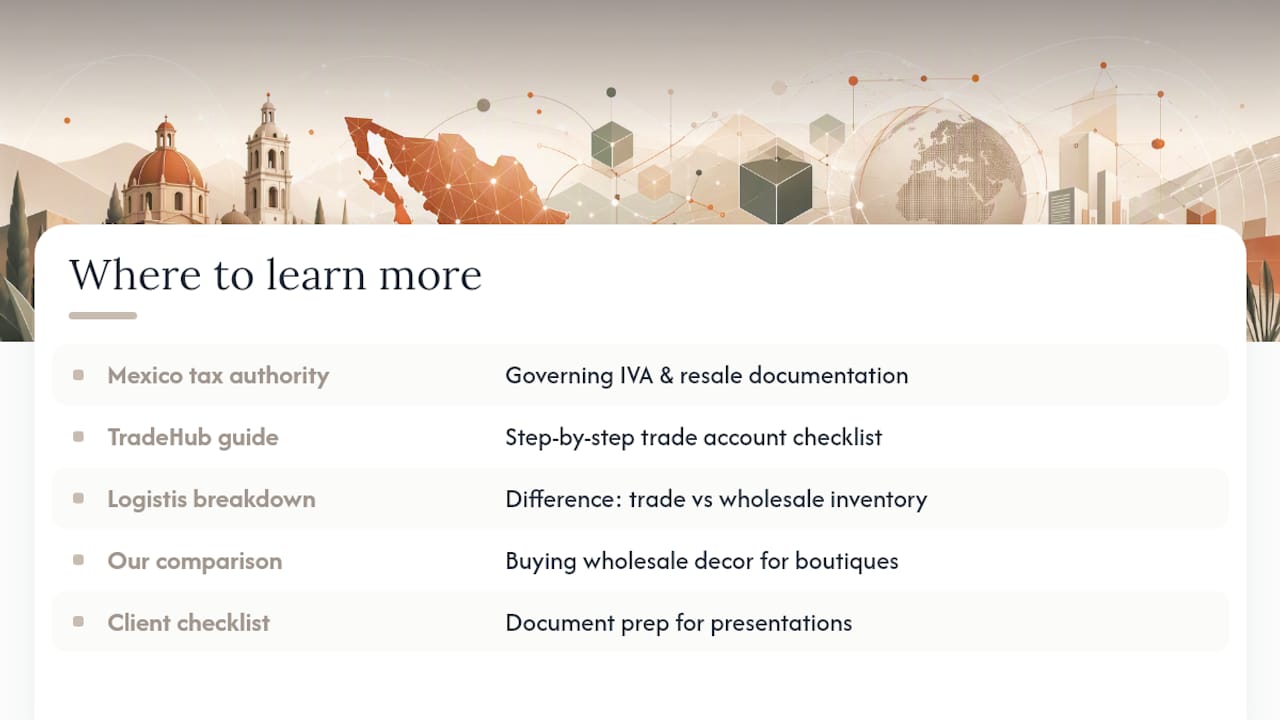
For a broader look at document checklists across the industry, the step-by-step trade account guide from TradeHub covers requirements that overlap closely with what Createdecorus and most décor brands ask for. If you're still unsure whether you need a trade account or a wholesale inventory account, Logistis's breakdown of the two models clears up the distinction well, and our own comparison of buying wholesale decor for a boutique applies that same logic to smaller retail buyers. For document prep specifically, our client presentation checklist is a useful companion while you assemble your portfolio materials.
Sources
- Servicio de Administración Tributaria (SAT) — Ley del IVA
- How to Apply for Trade Accounts: A Step-by-Step Guide for Interior Designers | TradeHub Blog
- Wholesale Accounts Explained: Trade vs Wholesale for Designers (Logistis)
- Interior Define trade application — required documents and tax exemption notes