Maximalismo mexicano, often called meximalismo, is an identity-rooted aesthetic that uses saturated color, layered craft objects, and symbolic ornamentation to resist homogenizing minimalist norms. The term crystallized publicly around 2022 and 2023, moving from social media commentary into design and fashion criticism within a few seasons. We see it, at Createdecorus, as something closer to a worldview than a decorating trend.
TL;DR:
- Meximalismo emphasizes regional craft traditions like Talavera, Zapotec textiles, and barro negro pottery, prioritizing authenticity over superficiality.
- The movement draws on Latin American layering techniques from Baroque architecture, Tequitqui art, and everyday market displays, reflecting a cultural ethos.
- Key colors include rosa Mexicano, turquoise, and magenta, and surfaces are densely layered with mixed materials to create depth and narrative complexity.
- Sourcing from named artisans and focusing on provenance ensures ethical support for traditional craft practices amid growing demand.
- Meximalismo encourages accumulation with purpose, advocating for meaningful objects over mere decoration to honor regional history.
Table of Contents
- What Is Maximalismo Mexicano?
- The Cultural Roots Behind the Color
- Signature Colors, Materials, and Textures
- How to Bring Meximalismo Into Your Space or Wardrobe
- Cultural Significance and How to Support It Ethically
- How Createdecorus Interprets Meximalismo
- Historical Evolution and the Figures Behind the Look
- How Mexican Maximalism Differs From Global Maximalist Styles
- The Movement's Impact on Contemporary Mexican Art and Design
- Sustainability and Ethics Inside the Movement
- Why Meximalismo Deserves More Than a Trend Cycle
- Bring Meximalismo Home the Right Way
- Sources
What Is Maximalismo Mexicano?
Meximalismo (sometimes spelled meximalism in English coverage) translates loosely to "too much, on purpose." It describes rooms, wardrobes, and artworks that reject the pared-down, beige-on-white template that dominated global interiors through the 2010s. According to Wikipedia's entry on the movement, the term gained recognition as a distinct cultural category around 2023, though its visual roots reach back decades into markets, churches, and family homes across the country.
What separates it from generic international maximalism is intent. A Memphis-style maximalist room might layer pattern for visual play alone. Meximalismo layers pattern, texture, and object to tell a story of mestizaje, regional pride, and inherited skill.
- The phrase surfaced widely on social platforms around 2022, often paired with the line "too Latina to be minimalist," before editorial coverage picked it up.
- It differs from Western maximalism through its narrative core, drawing on craft traditions from Oaxaca, Puebla, and Jalisco rather than abstract pattern-mixing.
- Fashion and hospitality writers now apply the label to boutique hotels, runway collections, and interiors alike.
The Cultural Roots Behind the Color
Meximalismo did not appear from nowhere. It draws directly on the "Ethos Barroco," a concept the philosopher Bolívar Echeverría used to describe a distinctly Latin American way of absorbing, layering, and reinterpreting imposed culture rather than discarding it. That framework connects to Baroque Novohispano architecture and altarpieces, where colonial-era churches were covered floor to ceiling in gilded ornament, and to Tequitqui art, the visual language that emerged when Indigenous artisans carved European religious motifs using pre-Hispanic techniques and symbolism.
You can see the same instinct alive today in places nobody labels "design."
- Mercados and public markets stack goods, colors, and signage with no negative space, and nobody experiences that as clutter.
- Home altars and ofrendas layer photographs, marigolds, candles, and food in dense, deliberate compositions.
- Lucha libre posters and street murals use flat, saturated color blocks the same way Talavera tile does.
- Contemporary designers still cite Tequitqui directly as a reference point, mixing Indigenous carving techniques with European-derived motifs in new collections.
This lineage matters because it reframes "more is more" as inherited language, not decorating excess.
Signature Colors, Materials, and Textures
The palette starts with Rosa Mexicano, a hot pink made internationally famous by architect Luis Barragán, alongside turquoise, magenta, and chromatic yellows pulled straight from marigolds and papel picado. These colors rarely sit alone. Meximalismo embraces horror vacui, the fear of empty space, which means surfaces get filled rather than edited down.
The material list reads like a map of regional craft traditions:
- Talavera ceramic tile and pottery from Puebla, hand painted in cobalt, yellow, and green.
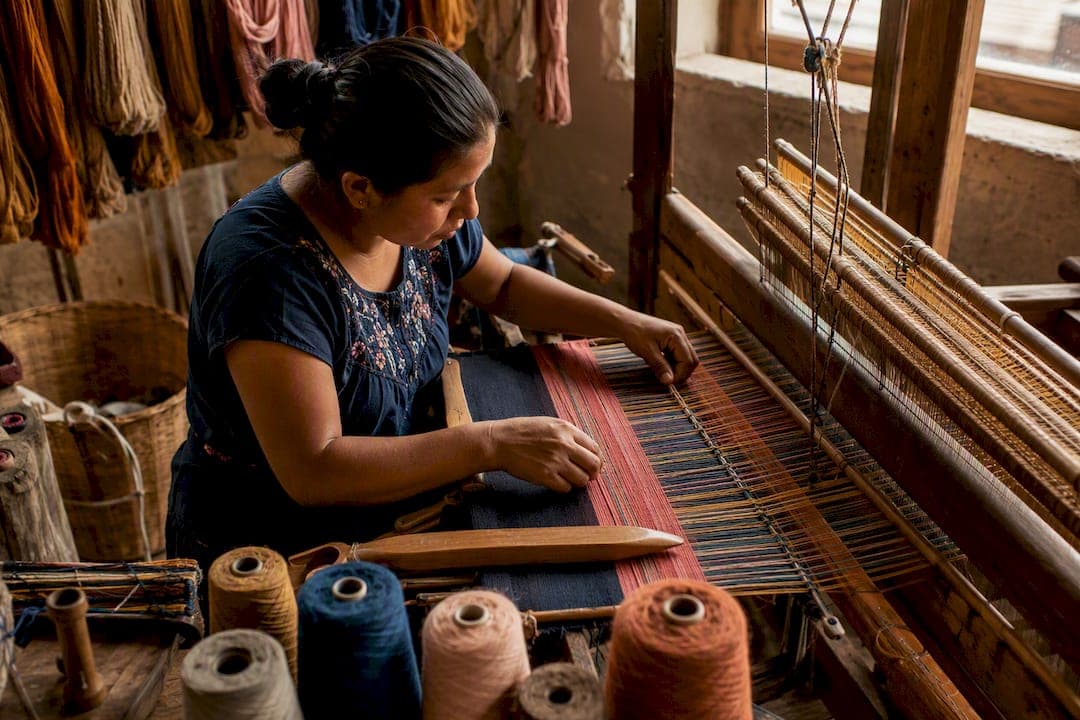
- Zapotec textiles from Oaxaca, woven on traditional looms with geometric motifs passed through generations.
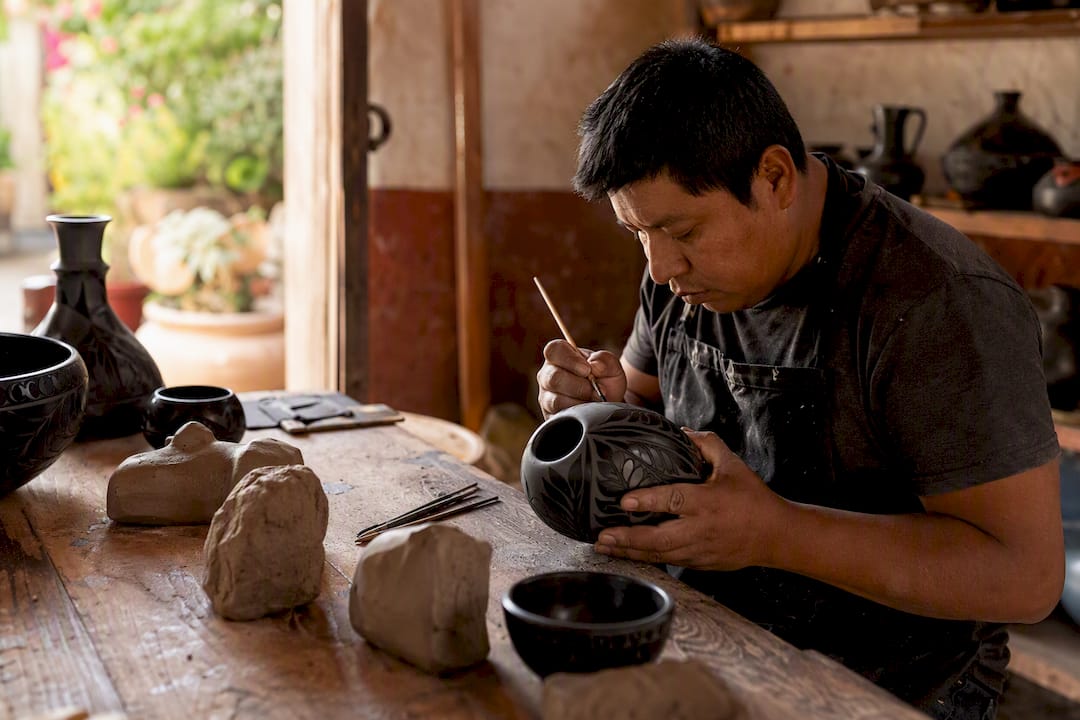
- Barro negro, the matte black pottery unique to San Bartolo Coyotepec.
- Equipale furniture, leather-and-wood seating built from a pre-Hispanic construction method.
- Chaquira beadwork, used in Huichol art and increasingly in home objects and jewelry.
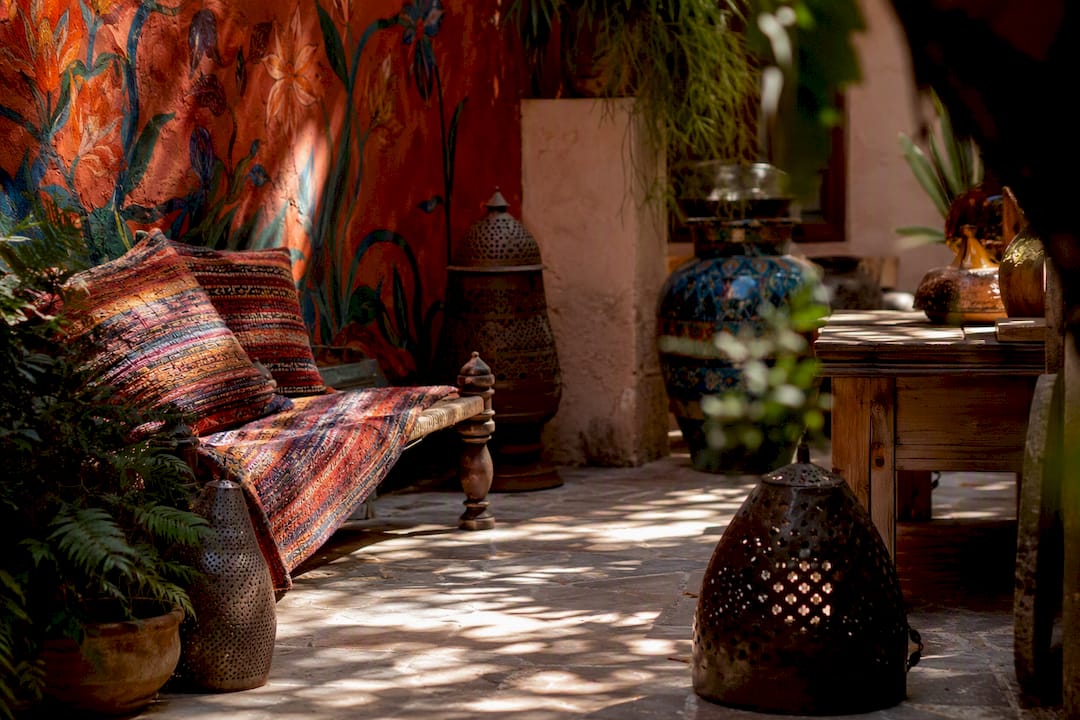
- Punched tin (hojalata) lighting fixtures that throw patterned shadow across a room.
The trick is layering, not stacking. A Talavera-inspired textile thrown over a plain sofa reads differently than the same pattern painted directly on a wall behind it. Mixed materials, tile against woven rug against carved wood, create depth that a single dominant pattern cannot.
How to Bring Meximalismo Into Your Space or Wardrobe
Adopting this look well takes more intention than buying a handful of colorful objects and calling it done. Here's a starting sequence that respects the style's internal logic.
- Choose one anchor material first. A Saltillo tile floor or a certified Talavera backsplash sets the visual grammar for everything else in the room, so pick it before anything else.
- Build a focal point. A gallery wall of folk art, a single carved equipale chair, or a hand-loomed rug gives the eye somewhere to land before it wanders into the rest of the layering.
- Layer textiles over structure. Add woven throws, embroidered pillows, and patterned upholstery on top of the anchor material, not instead of it.
- Control light and greenery deliberately, and consider installing interior doors as design focal points to enhance your space's texture and lighting. Punched tin fixtures throw pattern onto walls at night; plants soften hard tile edges during the day.
- For fashion, start with one statement accessory. A beaded belt, a hand-embroidered huipil-inspired blouse, or a woven bag paired against a neutral base outfit lets the craft object carry the visual weight.
- Source from named artisans wherever possible, and ask directly about provenance before buying anything marketed simply as "Mexican style."
Pro Tip: Accumulate with intention. Add one object at a time and ask what story it tells before buying the next one. A room full of meaning reads completely differently than a room full of stuff.
Cultural Significance and How to Support It Ethically
Proponents frame meximalismo as a direct answer to gentrification and what critics call the "clean look," the beige, minimalist aesthetic exported globally through platforms that reward visual restraint. Cultural commentators argue that neutral, pared-down design is not a neutral default at all. It is a Eurocentric choice, and meximalismo pushes back by treating color and density as valid, even necessary.
That said, the movement faces real critique. Once a cultural aesthetic gets a catchy name, commercial brands often flatten it into a print pattern stripped of its origin story, and critics rightly call that exoticization.
You can support the practice honestly by a few concrete habits: credit the maker by name whenever you can find it, pay prices that reflect skilled labor rather than souvenir markups, and avoid reducing an entire craft tradition to one recognizable motif slapped on unrelated products.
How Createdecorus Interprets Meximalismo
We build every piece around the same principle running through this whole tradition: objects should carry a maker's hand and a region's history, not just a color scheme. Our collection works from that Ethos Barroco logic directly.
- A hand-embroidered pillow layered over a plain linen sofa functions the same way a Zapotec rug functions on a tile floor: as an anchor of pattern against a calmer base.
- An artisan-made ottoman becomes the room's focal object, the equivalent of a carved equipale chair, built to be handled and lived with rather than displayed at a distance.
| What we prioritize | Why it matters |
|---|---|
| Named artisan collaborations | Keeps provenance and craft lineage visible, not erased |
| Sustainable, vacuum-compressed shipping | Reduces waste without compromising the handmade textile inside |
| Premium filling with memory foam and polyester | Comfort matches the visual weight of the design |
| Trade pricing for designers and boutiques | Supports professionals building meximalista interiors at scale |
Historical Evolution and the Figures Behind the Look
The visual instincts behind meximalismo predate the term by generations, but a handful of figures gave the aesthetic its modern shape. Architect Luis Barragán popularized the saturated pink, ochre, and cobalt walls that now read as shorthand for Mexican design internationally, even though his own work leaned more minimal in form than the maximalist interiors built around his color language today. Frida Kahlo's home and wardrobe, layered with folk textiles, religious iconography, and personal artifacts, remains one of the most cited visual references for the "ordered chaos" aesthetic critics now describe.
The colonial-era artisans who built Baroque Novohispano churches and practiced Tequitqui carving never used the word "maximalism," but their instinct to layer imported religious forms over Indigenous technique created the template later designers would formalize. Twentieth-century folk art collectors and muralists, including figures around the broader Mexican muralism movement, kept that dense, narrative visual language alive in public art long before design media caught up.
The actual naming moment came recently and quickly. Social media users began describing their own rejection of minimalism around 2022, and by 2023 the term had enough critical mass to appear in design journalism and reference entries. That compressed timeline, decades of visual tradition followed by a two-year naming sprint, is part of why the movement feels both ancient and startlingly current.
How Mexican Maximalism Differs From Global Maximalist Styles
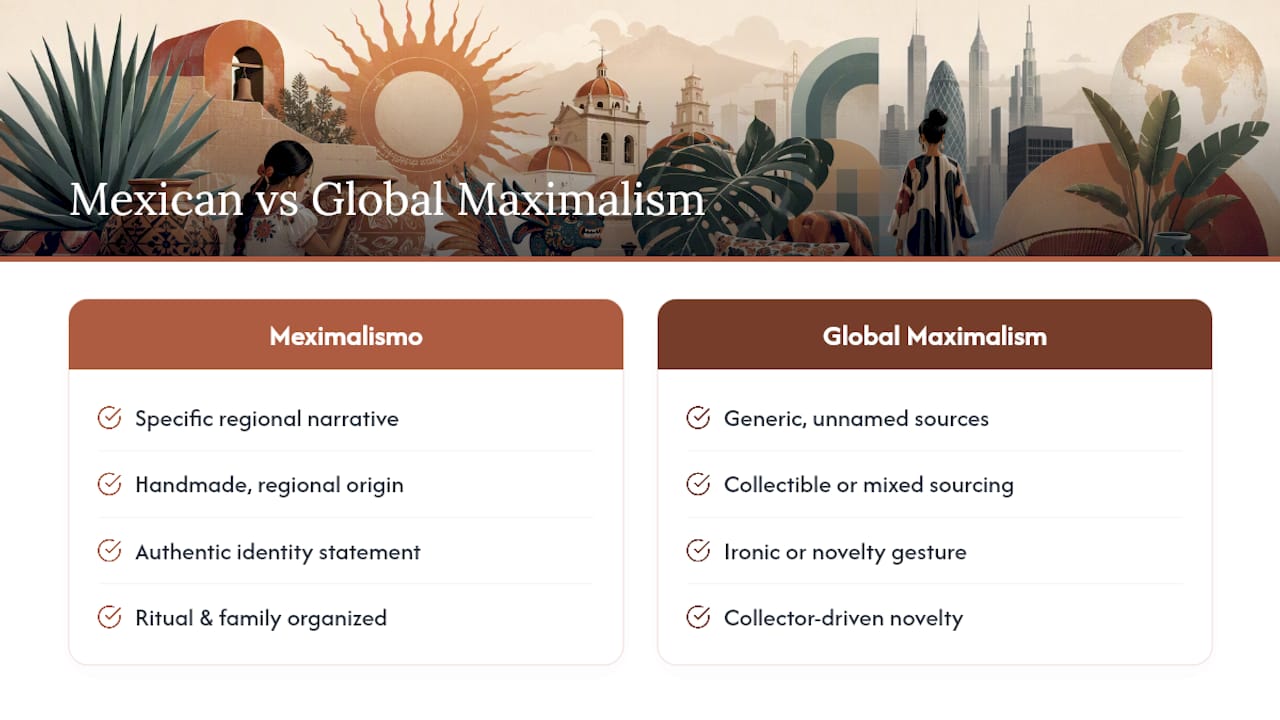
Maximalism as a broader design category is not unique to Mexico. British eclectic interiors lean on antique collecting and pattern clash for its own sake. Indian maximalist textiles favor dense embroidery and mirror work tied to specific regional weaving traditions. Memphis-style postmodern maximalism, born in 1980s Italy, prized bold geometric shapes and synthetic color almost as a joke aimed at modernist seriousness.
Meximalismo shares the visual density of all three but diverges on intent and material sourcing. Where Memphis design mocked modernism from the inside, meximalismo positions itself as a genuine identity statement rather than an ironic gesture. Where British eclecticism often prizes rarity and collector value, Mexican maximalism prizes handmade authenticity and regional origin over price or exclusivity. A reported "ordered chaos" runs through it: dense, yes, but organized around ritual, family, and community rather than novelty for its own sake.
The clearest distinguishing trait is narrative specificity. A room full of Zapotec weaving, Talavera tile, and barro negro pottery tells you exactly which regions and traditions it draws from. Generic global maximalism, by contrast, often borrows pattern without naming its source, which is precisely the flattening meximalismo's proponents object to.
The Movement's Impact on Contemporary Mexican Art and Design
Meximalismo has shifted how contemporary Mexican designers and artists talk about their own work. Instead of apologizing for color or scaling it back for international markets, a growing number of studios now lead with it. Boutique hotels, restaurant interiors, and fashion collections built since roughly 2023 openly market saturated, craft-forward interiors as a selling point rather than a regional limitation.
The ripple effect reaches artisans directly. Demand for Talavera, hand-loomed textiles, and punched tin lighting has grown alongside the movement's visibility, giving regional craft producers a larger audience than local markets alone could offer. That visibility cuts both ways. It creates real economic opportunity for makers whose techniques get passed through families, and it also invites the mass-market knockoffs that critics warn dilute the tradition's meaning.
Design education is catching up too. Younger designers increasingly cite Ethos Barroco and Tequitqui explicitly in their portfolios rather than describing their work with vague terms like "colorful" or "folk inspired." That shift toward naming sources, rather than borrowing them silently, may end up being the movement's most lasting contribution to Mexican design discourse, regardless of how long the specific word "meximalismo" stays fashionable.
Sustainability and Ethics Inside the Movement
A craft-first aesthetic carries real sustainability advantages the mass furniture industry cannot match. Handmade textiles, ceramics, and woodwork typically involve far less synthetic material and far shorter supply chains than factory-produced décor shipped from overseas. Barro negro pottery, punched tin fixtures, and hand-loomed rugs are also built to last generations rather than a single trend cycle, which cuts against the disposability that defines fast furniture.
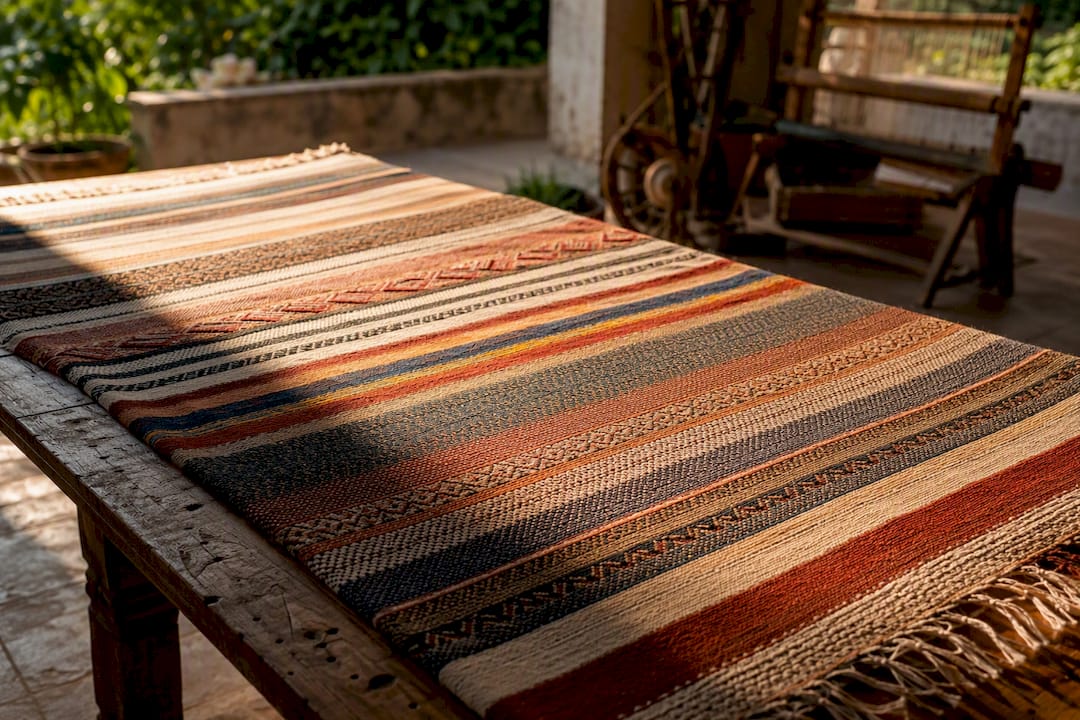
The ethical questions sit mostly around fair compensation and credit. Buying a piece labeled generically as "Mexican folk art" without any maker's name attached usually means the artisan who made it saw a fraction of the retail price. Practitioners increasingly recommend sourcing directly from named artisans or verified cooperatives and asking retailers directly where and by whom a piece was made.
Two habits protect the tradition as demand grows. First, treat provenance as a real question, not a marketing detail, before buying anything described only by aesthetic rather than origin. Second, favor pieces built to be used and kept rather than souvenir-grade items designed for a single season. A hand-embroidered pillow or a genuinely hand-painted tile costs more upfront than a printed imitation, but it also does not need replacing in a year, which is its own quiet form of sustainability.
Why Meximalismo Deserves More Than a Trend Cycle
Most coverage of this aesthetic treats it as a color palette you can copy. That misses the point entirely. The judgment this research actually supports is that meximalismo functions as a philosophy of accumulation, not a shopping list, and treating it as the latter is exactly the flattening its own proponents warn against.
Conventional design advice tends to say "add a few Mexican accents for warmth," which reduces an entire craft lineage to a garnish. The more honest approach asks what a Talavera tile or a hand-loomed rug actually cost the person who made it, and whether the buyer knows their name. That question rarely gets asked in mainstream design coverage, and it should come before any conversation about color theory or room layout.
If you take one thing from this explainer, prioritize the maker before the palette. Learn who wove the textile or fired the tile before deciding whether it fits your gallery wall. The color will always be the easy part. The provenance is where most people, and most articles, stop looking.
— Ernesto
Bring Meximalismo Home the Right Way
Createdecorus exists for exactly the reader who finished this article wanting the aesthetic without the guesswork of sourcing it responsibly. Every pillow, ottoman, and accent piece we sell comes from artisan collaborations built on the same provenance-first approach outlined above, rather than mass-produced prints that borrow the look without the labor behind it.
Our pieces work as the anchor objects this style depends on: a hand-embroidered pillow to layer over a neutral sofa, or a handcrafted ottoman to serve as your room's focal point. Sustainable, vacuum-compressed shipping keeps the footprint reasonable without touching the craftsmanship inside, and our trade pricing program gives designers and boutiques a straightforward way to source at scale. If a focal wall or a fashion accessory sourced with real provenance sounds like your next step, browse the current collection and start with one piece that tells an actual story.
Sources
- Meximalismo — Wikipedia
- White Isn’t Neutral. It’s a Choice. Meximalismo Claps Back — Majo Villa
- Maximalism: the most rooted concept in Mexican culture – The Volante
- Warm and Vibrant Traditional Mexican Interior Design — AWEDECO