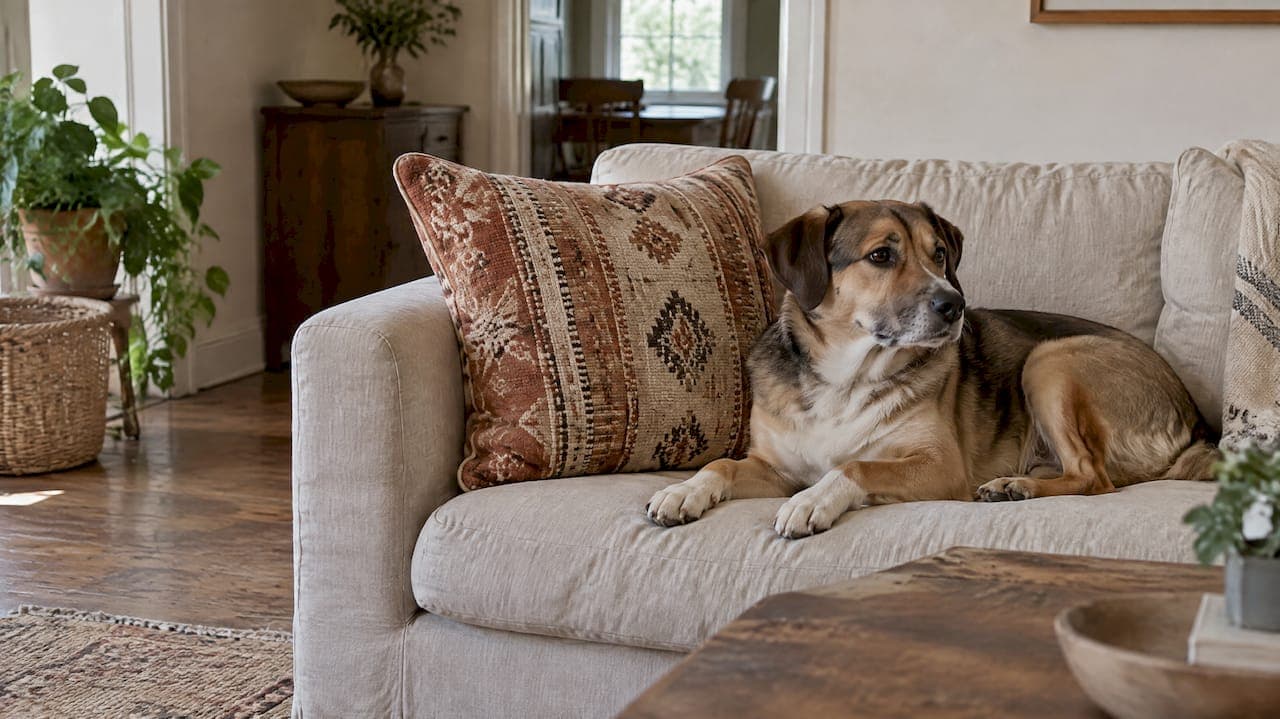
Yes, pet-friendly pillows exist, and the winning formula is simple: removable, machine-washable covers paired with tightly woven, durable fabric and reinforced seams. We handcraft our pillows with exactly this kind of resilience in mind, so a home full of paws and whiskers never has to mean a home without style. Read on for the checklist and cleaning routine that will help you choose with confidence.
TL;DR:
- Reinforced seams and concealed zippers are essential for preventing pets from pulling out stuffing or damaging the pillow.
- Durable, tightly woven fabrics like canvas or polyester microfiber resist scratching, shedding, and snagging, making them suitable for heavy-shedding pets.
- Machine-washable covers should be cleaned every two weeks and vacuumed weekly to control hair, dander, and odors effectively.
- Avoid fabrics with chemical finishes, scented sprays, or loose trims that could harm or irritate pets, especially in high-traffic or chew-prone areas.
- Select pillows with replaceable or removable covers and ensure seam quality and fill containment to extend longevity and safety.
Table of Contents
- What Makes a Pillow Genuinely Pet-Friendly
- Materials Explained: Fabrics and Fills for Comfort and Durability
- Cleaning and Maintenance: Wash Schedules and Safe Products
- Durability: Construction Details Worth Insisting On
- A Short Buyer's Checklist for Quick Shopping Decisions
- DIY Covers, Small Repairs, and Pet-Proofing Hacks
- Our Approach to Craftsmanship, Materials, and Care
- Balancing Style and Pet Safety: An Editorial Take
- Where to Shop for Pet-Conscious Pillows
- FAQ
- Sources
What Makes a Pillow Genuinely Pet-Friendly
A pillow earns the "pet-friendly" label through specific construction choices, not marketing language. The details that matter most live in the seams, the closures, and the finish of the fabric itself, long before you ever consider color or pattern.
Reinforced seams are the first line of defense. Double-stitched or French seams resist the pulling and kneading that happens when a cat settles in or a dog leans against a cushion for an afternoon nap. A single row of stitching gives way faster under repeated stress, and once a seam opens even slightly, curious pets tend to investigate further.
Concealed zippers matter just as much. An exposed zipper pull becomes a toy in a dog's mouth within minutes, and a damaged zipper can expose the filling inside. Covers with a hidden zipper placement, tucked along a back seam or secured with a fabric flap, keep that risk out of reach. Fill containment follows the same logic: a well-constructed pillow keeps its stuffing locked behind sturdy inner lining, so a small puncture does not immediately spill foam or fiber across your floor. This is not a cosmetic concern. The VCA Hospitals guidance on ingestion of foreign bodies warns that swallowed stuffing or fabric pieces can cause serious gastrointestinal obstruction in dogs, often requiring veterinary intervention. Keeping zippers concealed and filling contained is a safety decision as much as a design one.
Non-toxic treatments deserve equal attention. Some decorative fabrics are finished with stain-repellent chemicals or scented sprays that were never meant for a pet's sensitive nose or skin. Look for pillows free of heavy chemical finishes, and skip anything marketed with essential-oil infusions, since many common oils are unsafe for pets in close, repeated contact.
Finally, match your choice to the animal you actually live with:
- A heavy chewer or a young, teething puppy needs thicker, tightly woven fabric and minimal trim detail.
- A light snuggler, like most adult cats or small senior dogs, can wear a wider range of fabrics, including looser weaves.
- Larger dogs put more sustained weight and pressure on seams, so prioritize reinforced construction over delicate accents.
- Multi-pet households benefit from washable covers above almost every other feature, since cleaning frequency rises with every additional animal.
Pro Tip: Run your hand firmly across a seam before buying. If you can feel the stitching give or separate even slightly, a determined paw will find that weakness fast.
Materials Explained: Fabrics and Fills for Comfort and Durability
The fabric you choose determines how much hair it collects, how it holds up to claws, and how easily it comes clean. Each option carries real trade-offs worth weighing against your household.
Polyester microfiber resists staining and sheds pet hair with a quick shake or a lint roller, making it one of the easiest fabrics to keep looking fresh between washes. It also dries quickly after washing, which matters for households that wash covers often.
Canvas brings serious durability. Its tight, heavy weave shrugs off light scratching and holds its shape through years of use, though it can feel stiffer and less plush than softer options.
Tightly woven cotton offers a comfortable middle ground: breathable, soft to the touch, and reasonably resistant to pilling when the weave is dense. Loosely woven cotton, by contrast, snags easily on claws and should be avoided in pet-heavy rooms.
Linen blends bring texture and a relaxed, elegant look, but pure linen wrinkles and can loosen at the weave under repeated clawing. A linen-cotton blend tends to hold up far better than linen alone.
Outdoor acrylics, originally designed for patio furniture, resist moisture, fading, and stains better than almost any indoor fabric, which makes them a smart pick for pet beds or sofas near doors and high-traffic zones.
Fill matters as much as fabric. Polyester fiberfill is lightweight, machine-washable in most cases, and recovers its shape well after a pet jumps off. Shredded memory foam offers more support and contours to a pet's weight, though it is heavier and typically needs a removable cover since the fill itself is harder to wash. Down alternatives feel luxurious and plush, but real down or loose feather fill poses a higher ingestion risk if a seam fails, since feather quills can puncture soft tissue if swallowed. We detail these trade-offs further in our guide to cushion filling types, which is worth a look if plushness matters as much as durability to you.
Weave tightness directly affects two things: how much pet hair clings to the surface, and how well the fabric resists abrasion from daily paw traffic. A dense, tight weave releases hair more easily with a vacuum attachment or lint roller, while a looser, textured weave traps hair deep in its fibers. Fabric finish plays a role too: a smooth, flat finish sheds hair faster than a napped or brushed texture, which tends to grab and hold onto loose fur.
- Choose tight weaves (canvas, dense cotton, outdoor acrylic) for homes with heavy shedders.
- Choose polyester fiberfill or a washable cover over loose down for any pillow a pet sleeps against directly.
- Avoid delicate linen or open-weave fabrics in rooms where pets jump, scratch, or knead regularly.
Cleaning and Maintenance: Wash Schedules and Safe Products
A consistent cleaning routine keeps pillows hygienic and prevents the slow buildup of dander, oils, and odor that pet-adjacent textiles accumulate faster than any other soft furnishing.
Better Homes & Gardens recommends washing pet bedding and pillow covers used by pets about every two weeks, with vacuuming in between to control hair, dander, and odor buildup. That two-week rhythm applies well to any decorative pillow your pet regularly lounges against, even if it was not designed as a dedicated pet bed.
Here is a simple routine that works for most removable covers:
- Vacuum the cover's surface first with an upholstery attachment to lift loose hair before washing, since hair left in place can clog your machine's drain filter.
- Check the care tag for the maximum safe water temperature. Most cotton and polyester blends tolerate hot water, which helps break down oils and dander more effectively than a cold cycle.
- Wash with an unscented, pet-safe detergent. Scented formulas and essential-oil additives can irritate a pet's skin or nose, and Better Homes & Gardens specifically warns against essential oils like eucalyptus and tea tree, which are toxic to many pets even in small residual amounts on fabric.
- Add an extra rinse cycle if your machine allows it, to clear any lingering detergent residue that could bother sensitive skin.
- Air dry delicate blends, including wool or linen, rather than machine drying, to prevent shrinkage or fiber damage. Our guide on air drying handcrafted wool cushions walks through the full process if your cover includes natural fibers.
Between full washes, vacuuming once or twice a week keeps hair and dander from settling deep into the fabric, which also cuts down on allergens circulating through the room.
The two-week wash cycle recommended for pet-used bedding and pillow covers keeps dander and odor from building up to noticeable levels, a habit worth adopting even for decorative pillows your pet merely leans against.
For stains, blot first rather than rub, then spot-treat with a pet-safe stain remover before a full wash. If odor persists after washing and air drying, the insert itself may need replacing rather than the cover. Inserts absorb oils and moisture over time in ways covers do not, and a tired insert inside a freshly washed cover will still smell faintly of pet. On the safety side, the VCA Hospitals resource on ingestion risks is a useful reminder that any pillow with an exposed seam, a loose zipper pull, or visible filling should be set aside and repaired or replaced immediately, since pets rarely resist the temptation to pull at a loose thread.
Durability: Construction Details Worth Insisting On
The difference between a pillow that lasts three years and one that lasts ten usually comes down to construction details most shoppers never think to check.
Double-stitching along every seam is the baseline. A single pass of stitching can unravel from one determined tug, while a double row distributes stress across more thread and holds far longer under repeated pressure. Reinforced piping, the trim that runs along the seam edge, adds another layer of structural support and also hides the stitching itself, which reduces the temptation for a cat to pick at a visible thread. Our guide to reinforced seams breaks down exactly how this construction extends a cushion's usable life.
Concealed zippers, as covered earlier, protect both your pet's curiosity and the pillow's structural integrity. Replaceable inserts deserve special mention here too: a cover that zips or unzips easily from its insert lets you wash the fabric as often as needed without wearing down the fill inside, which extends the life of the whole pillow by years rather than months.
When you are reading a product description or a fabric spec sheet, a Martindale rub count tells you how many cycles of abrasion a fabric withstood in testing before showing wear. Fabrics in the 20,000 to 30,000 range hold up well to regular household use, including pets, while anything lower suggests a fabric meant for light, occasional use only. Our fabric durability guide matches ten common cushion fabrics to their appropriate use cases, which is a helpful reference if a product page lists a Martindale number you are unsure how to interpret.
A few red flags are worth avoiding outright:
- Delicate trims like loose fringe, beading, or sequins that a pet can pull loose and potentially swallow.
- Unguarded zipper pulls with no fabric tab or concealment, which invite chewing.
- Any pillow description that omits seam type or fill containment entirely, since that omission often means neither was a design priority.
- Fabric described only as "decorative" with no mention of washability or durability testing.
A Short Buyer's Checklist for Quick Shopping Decisions
When you are standing in front of a product page or a store display, six checks will tell you almost everything you need to know in under a minute.
- Does the cover remove completely from the insert, or is the pillow sewn shut?
- What do the washing instructions say: machine wash, hand wash only, or dry-clean?
- What fabric is listed, and does it match the durability your pet's behavior demands?
- Is the seam type described, such as double-stitched or reinforced piping?
- Is the zipper concealed, and does the listing mention it at all?
- What is the return policy or warranty if the pillow does not hold up as described?
Prioritize this list differently depending on where the pillow will live. A sofa pillow that a cat merely brushes past needs less reinforcement than a cushion placed directly in a dog's favorite resting spot, where weight, drool, and daily wear accumulate fast. For pet beds or floor cushions used nightly, move the removable-cover and seam questions to the very top of your list.
Pro Tip: Before ordering, measure the space where your pillow will sit and compare it against the insert dimensions listed on the product page. Our guide to cushion sizing and our checklist for choosing artisan cushions, which recommends keeping roughly one to three inches between insert and cover for a full, supportive look, can help you avoid a pillow that looks flat or overstuffed once it arrives.
DIY Covers, Small Repairs, and Pet-Proofing Hacks
A few simple habits extend a pillow's life well beyond what the fabric alone can promise, and none of them require sacrificing style.
If your favorite pillow lacks a removable cover, a simple slipcover sewn from a durable, washable fabric like canvas or cotton duck can protect the original without hiding its design entirely. Layering works just as well: placing a washable throw or blanket over a high-use pillow, particularly in a dog's favorite spot on the sofa, gives you one more washable barrier between pet and pillow, and it is far easier to toss a blanket in the wash than an entire cushion.

Small repairs go a long way, too. A seam that has started to separate can often be reinforced at home with a needle and heavy-duty thread before it becomes a full tear. A zipper pull that has broken off can be replaced with a small fabric loop, which also doubles as a way to conceal the zipper further. A snagged thread from a claw pull should be trimmed, never yanked, since pulling can unravel an entire row of stitching.
A handful of behavior adjustments help prevent damage before it starts:
- Rotate chew toys regularly so a bored dog has an appealing alternative to the nearest pillow.
- Supervise young puppies and kittens around new pillows until you know their habits.
- Use pet-safe deterrent sprays, available at most pet stores, on corners or trim a pet has shown interest in chewing.
- Keep a dedicated, durable pillow or bed in a pet's favorite spot so the more delicate pieces in the room stay protected.
None of these steps demand compromise on design. A well-chosen fabric, a smart layering trick, and a little consistency go a long way toward keeping a styled room looking the way you intended, pets included.
Our Approach to Craftsmanship, Materials, and Care
We build every pillow by hand, using traditional techniques passed down through generations of artisans alongside premium materials chosen for both beauty and daily wear. That combination matters for pet owners specifically: a handcrafted pillow built with intention tends to carry sturdier construction than mass-produced alternatives, since every seam and closure reflects deliberate craftsmanship rather than an assembly line shortcut.
Our collection includes options with removable covers, which we recommend whenever a pillow will live in a pet-active room. We also welcome custom requests for shoppers who want a specific fabric, size, or fill combination suited to their household, and we offer trade pricing for designers and boutiques sourcing pieces for clients with pets in the home.
Before you buy, a few questions are worth asking directly:
- Does this specific piece include a removable, washable cover, or is it decorative-only?
- What fabric and fill combination suits the room and the pet who will share it?
- Are there care instructions specific to the fabric, such as air drying or hand washing for natural fibers?
- Is a custom size or fill available if the standard option does not fit your space?
Our blog offers detailed care guidance for handcrafted cushions, including keeping artisan textiles at a stable temperature and humidity to protect natural fibers over time. We encourage anyone furnishing a pet-friendly room to read through our product pages and care notes before ordering, since the right fabric and fill pairing depends on your specific pet and space.
Balancing Style and Pet Safety: An Editorial Take
Most advice on pet-friendly decor treats durability and style as opposites, as though protecting your furniture means giving up on beauty. We do not see it that way. The pillows that hold up best in pet homes are often the ones with the strongest construction, not the plainest design, and reinforced seams or a tight weave can sit underneath a bold pattern just as easily as a muted one.
If we had to rank priorities, durability wins over delicate trim every time, and a removable cover beats a decorative-only finish in any room a pet actually uses. Fringe and beading look lovely in a photograph, but they rarely survive a curious paw.
The smartest approach treats pet-friendly pillows as a design decision, not a compromise. Choose fabrics and fills that fit your pet's behavior, keep the buyer's checklist nearby when you shop, and trust that a well-built pillow can be both sturdy and genuinely beautiful.
— Ernesto
Where to Shop for Pet-Conscious Pillows
We design our pillows to hold up in real homes, which means homes with dogs underfoot, cats on the sofa, and the daily wear that comes with both. Our shop features handcrafted decorative pillows, including removable-cover options that make the two-week wash routine simple rather than stressful.

If bold pattern and texture appeal to you alongside durability, our animal print pillow collection pairs striking design with the kind of sturdy, washable covers pet homes need. Designers and boutiques furnishing multiple pet-friendly spaces can also explore our wholesale trade program for custom orders and trade pricing.
A few things worth checking before you order:
- Confirm whether the specific piece includes a removable cover and review its care tag.
- Ask about custom fill or fabric options if your pet has specific needs, like a heavy chewer or a shedder.
- Browse our full shop to compare fabric weights and sizing against the checklist above.
FAQ
What is the best pet pillow?
The best pet pillow combines a removable, machine-washable cover with a tightly woven, durable fabric and reinforced seams. Polyester microfiber and canvas tend to perform best for shedding and durability, while a concealed zipper and contained fill reduce ingestion risk.
Are pillows safe for dogs?
Pillows are generally safe for dogs when seams are reinforced, zippers are concealed, and filling stays contained inside the cover. VCA Hospitals warns that swallowed stuffing or fabric pieces can cause serious gastrointestinal obstruction, so any pillow with exposed filling or a loose zipper should be repaired or replaced right away.
What is the best sleeping pillow for dogs?
A supportive fill like shredded memory foam, paired with a thick, tightly woven, washable cover, tends to work well for a dog's sleeping pillow since it offers cushioning without the ingestion risk of loose down or feather fill. Removable covers make it far easier to follow the recommended two-week wash schedule for pet-used bedding.
What is a good neck pillow for dogs?
Dogs do not typically need a specialized neck pillow the way people do, but a firmer, contoured cushion can offer extra support for senior dogs or those with joint sensitivity. Look for the same durability markers that apply to any pet pillow: a washable cover, dense fill, and reinforced seams that hold up to daily use.
Sources
- Ingestion of foreign bodies in dogs | VCA Hospitals
- How to clean a pet bed (and keep it that way) | Better Homes & Gardens