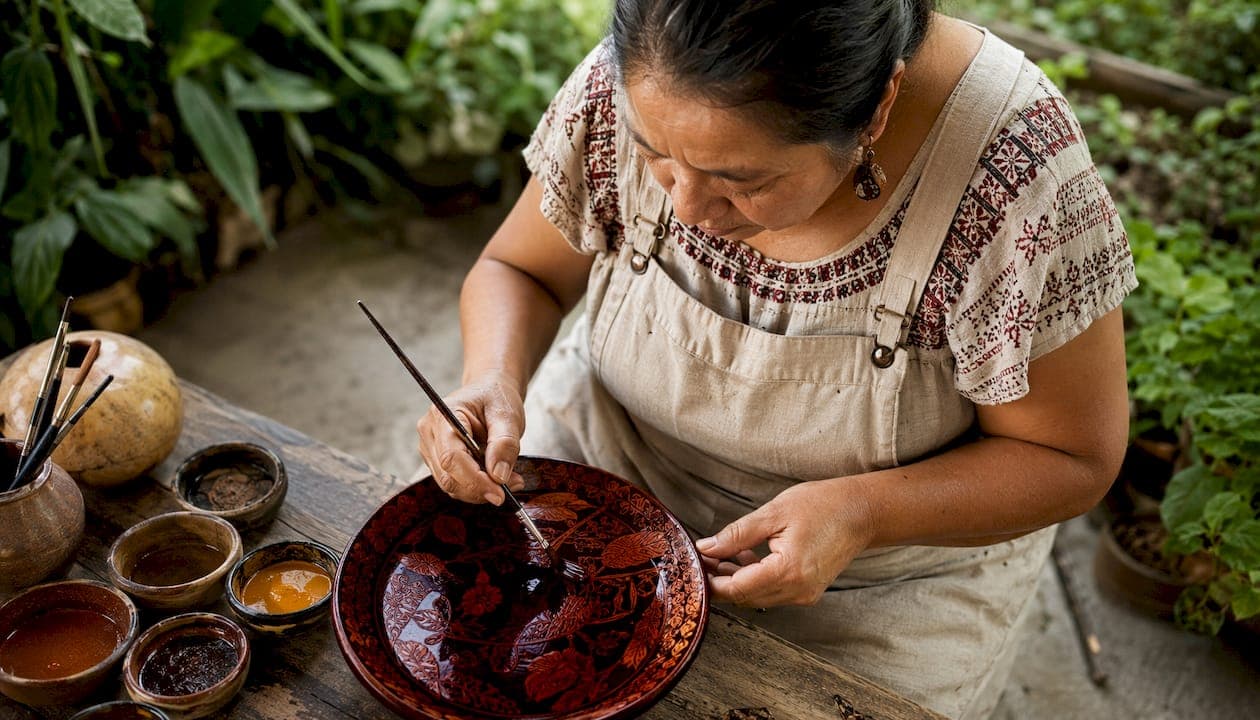
Mexican lacquerware, known locally as laca or maque, is one of Mexico's oldest living crafts: a layered decorative technique that applies an organic composite of insect-derived wax or seed oils mixed with powdered minerals to wooden objects, gourds, and furniture. For shoppers building a thoughtful luxury interior, a genuine lacquered piece offers something no factory finish can replicate — handcrafted depth, warm color saturation, and a provenance tied to specific families and towns. Technical analysis published through NYU's LAPIS project confirms the lacquer behaves as a breathable, bonding composite that hardens and develops character over time, while Mexico's Sistema de Información Cultural recognizes the craft as part of the country's intangible cultural heritage.
Table of Contents
- Why lacquerware belongs in a luxury interior
- The five core techniques and how to spot them
- What lacquer is actually made of
- How a lacquerware piece is made
- A brief history and the regional centers you should know
- How to evaluate authenticity before you buy
- Caring for lacquerware at home
- Buying responsibly and supporting artisan communities
- Key Takeaways
- Lacquerware's quiet power in a modern room
- Createdecorus brings this craft to your home
Why lacquerware belongs in a luxury interior
Lacquerware earns its place in a curated room because it does what mass-produced decor cannot: it carries warmth, texture, and a quiet story in the same object. The surface sheen is neither plastic-bright nor flat matte — it sits somewhere between the two, with a depth that shifts under different light. That quality makes it a natural anchor in several design directions:
- Modern-minimal: A single lacquered tray or box introduces color and handwork without visual noise.
- Boho-luxe: Layered patterns in deep reds and blacks complement woven textiles and natural wood.
- Curated vintage: Colonial-era motifs on a chest or panel read as collected, not purchased.
- Global-modern: Contemporary geometric lacquerware from Olinalá pairs cleanly with mid-century furniture.
Because the organic lacquer composition hardens and develops patina over years of use, a well-chosen piece actually improves with age — a quality that justifies treating it as an investment rather than a seasonal accent.
Pro Tip: Place a lacquered object where it catches indirect light — a console table opposite a window, or a shelf with a warm-toned lamp nearby. Raking light reveals the surface texture and color depth that make these pieces so distinctive.
At Createdecorus, we source pieces that hold their own in exactly these settings, chosen for the kind of artisan heritage that gives a room its soul.
The five core techniques and how to spot them
Artisans employ four primary decorative techniques — rayado, pintado, dorado, and plateado — and frequently combine them into punteado, a pointillist dot work that can appear on its own or alongside the others.
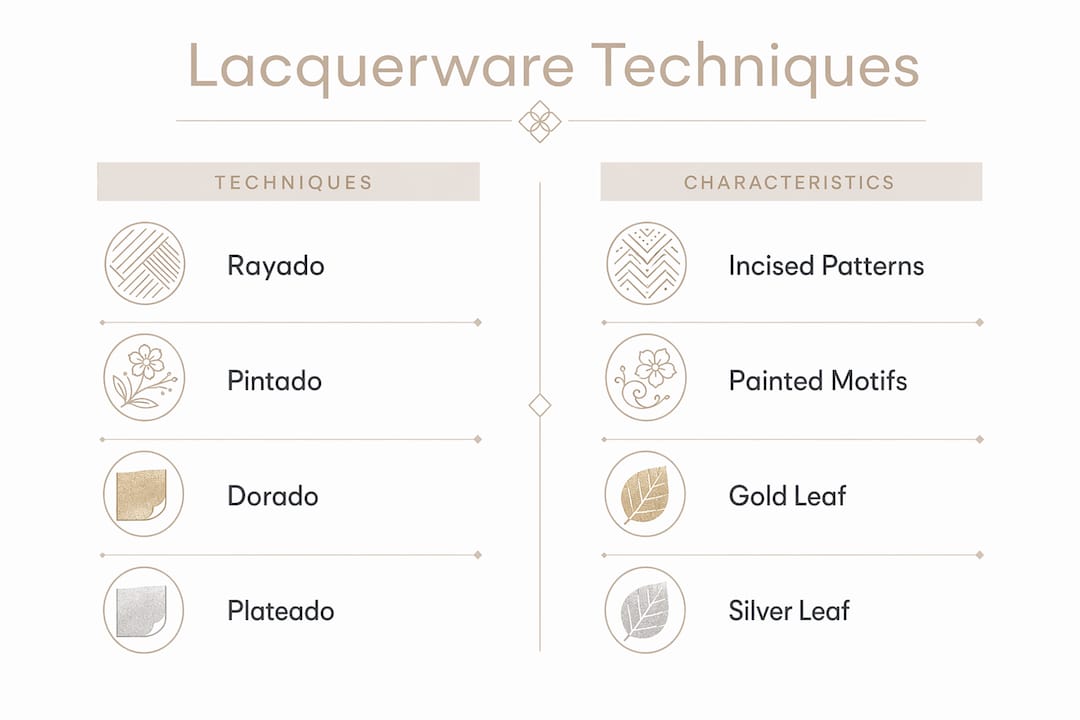
| Technique | Method | Common materials | Visual identifier |
|---|---|---|---|
| Rayado | Incising the lacquer surface with a sharp tool | Lacquered gourd or wood | Fine carved lines, often revealing a contrasting base color |
| Pintado | Hand-painting motifs directly onto the lacquer | Natural pigments, fine brushes | Fluid, painted imagery; florals, animals, landscapes |
| Dorado | Applying gold-toned paint or metallic powders | Gold-toned pigment or powder | Warm metallic highlights, often outlining motifs |
| Plateado | Applying metal leaf to the surface | Silver or aluminum leaf | Cool, reflective areas within the design |
| Punteado | Building imagery from fine dots | Pigment applied point by point | Dense dot patterns; mosaic-like texture up close |
Artisans frequently combine techniques on a single piece — a chest might carry rayado borders with pintado floral panels and dorado accents. That layering is one of the clearest signs of fine-quality work. Objects range from small lacquered gourds (jícaras) and jewelry boxes to large furniture panels and decorative screens.
What lacquer is actually made of
Traditional lacquer is an oil-and-mineral organic composite — not a synthetic varnish. The base begins with aje wax, a greasy substance extracted from the larvae of the coccus axin insect, or with seed oils such as chia or linseed. That oil is then mixed with powdered dolomite or local mineral clays to create a creamy, workable paste. Natural pigments — indigo for blue, charcoal for black, cochineal for reds and purples, and regional minerals like tecostle for ochre — give each region its characteristic palette.
Laboratory studies characterize this as a "living" oil-mineral matrix that breathes and hardens over time, explaining both the long-term durability and the subtle surface variations that collectors prize.
That chemistry sets traditional lacquer apart from any synthetic coating. The organic binders cure slowly, bonding to the substrate at a molecular level and waterproofing the surface without sealing it completely. Over years, the finish deepens rather than yellows or chips. Slight variations in texture and color across a piece's surface are a direct result of natural binders drying at different rates — they are indicators of handwork, not defects.
One honest caveat: modern workshops sometimes substitute imported linseed oil for aje wax, or use industrial pigments. These pieces can still be beautiful, but they behave differently over time and generally fall into the folk or commercial quality tier rather than the fine category.
How a lacquerware piece is made
The production process is genuinely multi-stage, and understanding it helps explain both the price and the provenance of a fine piece.
- Substrate preparation: Wood or gourd is sanded smooth; cracks are filled with a mineral-clay paste called nimacata.
- Base lacquer application: The oil-mineral mixture is rubbed in by hand or with a deer-tail applicator and left to cure.
- Drying windows: Base layers are left 15–20 days between applications to build stable, burnished depth. A single piece may require three or more base coats.
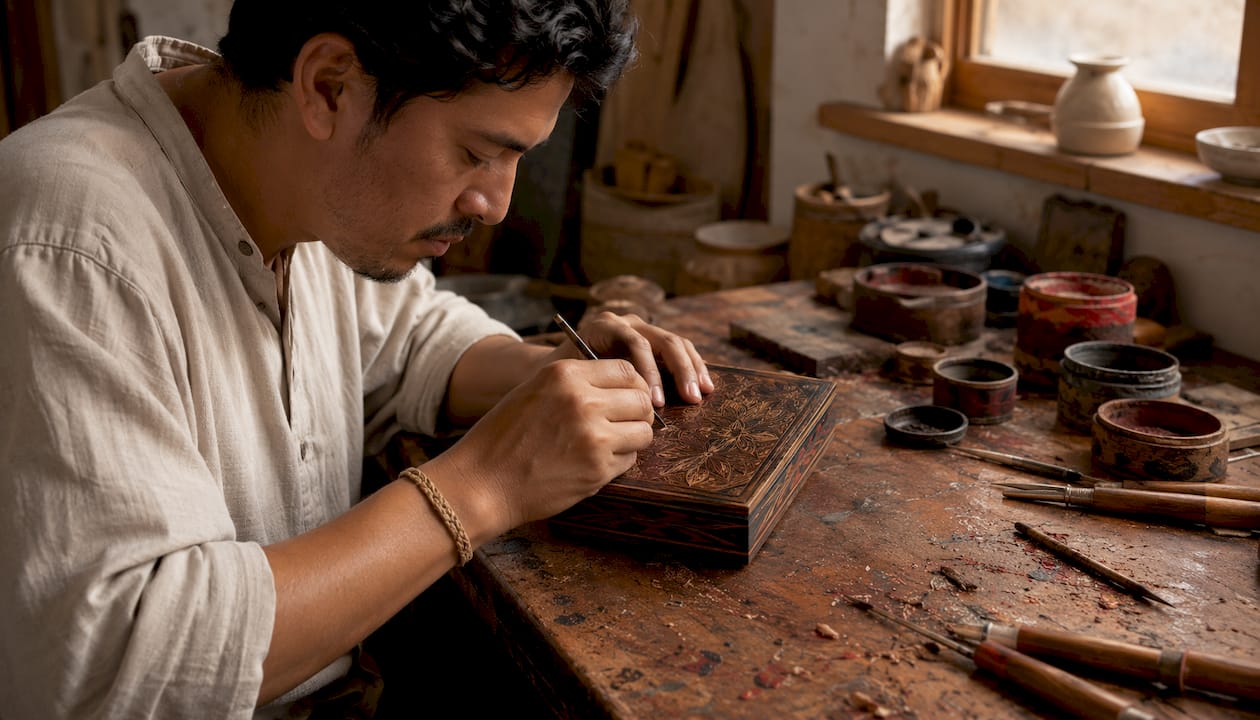
- Decorative layering: Rayado incising, pintado painting, or punteado dot work is applied over the cured base.
- Burnishing: The surface is polished with smooth stones or bone ash to achieve the characteristic sheen.
- Gilding or metal leaf (where used): Dorado or plateado accents are added last and burnished again.
Multiple specialists often touch a single piece — mineral preparers, lacquer mixers, painters, incisers, and burnishers — frequently within one family or workshop. That communal model is part of what makes workshop attribution a meaningful value signal when you are buying.
A brief history and the regional centers you should know
The craft has pre-Hispanic roots and has evolved through four distinct periods:
- Pre-Hispanic: Lacquer applied primarily to dried gourds for ceremonial and noble use, especially chocolate cups for Mesoamerican elites.
- Colonial period: Spanish missionaries and indigenous craftsmen merged European furniture forms with indigenous lacquer technique; Asian influences arrived via the Manila Galleon trade route, adding new motifs and color schemes. A technical study of objects from the 16th to 19th centuries documents this hybridization in detail.
- 19th century: Armed conflicts disrupted production; new synthetic materials began entering workshops, changing material heritage even as stylistic traditions continued.
- 20th century to present: A revival of traditional techniques, supported by institutions like ICAT Olinalá and national craft bodies such as Fonart and AMACUP, brought the craft back to prominence.
Today, three regions define the contemporary craft. Olinalá, Guerrero is the largest producer, known for rayado work on linaloe wood boxes and chests; the town holds a denominación de origen for its distinctive style. Uruapan and Pátzcuaro, Michoacán are associated with the term maque and the use of aje wax — knowing that regional terminology helps verify material provenance. Chiapa de Corzo, Chiapas produces lacquered gourds and furniture with its own regional palette. Motifs have shifted from pre-colonial geometry to colonial florals to contemporary abstract designs, and that evolution affects market positioning: traditional geometric or floral work from a named town typically commands more collector interest than generic contemporary patterns. For a deeper look at how these indigenous patterns translate into modern interiors, the design context matters as much as the technique.
How to evaluate authenticity before you buy
Provenance and materials matter more than glossy photos. Authenticity is a combination of maker attribution, verifiable materials, and visible technique.
What to look for:
- Substrate: genuine fine lacquerware uses linaloe wood or dried gourd, not MDF or composite board.
- Visible rayado or pintado detail: look for fine incised lines or hand-painted brushwork under magnification.
- Slight surface variation in texture and color — a sign of natural binders, not a flaw.
- Town or workshop attribution: Olinalá, Uruapan, Pátzcuaro, or Chiapa de Corzo on a provenance label carries weight.
Questions worth asking any seller:
- Which oils or waxes were used in the base?
- Where were the pigments sourced?
- Which family or workshop produced the piece, and when?
Red flags:
- Claims of pre-conquest origin. Pre-colonial lacquer pieces are rarely available in private markets because organic binders are perishable; high-quality traditional lacquerware for sale generally dates from the 20th century to the present.
- Perfectly uniform, factory-smooth finishes with no surface variation.
- Evasive or unspecified material answers from the seller.
Contemporary production falls into three broad quality tiers: fine lacquerware (museum or collector quality, traditional materials throughout), folk lacquerware (sometimes using imported materials), and commercial lacquerware (non-traditional materials for mass markets). Fine pieces command a meaningful premium — and they earn it.
Caring for lacquerware at home
Gentle, consistent care preserves the finish for decades.
Do:
- Wipe with a soft, dry cloth or a very slightly damp cloth for dust.
- Use felt pads under objects placed on hard surfaces.
- Store and display in stable humidity and temperature — away from heating vents and air conditioning units.
- For placement near other delicate decor, the same principles that apply to fragile home accents apply here: avoid direct sun and extreme humidity swings.
Don't:
- Use abrasive pads, solvents, or alcohol-based cleaners.
- Expose pieces to prolonged direct sunlight, which fades natural pigments.
- Stack lacquered objects without protective cloth between them.
If a piece develops a crack or significant chip, seek artisan restoration rather than DIY repair — the organic lacquer system requires compatible materials to bond correctly. For U.S. buyers importing pieces, wrap in acid-free tissue and cushion against humidity changes during transit.
Buying responsibly and supporting artisan communities
Authentic lacquerware is often the product of family and community collaboration. Buying responsibly supports livelihoods, cultural continuity, and the training programs that keep the craft alive for the next generation.
- Ask whether the workshop pays fair wages and whether production is family- or community-based.
- Look for pieces with clear artisan or town attribution — vague "made in Mexico" labels without workshop detail are a step down in accountability.
- Support cooperatives and training institutes where possible; institutions like ICAT Olinalá have played a documented role in reviving artisan communities and passing technique to younger craftspeople.
- Avoid pieces with false or inflated provenance claims, including any "pre-conquest" marketing language.
The economic impact on towns like Olinalá is real and direct: lacquerware is the primary income source for most families there, and Mexican artisan craft traditions depend on buyers who ask the right questions. Choosing a piece with traceable provenance is one of the most meaningful things a luxury shopper can do.
Key Takeaways
Mexican lacquerware is an organic oil-and-mineral craft with pre-Hispanic roots, and buying authentically means verifying technique, materials, and workshop provenance before any other consideration.
| Point | Details |
|---|---|
| What it is | An organic oil-mineral composite applied in layers to wood or gourd — not a synthetic varnish. |
| Techniques to recognize | Rayado (incised lines), pintado (hand-painted), dorado (gold), plateado (metal leaf), and punteado (dot work). |
| Provenance matters | Pieces from named towns — Olinalá, Uruapan, Chiapa de Corzo — carry verifiable regional identity and quality signals. |
| Care basics | Soft dry cloth, stable humidity, no direct sun, no solvents; the finish improves with careful handling over time. |
| Createdecorus | Curates handcrafted Mexican artisan pieces with provenance and care guidance built into every selection. |
Lacquerware's quiet power in a modern room
There is a tendency in luxury decor to treat Mexican lacquerware as a decorative curiosity — something colorful to fill a shelf. That framing undersells it considerably. What we find, piece by piece, is that the craft's real value lies in its resistance to uniformity. Every rayado line was cut by hand. Every pigment was mixed from minerals with a regional identity. The slight variation in surface texture that a first-time buyer might question is precisely what a collector learns to seek out.
At Createdecorus, our curation philosophy starts from that understanding. We look for pieces where the technique is legible — where you can see the work — and where the workshop attribution is honest. The goal is not to fill a room with objects that look expensive. It is to bring in pieces that carry genuine craft, the kind that holds up to close inspection and deepens in meaning the longer it lives in your home. That is what handcrafted Mexican goods have always offered, and it is the standard we hold ourselves to.
Createdecorus brings this craft to your home

Createdecorus curates handcrafted Mexican artisan home accents with provenance and care guidance included — so you know exactly what you are bringing into your space and where it came from. Every piece in our collection reflects a dialogue between artisan heritage and contemporary design, chosen for the kind of tactile richness and cultural depth that transforms a room into something personal.
Whether you are furnishing a single statement corner or building a collection of artisan pieces over time, our team can help you find work that fits your interior and your values. Trade and wholesale inquiries are welcome through our trade program for designers and collectors working at scale. Ready to see what is available? Browse the full collection and find a piece that earns its place in your home.